
Root Canal and Crown Costs in Arizona: What You'll Actually Pay
Nobody quotes you the second bill. You're told what the root canal costs, you brace for it, you pay it — and then the crown arrives, and it's often the larger of the two.
This guide lays out the three things that trip people up on this tooth: what your plan actually pays once the annual maximum bites, what the pair really costs in Arizona, and who should do which half. When you're ready to compare offices, we have 1,095 verified Arizona dentists to filter by city and insurance.
- It's two bills, not one. Delta Dental of Arizona publishes a Phoenix-metro median of $1,230 for a root canal and $1,349 for a crown — roughly $2,600 for the pair, before add-ons.
- The crown is often the bigger half, and most treated back teeth need one.
- Coverage: root canals are usually a basic or major service and crowns a major one — but they draw on the same annual maximum, which is why "80/50 coverage" can quietly become far less on a single-tooth year.
- Ask for the CDT codes. Root canals are priced by tooth position: D3310 front, D3320 premolar, D3330 molar. The crown is commonly D2740.
01 · INSURANCEWhat your plan actually pays
Coverage first, because on this tooth the coverage is the story. Root canals and crowns are usually both covered — and that fact is far less useful than it sounds.
- The root canal — often as a basic or major service
- The crown — usually a major service
- Diagnostic X-rays
- Retreatment, on some plans, subject to frequency limits
- The extraction, if the tooth can't be saved
- Anything above your annual maximum
- Crown replacement inside the plan's frequency limit (commonly 1 per 60 months)
- Anything during a waiting period, where one applies
- Purely cosmetic upgrades to crown material
The cap is the trap, and it's worth walking through with real numbers. Here's an illustrative example — your plan's terms will differ, so treat this as arithmetic, not a prediction:
| Step | Charge | Plan pays | You pay |
|---|---|---|---|
| Molar root canal | $1,300 | $1,040 (80%) | $260 |
| Crown | $1,400 | $460 — only what's left under a $1,500 cap | $940 |
| Total | $2,700 | $1,500 (the cap) | $1,200 |
Read the middle row again. The plan advertises 50% on crowns. It paid $460 of $1,400 — about 33% — not because the contract lied, but because the cap ran out on the first procedure. On a single-tooth year, the annual maximum, not the coinsurance percentage, is what decides your bill.
Two procedures. One annual maximum. Ask your dentist for a pre-treatment estimate covering BOTH the root canal and the crown together — not one, then the other. That single request is what turns a surprise into a plan.
"My plan covers crowns at 50%, so I'll pay half." Only if there's room left under the cap. A root canal earlier in the same benefit year can consume most of it, and the crown then gets whatever remains — which may be a great deal less than half.
On AHCCCS: the adult dental benefit is primarily an emergency benefit, generally capped around $1,000 per contract year. Whether a specific root canal qualifies depends on the clinical situation and the policy — an acute, painful infection is treated very differently from elective restorative work. Confirm with your plan rather than assuming either way. Details: Does AHCCCS cover dental for adults?
02 · COSTWhat a root canal and crown actually cost in Arizona
A root canal removes the infected pulp and seals the tooth's interior. A crown rebuilds and protects what's left. Separate procedures, separately billed, sometimes by separate providers — and the second is frequently the larger.
A treated tooth, especially a molar, is more brittle than a living one. For back teeth taking chewing force, a crown afterward is standard restorative practice, not an upsell. A front tooth with minimal structural damage can sometimes take a filling instead — one of the few places this bill legitimately shrinks. Ask which camp your tooth is in before treatment starts.
| Procedure | AZ self-pay | With insurance | Phoenix median |
|---|---|---|---|
| Root canal — front tooth (D3310) | $700–$1,100 | Often covered* | Not published |
| Root canal — premolar (D3320) | $800–$1,300 | Often covered* | Not published |
| Root canal — molar (D3330) | $1,000–$1,600 | Often covered* | Not published |
| Root canal — median, any position | — | — | $1,230 |
| Crown (D2740) | $800–$2,500 | Often covered* — subject to the cap | $1,349 |
| The pair, all-in | $1,700–$3,200 | Capped by your annual maximum | ~$2,600 |
The further back the tooth, the more canals it has and the more you pay. A front tooth usually has one canal; a molar can have three or four, with curvature that takes real time to treat. That isn't a markup — the CDT code literally changes with tooth position, which is why the price does.
Crown pricing swings on material: porcelain-fused-to-metal at the lower end, all-ceramic and zirconia toward the top. For a visible front tooth, the aesthetics justify the premium. For a second molar nobody will ever see, ask about the cheaper material — it's a fair question and dentists field it daily.
Ask for the treatment plan with the CDT codes on it, then look each one up for your own ZIP at FAIR Health Consumer. Codes are what make two quotes genuinely comparable — without them you're comparing adjectives.
Get BOTH quotes before you start. The root canal and the crown, in writing, together. A tooth is not a subscription you discover the price of one invoice at a time.
The plan says it covers crowns at 50%. On a single-tooth year, it paid 33% — because the cap ran out on the root canal.
Root canal vs. extraction: the ten-year view
Pulling the tooth is cheaper this year and usually more expensive this decade — if you replace it. An extraction carries a Phoenix-metro median of $340. But that's rarely the end of the story:
| Path | Year-one cost | The ten-year picture |
|---|---|---|
| Root canal + crown | $1,700–$3,200 | Usually done; crowns commonly last 10–15 years |
| Extraction + implant | $3,200–$6,700 | Comparable longevity, much higher up front |
| Extraction + bridge | $2,200–$5,600 | Grinds down the neighbouring healthy teeth |
| Extraction, no replacement | ~$340 | Free — until adjacent teeth shift and bite problems follow |
Saving a restorable natural tooth is often the best value in dentistry. Where extraction genuinely wins: vertical fractures, insufficient remaining tooth structure, or a failed prior root canal. Get that assessment explicitly — "Is this tooth worth saving, and how confident are you?" is a completely reasonable question.
How we source these numbers
There is no free, authoritative national dental fee benchmark anymore. The ADA discontinued its Survey of Dental Fees in 2023, and federal law now bars the association from publishing or recommending fees at all. Every article you'll find on this subject hit that same wall — most filled it with dental-chain marketing pages and financing companies. We don't. We triangulate three public sources and tell you what they are:
- Delta Dental of Arizona publishes usual-and-customary fees based on median dentist fees in ZIP prefix 850 — the Phoenix metro. That's our Arizona anchor, and it's the closest thing to a real local market figure available publicly.
- FAIR Health Consumer lets you look up any procedure by CDT code and your own ZIP, drawn from billions of claim records. That's our cross-check — and you can run it yourself, which is the entire point of us naming the codes.
- The AHCCCS fee schedule tells us what the state reimburses. We use it for coverage questions only, never as a market price: Medicaid reimbursement is a floor, not what a cash patient pays.
Where a figure isn't published anywhere public — Delta doesn't break its root-canal median out by tooth position — we say "not published" rather than invent one. This article previously cited GoodRx, CareCredit and Aspen Dental for its prices. Those are a coupon site, a financing company, and a dental chain. They've been removed.
Endodontic care isn't evenly spread across the state. Here's where Arizona practices that publish root canal or endodontic services actually are:
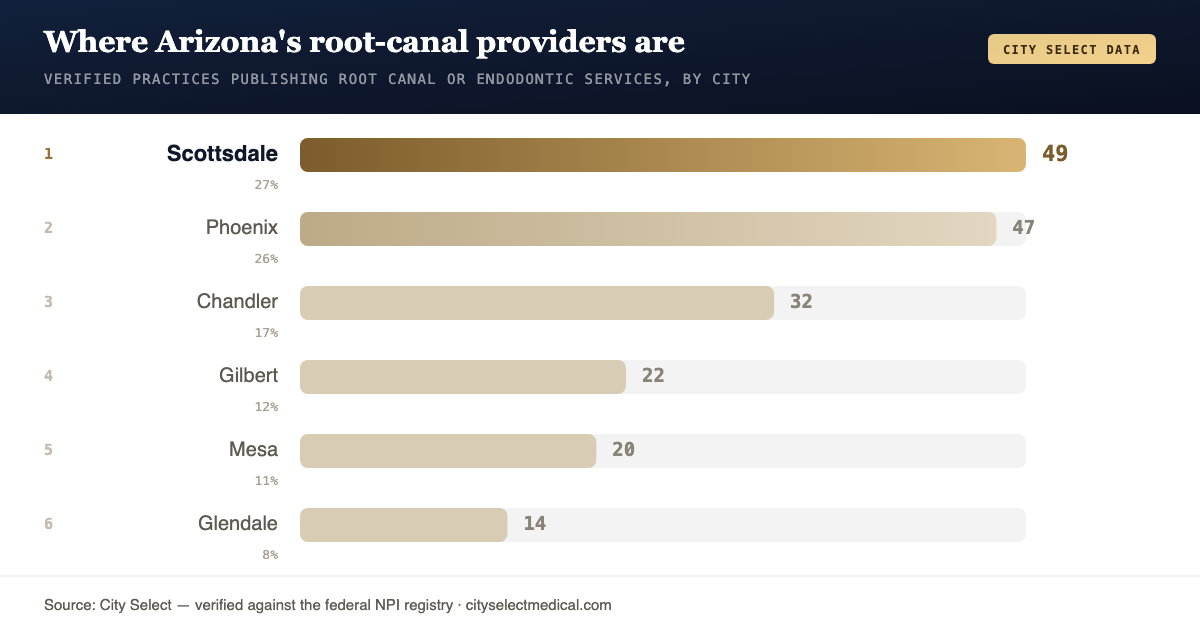
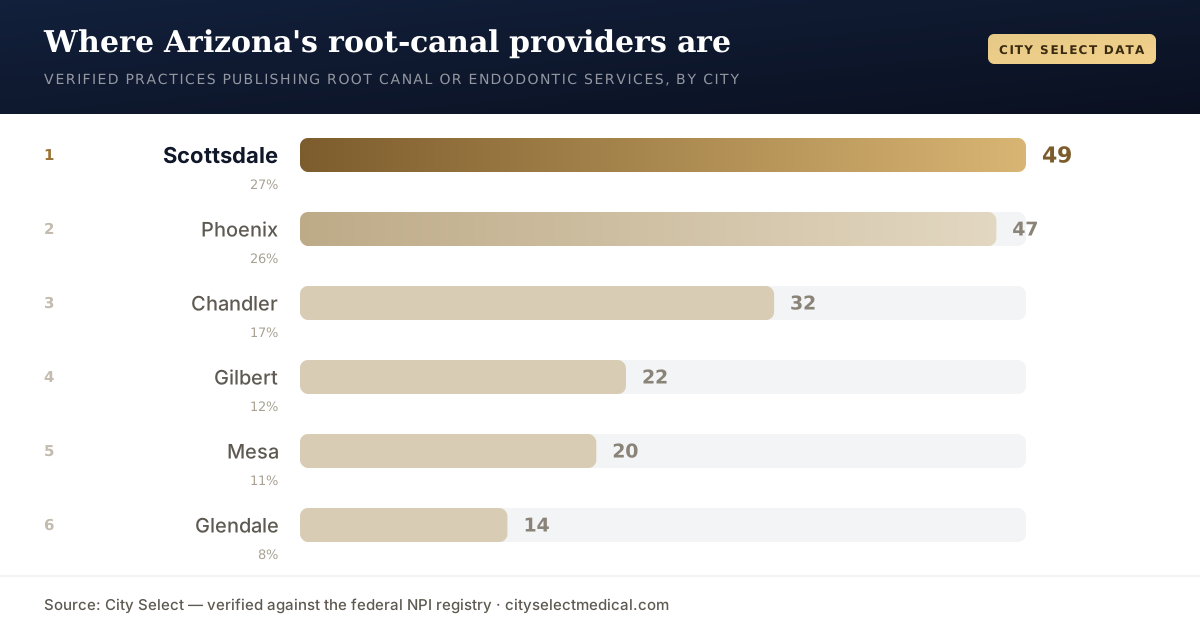
Arizona-specific: for 43% of Arizona dental practices, we could not find or confirm a single insurance plan they accept — most publish none at all. On a two-procedure tooth where the annual maximum decides your bill, in-network status is worth several hundred dollars. Confirm it with both the office and your insurer before the first appointment, not after the second bill.
How to lower the bill
In rough order of impact — and none of these involve skipping care you need:
Get both numbers in writing before treatment starts
The root canal and the crown, with CDT codes, together. It's the only way to plan — and the only way to compare offices honestly.
Ask about tooth-position pricing
If a front tooth needs only a filling after the root canal rather than a crown, that's roughly $1,000 saved legitimately. Ask which camp your tooth is in.
Ask about crown material
Porcelain-fused-to-metal sits at the lower end, all-ceramic and zirconia at the top. On a second molar nobody will see, the cheaper material is a completely reasonable ask.
Ask for the self-pay price out loud
Cash pricing is frequently lower than the "insurance rate," and it is almost never volunteered.
Check in-house membership plans
Many offices sell their own (~$300–$500/yr) with 10–20% off major work. On a $2,600 pair of procedures, that can beat a thin insurance plan outright.
Consider a dental school clinic
Supervised residents at accredited programs do root canals and crowns at a substantial discount. Teaching clinics price below market to attract cases — treat it as the cheapest door available to you, not as the going rate.
The single highest-value hour in this process is the one you spend getting both quotes, itemised by CDT code, before anything begins. Everything else on this page is a footnote to that.
If cost is the whole problem, say so — out loud, at the front desk. Practices deal with this daily and often have options they don't advertise: staged treatment, membership plans, payment arrangements. What they cannot do is help with a constraint they don't know about.
03 · FROM THE WEBQuestions people are actually asking
My dentist quoted the root canal but never mentioned a crown. Now there's another $1,400. Is that normal?
Unfortunately yes, and it's the single most common complaint about this procedure. The crown is a separate code and a separate bill. Ask for a pre-treatment estimate covering both, before the first appointment.
Can I skip the crown to save money?
On a front tooth with minimal damage, sometimes — a filling may be enough. On a molar, skipping it risks fracturing a brittle treated tooth, and a fractured tooth often can't be saved at all. That's a clinical call, not a budget one; make your dentist justify it either way.
Is an endodontist better than a general dentist for a root canal?
Endodontists are root-canal specialists with additional residency training, and they typically handle the complex cases — molars with curved or extra canals, retreatments, unusual anatomy. Many general dentists perform straightforward root canals routinely. A fair question either way: *"How many molar root canals do you do a month?"*
Why is a molar root canal so much more expensive?
More canals, harder access. The billing code itself changes with tooth position — D3310 for a front tooth, D3330 for a molar — so the price difference is built into how the procedure is coded, not added on afterwards.
1,095 NPI-verified dentists across Arizona. Filter by your city and the insurance they publish — then get both quotes, the root canal and the crown, in writing and in-network.
04 · THE VISITWhat to expect
A root canal is typically one or two appointments. You'll be numbed with a local anesthetic, the dentist or endodontist opens the tooth, removes the infected pulp, cleans and shapes the canals, and seals them. Patients commonly describe it as comparable to having a large filling — the infection beforehand is usually the painful part, which is why waiting rarely saves either money or discomfort.
Then a temporary filling goes in, and the tooth waits for its crown.
| Stage | Typical timing | What happens |
|---|---|---|
| Diagnosis + X-ray | Visit 1 | Confirms the pulp is infected and the tooth is restorable |
| Root canal | 1–2 appointments | Pulp removed, canals cleaned and sealed |
| Temporary filling | Same day | Not built for long-term chewing |
| Crown prep + impression | Usually within weeks | Often back at your general dentist |
| Permanent crown fitted | ~2 weeks later | The tooth is finally protected |
"The temporary filling can wait — I'll do the crown next year." For back teeth, weeks is reasonable; months is a gamble. A temporary isn't built for chewing force, and a treated tooth that cracks under it often can't be saved at all — turning a $1,400 crown into a $4,000 implant. If you're considering timing the crown across benefit years, do it only with your dentist's explicit sign-off, and never delay clinically necessary care to chase a benefit year.
A temporary filling is a lid, not a tooth. Treat the gap between the root canal and the crown as a countdown, not a grace period.
05 · CHOOSINGWho should do which half
General dentists perform straightforward root canals routinely. Endodontists — root-canal specialists with two or more additional years of residency training — typically take the complex cases: molars with curved or extra canals, retreatments of a failed root canal, or unusual anatomy visible on the X-ray. Often the endodontist does the root canal and your general dentist places the crown, which is why two offices can appear on one tooth.
Get both quotes, in writing, before anything starts
The root canal AND the crown, with CDT codes. If two offices are involved, get both — and confirm both are in-network.
Verify the licence yourself
Check any dentist or specialist at the Arizona State Board of Dental Examiners. Every City Select listing is separately checked against the federal NPI registry.
Ask about volume on complex teeth
If your general dentist plans to do a tricky molar in-house, "how many molar root canals do you do a month?" is a fair, normal question. A good provider answers it without flinching.
Ask what a failure would cost you
Retreatment and apicoectomy are real possibilities. Ask what happens — and what you'd pay — if this tooth fails within a year. Get the answer on paper.
Ask for the pre-treatment estimate
The office submits the proposed treatment with codes; the insurer replies in writing with what it will pay, before the work happens. On a $2,600 pair of procedures, this isn't optional.
If cost is genuinely the constraint, treat the infection first. An extraction you can afford beats a root canal you can't — untreated dental infections are dangerous, and this is not a bill to wait out. Options when money is the whole problem: emergency dental care without insurance in Arizona. Dental school clinics also offer supervised root canals and crowns at a substantial discount — worth knowing that teaching clinics price below market to attract cases, so treat that as the cheapest door available to you rather than the going rate.
The bottom line
Budget for the pair, not the procedure: roughly $2,600 at the Phoenix-metro median, or $1,700–$3,200 self-pay depending on the tooth and the crown material. And know that on a single-tooth year, your plan's annual maximum — not its coverage percentage — is what decides your bill.
Three moves do most of the work: get both quotes in writing with CDT codes before anything starts, ask whether your specific tooth truly needs the crown, and get a pre-treatment estimate covering both procedures together. Then confirm in-network status with the office and the insurer — because on a two-bill tooth, that gap is worth several hundred dollars.
Frequently asked questions
How much does a root canal and crown cost in Arizona?
Delta Dental of Arizona publishes a Phoenix-metro median of $1,230 for a root canal and $1,349 for a crown — roughly $2,600 for the pair before any add-ons. Self-pay ranges run wider: about $700–$1,600 for the root canal depending on tooth position, and $800–$2,500 for the crown depending on material. Both bill separately, and both draw on the same annual maximum.
Does a root canal always need a crown?
Not always, but molars and premolars usually should have one — chewing force cracks brittle treated teeth. Front teeth with minimal structural damage can sometimes take a filling instead. Ask your dentist to justify the recommendation for your specific tooth, because the answer changes the total by roughly $1,000.
What CDT codes are used for a root canal and crown?
Root canals are coded by tooth position: D3310 (anterior/front), D3320 (bicuspid/premolar), D3330 (molar). A porcelain or ceramic crown is commonly D2740. Ask for a treatment plan with the codes on it, then look each one up for your own ZIP at FAIR Health Consumer — that's how you make two quotes genuinely comparable.
Why does a molar root canal cost more than a front tooth?
More canals and harder access. A front tooth usually has one canal; a molar can have three or four, with curvature that takes longer to treat. The CDT code itself changes with tooth position, which is why the price does too.
How long can I wait between the root canal and the crown?
Weeks, not months, for back teeth — a temporary filling isn't built for long-term chewing, and a cracked treated tooth can mean extraction. If you're considering timing the crown across benefit years, do it with your dentist's explicit sign-off, and never delay clinically necessary care to chase a benefit year.
Why did I get quotes from two different offices?
Common and normal: an endodontist performs the root canal, and your general dentist places the crown. Make sure you have both quotes, in writing, and that both offices are in-network — otherwise the second bill can arrive at out-of-network rates.
Is a root canal painful?
The procedure is done under local anesthetic and patients commonly describe it as comparable to having a large filling. The infection before treatment is typically the painful part, which is why delaying rarely saves money or discomfort.
Is it cheaper to just pull the tooth?
Cheaper this year, usually more expensive this decade — if you replace it. An extraction has a Phoenix-metro median of $340, but replacing the tooth with an implant or bridge costs several thousand. Not replacing it at all is free until adjacent teeth shift. Saving a restorable natural tooth is often the best value in dentistry.
What if the root canal fails?
Retreatment, usually by an endodontist, or an apicoectomy can salvage many failures; persistent failures move to extraction and replacement. Ask any provider what a failure within the first year would cost you, and get the answer in writing.
Does AHCCCS cover a root canal?
AHCCCS's adult dental benefit is primarily an emergency benefit, generally capped at $1,000 per contract year. Whether a specific root canal qualifies depends on the clinical situation and the policy — an acute, painful infection is treated very differently from elective restorative work. Confirm with your plan before assuming either way.
Find a verified dentist in Arizona
Every dentist on City Select is sourced from the federal NPI registry and organized by city and specialty — no pay-to-rank, no mystery. Filter by your city and insurance:
 Insurance & Costs
Dental Implant Costs in Arizona: Single Tooth to Full Arch
The quote you get by phone is rarely the number you'll pay. Here's how implant pricing actually breaks down — component by component — and where the real savings are.
 Insurance & Costs
Does Dental Insurance Cover Implants? Arizona Coverage, Decoded
"Covered" is not the same as "paid for." Four contract clauses decide what your plan actually hands over on an implant — and most people meet them for the first time on the denial letter.
 Insurance & Costs
Dental Insurance in Arizona, Decoded: What "We Accept Your Plan" Really Means
Dental insurance isn't health insurance — it's closer to a prepaid discount card with a spending cap. Once you see the structure, every confusing EOB starts making sense.
Written by the City Select editorial team and edited by Alan S., Senior Editor. Drafted with AI assistance and checked against the official sources below. City Select is not a healthcare provider, and this guide is not medical advice. Our editorial & data standards →
- Delta Dental of Arizona — usual & customary fees (median dentist fees, ZIP prefix 850)
- FAIR Health Consumer — dental cost lookup by ZIP and CDT code
- American Association of Endodontists — root canal treatment
- American Dental Association — CDT procedure codes
- Delta Dental of Arizona — Individual & Family plan comparison (eff. 1/1/2026)
- AHCCCS Medical Policy Manual 310-D1 — adult dental benefit
- Arizona State Board of Dental Examiners — license verification
- NPPES NPI Registry
- How we verify
This guide is for general information and isn't medical, legal, or insurance advice. Coverage, prices, and policies change — verify current details with the relevant provider, plan, or agency, and confirm with the practice before booking. Last updated July 12, 2026.