
Dental Insurance in Arizona, Decoded: What "We Accept Your Plan" Really Means
Dental insurance isn't health insurance. Health insurance protects you from catastrophe; dental insurance stops paying right around the point where things get expensive.
It's closer to a prepaid prevention plan with a capped contribution to everything else — and once you see the structure, every confusing EOB starts making sense. This guide covers what your plan actually pays, what the fine print does to that, and — using our own directory data — which plans Arizona dentists actually publish that they take, across 1,095 verified practices.
- The shape: roughly 100% preventive / 80% basic / 50% major on many plans. It's a convention, not a rule — check yours.
- The number that matters is the cap. Arizona individual plans commonly run a $1,000–$2,000 annual maximum. Once it's gone, you pay everything.
- "We accept your plan" ≠ "we're in-network." One means they'll mail the claim. The other means contracted rates.
- The fine print bites: waiting periods (often 6–12 months), missing-tooth provisions, frequency limits, and alternate-benefit downgrades.
- Our data: for 43% of Arizona dental practices, we could not find or confirm a single plan they accept.
01 · INSURANCEThe 100/80/50 structure, in plain English
Dental plans pay by category — and the categories are about cost to the insurer, not importance to you.
- Preventive — cleanings, exams, routine X-rays, usually at 100% and usually NOT against the cap
- Basic — fillings, simple extractions, often ~80%
- Major — crowns, bridges, dentures, often ~50%
- Orthodontics — where covered, under a separate LIFETIME maximum
- Anything above your annual maximum
- Cosmetic work (whitening, veneers)
- Care during a waiting period
- Teeth missing before the policy started, where a missing-tooth provision applies
- The difference, where an alternate-benefit rule applies
Two structural details are worth internalising. The deductible (commonly $25–$150) usually applies to basic and major work but not preventive. And the tier assignment varies by plan — which is precisely the sort of thing nobody reads until the EOB arrives.
The design logic: dental plans make prevention free and catastrophe partially yours. Use the free cleanings maximally. Plan the major work deliberately.
Ask which tier your specific procedure falls into — before you agree to it. A root canal classified as "basic" is often paid at ~80%; the same procedure classified as "major" may be paid at ~50%. Same tooth, same work, several hundred dollars of difference. The office's billing coordinator can tell you in a minute, and it's a completely normal thing to ask.
Preventive care is the part of your plan that's genuinely, fully paid for — and it usually doesn't draw down your annual maximum. Not using it is leaving the only unambiguously good part of the product on the table.
The annual maximum: the number that actually runs your year
The annual maximum is the most the plan will pay in a benefit year, total. On Arizona individual plans it commonly runs $1,000 to $2,000. Once it's exhausted, you pay everything — regardless of what percentage the brochure advertised.
This is why "I have dental insurance" and "I can afford this crown" are different statements. A root canal plus the crown it needs can consume an entire year's cap on a single tooth — we walk that arithmetic step by step in our root canal and crown cost guide.
"My plan covers major work at 50%, so I'll pay half." Only while there's room under the cap. Spend most of a $1,500 maximum on a root canal and the crown gets whatever's left — which can be a great deal less than half. The cap, not the coinsurance percentage, is what decides your bill.
02 · COSTWhat Arizona plans actually cost — and pay
Here's where it gets concrete. Delta Dental of Arizona publishes its individual-plan grid, and it rewards a careful read.
| Plan | Annual maximum | You pay: major services | Monthly, age 3–54 |
|---|---|---|---|
| Palo Verde | $2,000 | 40% | $59.72 |
| Mesquite | $2,000 | 50% | $47.78 |
| Saguaro | $1,500 | 60% | $28.14 |
| Agave | $1,000 | 70% | $20.60 |
| Cholla | Unlimited | Major services not covered | $19.32 |
Read the bottom row.
"Unlimited annual maximum" is the best deal on the page. The Cholla plan is the cheapest at $19.32 a month and carries an unlimited annual maximum — which sounds extraordinary. It doesn't cover major services at all. The unlimited cap applies only to what it does cover. An unlimited maximum on a plan that excludes crowns, bridges and implants isn't generosity; it's a ceiling you'll never reach.
Two plans in that family — Copper and Turquoise — carry no waiting periods, and your coinsurance improves over the first three years you stay enrolled. If you know work is coming but it isn't urgent, that structure is worth modelling against a nine-month wait.
The cheapest plan on the page has an unlimited maximum and covers no major work. The maximum is marketing. The grid is the contract.
Compare plans in this order: annual maximum → waiting period → what's actually covered → premium. The monthly price is the least informative number on the page, and it's the one every comparison site leads with.
Ask about the prior-coverage waiver before you enrol, not after. Delta Dental of Arizona's plan document says waiting periods may be waived for members with qualifying prior PPO/Indemnity or DHMO coverage and no more than a 63-day gap — and that granting the waiver is at its sole discretion. Request a certificate of prior coverage from your old insurer and get the new insurer's answer in writing. That one document can be worth nine months.
How we source this
The Arizona plan figures above come directly from Delta Dental of Arizona's own Individual & Family plan comparison document (DDAZ-0229-rev0625, rates effective 1/1/2026) — not from a summary, a broker site, or a dental practice's blog. We read the grid and the footnotes, because the footnotes are where the waiting-period waiver, the 63-day gap rule, and the frequency limits actually live.
Two honest caveats about the rest of this page:
- "100/80/50" is a convention, not a standard. We describe it because it's the shape commonly encountered — not because every plan follows it. Yours may not.
- Procedure costs come from Delta Dental of Arizona's published Phoenix-metro median fees, cross-checked against FAIR Health Consumer's ZIP-and-CDT-code lookup, which you can run yourself. There is no free national dental fee benchmark anymore — the ADA discontinued its Survey of Dental Fees in 2023 and federal law now bars it from publishing fees — so we triangulate and tell you we're triangulating.
The directory figures are our own, recounted at every build. They are a floor, not a census — see the chart caveat below.
03 · FROM THE WEBQuestions people are actually asking
My dentist said they "take" my insurance and I still got a huge bill. How?
Almost certainly out-of-network. *Taking* your plan means they'll send the claim; *in-network* means they've agreed to contracted rates. Out-of-network, the office can bill you the balance above what your plan allows. Ask the question in those exact words: *"Are you in-network, not just accepting it?"*
Why did my plan pay for a metal filling when I got a white one?
That's an alternate-benefit downgrade. The plan bases its payment on the least expensive treatment that would have worked, and you cover the difference. Legal, common, and almost never explained before treatment. Ask whether your plan has an alternate-benefit provision.
Is dental insurance actually worth it?
Depends entirely on your teeth. Premiums plus a deductible plus a waiting period plus a $1,000–$2,000 cap often means the plan returns little more than it costs in year one. It works best when you know work is coming and can wait out the waiting period. For a healthy mouth, an in-office membership plan frequently wins.
Can I buy dental insurance the month before a big procedure?
Rarely usefully. Major work typically sits behind a 6–12 month waiting period, and a missing-tooth provision can exclude the very thing you bought the plan for. If you had prior coverage with no real gap, ask about a waiver — that's the one path that sometimes works.
1,095 NPI-verified Arizona dental practices. Filter by your city and your carrier — then call to confirm in-network status, because the office is always the final word.
04 · THE VISIT"We accept your insurance" vs. "we're in-network"
These are different sentences with different prices. In-network means the dentist signed a contract with your insurer to charge negotiated rates. "We accept your plan" can simply mean "we'll send them the claim" — at the office's full rates, with you covering the gap.
On a PPO, out-of-network care usually still attracts some coverage. But you lose the negotiated pricing, and the negotiated pricing is frequently the bigger discount.
Ask the office the exact question
"Are you in-network with [plan] — not just accepting it?" Those words, in that order. "We take it" is not an answer to this question.
Check the insurer's directory too
Provider directories go stale and mid-year contract changes happen. The two sources disagree often enough that checking both is the only reliable method.
Ask for a pre-treatment estimate on anything major
The office submits the plan with CDT codes; the insurer replies in writing with what it will pay. On a four-figure procedure this is not optional.
Ask for your remaining annual maximum
The office can run this. Do it before major work, not after.
Which plans Arizona dentists actually publish
This is the part nobody else can tell you, because it comes from our own verified directory of Arizona dental practices.
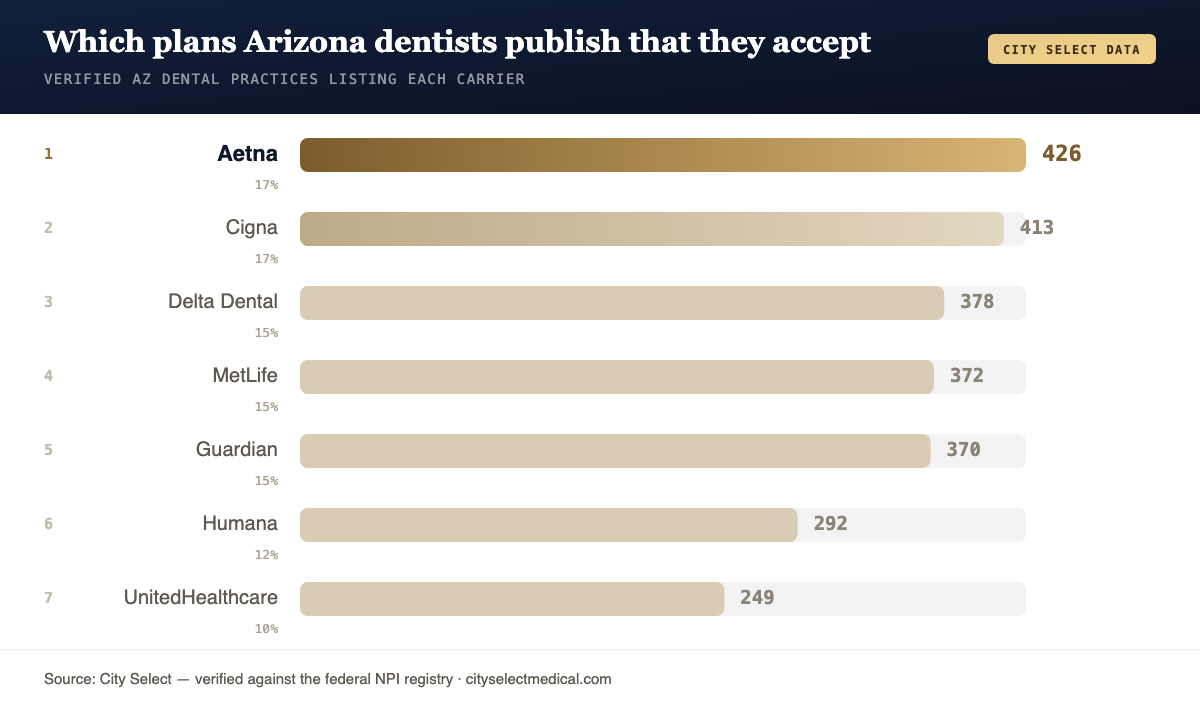
For 43% of Arizona dental practices, we could not confirm a single plan they accept. The industry's most basic question still requires a phone call.
Arizona-specific: that gap is the entire reason our insurance filter exists. Filter by your plan first, call to confirm second. It turns an afternoon of cold calls into a shortlist — but the office is always the final word, because participation changes and nobody updates their website when it does.
05 · CHOOSINGThe fine print that actually bites — and what to do without a plan
Waiting periods
Commonly 6–12 months on basic and major work; preventive usually starts immediately. Buying insurance the week you need a crown rarely works. Ask about a prior-coverage waiver.
The missing-tooth provision
Many plans won't pay to replace a tooth lost before the policy started. If you're buying coverage with an implant or bridge in mind, this is the first question to ask — not the last.
Frequency limits
Two cleanings a year, one set of X-rays, one crown per tooth per 5–8 years (Delta Dental of Arizona's individual plans limit implants and crowns to one per 60 months). Exceed the schedule and you self-pay, even for a "covered" procedure.
Alternate-benefit downgrades
Some plans pay for the cheapest clinically acceptable option and leave you the difference. Ask whether the plan contains one before you enrol.
No insurance? Skipping a plan isn't automatically losing. The arithmetic depends on your teeth:
- In-office membership plans (roughly $300–$500/yr at many practices): typically include cleanings and exams plus 10–20% off other work, with no waiting periods, no annual maximum, and no missing-tooth clause. For a healthy-mouth adult, frequently better value than a marketplace dental plan.
- Marketplace dental plans: make sense mainly when you anticipate basic or major work and can wait out the waiting periods.
- Dental schools and community clinics: the deepest legitimate discounts, at the cost of time. Teaching clinics price below market to attract cases — the cheapest door available to you, not the going rate.
- On AHCCCS? Adults get an emergency-only benefit — the $1,000 rule, and the five exceptions to it.
- Urgent, no coverage at all? Your real options, ranked.
Before you buy any plan, ask four questions in writing: What's the annual maximum? What's the waiting period on major work — and can it be waived with prior coverage? Is there a missing-tooth provision? Is there an alternate-benefit provision? Those four answers tell you more than the premium does.
The bottom line
Dental insurance is a prepaid prevention plan with a capped contribution to everything else. Read it that way and the decisions get simple: max out the preventive care that's genuinely free, confirm in-network (not "accepted") before anything expensive, and treat the annual maximum as the real coverage number — because it is.
Before buying, read for the waiting period, the missing-tooth provision, and the alternate-benefit rule — those three decide whether the plan pays for the thing you're buying it for. And because most Arizona practices never publish what they take, start from data rather than cold calls: filter verified Arizona dentists by plan, then confirm with the office.
Frequently asked questions
What is the 100/80/50 rule in dental insurance?
It's the common shorthand for how many plans tier coverage: roughly 100% for preventive care (cleanings, exams, X-rays), around 80% for basic work (fillings, simple extractions), and around 50% for major work (crowns, bridges, dentures). It's a convention, not a law — real plans vary, and which tier a procedure lands in changes between plans. Delta Dental of Arizona's individual plans, for instance, range from 40% to 70% patient responsibility on major services depending on which plan you buy.
What is a dental annual maximum, and why does it matter so much?
It's the most your plan will pay in a benefit year, total — commonly $1,000 to $2,000 on Arizona individual plans. Once it's gone, you pay everything. It matters more than the coverage percentage: a root canal plus a crown can consume the entire cap on one tooth, which turns advertised '50% coverage' into far less in practice.
What's the difference between 'we accept your insurance' and 'in-network'?
Accepting means the office will send the claim to your insurer. In-network means the dentist has signed a contract agreeing to negotiated rates. Out-of-network you may still get some coverage on a PPO, but you lose the negotiated pricing — which is often the larger discount. Ask the office: 'Are you in-network with my plan, not just accepting it?' Then verify with your insurer, because the two sources disagree often enough that checking both is the only reliable method.
How long are dental insurance waiting periods in Arizona?
Commonly 6 to 12 months for basic and major work; preventive usually starts immediately. On Delta Dental of Arizona's individual plans, major services sit behind 6-month (Type 3A) or 9-month (Type 3B) waiting periods. Those waiting periods MAY be waived for members with qualifying prior coverage and no more than a 63-day gap — the plan document states the waiver is at Delta Dental of Arizona's sole discretion, so ask in writing.
Which dental plan has no waiting period in Arizona?
Delta Dental of Arizona's Copper and Turquoise 'incentive' plans carry no waiting periods, and your coinsurance improves over the first three years you stay enrolled. If you know work is coming but it isn't urgent, that structure is worth modelling against a plan with a 9-month wait.
Is dental insurance worth it if I have healthy teeth?
Run the arithmetic. Individual premiums on Arizona plans run roughly $230–$920 a year depending on the plan and your age, against a retail cost of two cleanings and an exam in the $300–$500 range. For a low-risk mouth that's close to break-even — which is why in-office membership plans, with no waiting periods and no annual cap, frequently win for healthy adults.
What is a missing tooth clause?
A provision excluding replacement of teeth that were already missing before your policy started. It's the single most important question if you're buying coverage with an implant or bridge in mind: 'Does this plan contain a missing-tooth provision?' Ask before you enrol, not after.
What is an alternate benefit or downgrade?
Some plans base their payment on the least expensive treatment that would have worked — reimbursing a tooth-coloured filling at the metal-filling rate, or an implant at the bridge rate — and you're responsible for the difference. It's legal, it's common, and it is rarely explained up front. Ask whether your plan contains an alternate-benefit provision.
Can I use two dental plans at once?
Yes — it's called coordination of benefits, and it's common when both spouses have coverage. The plans coordinate so combined payment doesn't exceed the bill; you generally end up owing less, not nothing. Tell both the office and both insurers up front.
What's the difference between a dental PPO and a DHMO?
A PPO lets you see any dentist, pays better in-network, and applies an annual maximum. A dental HMO (DHMO) typically has lower premiums and often no annual maximum, but you must use network dentists and you pay set copays rather than percentages. A DHMO can be genuinely good value — if the network contains a dentist you'd actually choose.
Do all Arizona dentists take Delta Dental?
No plan is universal. In our directory, 439 of 1,095 verified Arizona dental practices publish that they accept Delta Dental. But that's a floor, not a census — for roughly 43% of practices we could not find or confirm any insurance information at all, so absence from a website doesn't mean non-participation. Filter first, then confirm by phone.
Find a verified dentist in Arizona
Every dentist on City Select is sourced from the federal NPI registry and organized by city and specialty — no pay-to-rank, no mystery. Filter by your city and insurance:
 Insurance & Costs
Root Canal and Crown Costs in Arizona: What You'll Actually Pay
The root canal quote is only half the bill. Here's the number nobody says out loud at the first appointment — and why your plan's annual maximum quietly turns "80/50 coverage" into far less.
 Insurance & Costs
Does AHCCCS Cover Dental for Adults? Arizona's $1,000 Rule, Explained
If you're on AHCCCS and your tooth hurts, the answer is "yes, but" — and there are five exceptions written into the policy that don't touch your $1,000 at all.
 Insurance & Costs
Does Dental Insurance Cover Implants? Arizona Coverage, Decoded
"Covered" is not the same as "paid for." Four contract clauses decide what your plan actually hands over on an implant — and most people meet them for the first time on the denial letter.
Written by the City Select editorial team and edited by Alan S., Senior Editor. Drafted with AI assistance and checked against the official sources below. City Select is not a healthcare provider, and this guide is not medical advice. Our editorial & data standards →
- Delta Dental of Arizona — Individual & Family plan comparison (rates effective 1/1/2026)
- Delta Dental of Arizona — usual & customary fees (median dentist fees, ZIP prefix 850)
- FAIR Health Consumer — dental cost lookup by ZIP and CDT code
- AHCCCS Medical Policy Manual 310-D1 — adult dental benefit
- American Dental Association — CDT procedure codes
- Arizona Department of Insurance and Financial Institutions — consumer resources
- Arizona State Board of Dental Examiners — license verification
- NPPES NPI Registry
- How we verify
This guide is for general information and isn't medical, legal, or insurance advice. Coverage, prices, and policies change — verify current details with the relevant provider, plan, or agency, and confirm with the practice before booking. Last updated July 12, 2026.