Emergency Dentist With No Insurance: Your Real Options in Arizona
A dental emergency without insurance feels like a trap. It isn't — but the order you do things in matters enormously, and the first decision isn't about money at all.
Before anything else, work out whether this is a dental problem or a medical one. Then, if it's dental, there are five real doors, and knowing their order saves you hundreds of dollars and possibly the tooth. This guide walks all of it, and points you at 432 verified Arizona practices that publish emergency dental services.
- Go to the ER now if you have facial swelling spreading toward your eye or neck, trouble swallowing or breathing, uncontrolled bleeding, fever with swelling, or a possible broken jaw. A spreading dental infection can become life-threatening.
- Otherwise, a dentist beats the ER — on cost and on outcome. ERs manage pain and infection; they rarely treat the tooth.
- Knocked-out adult tooth? Handle it by the crown, never the root. Rinse gently with water only if it's dirty; store it in milk. Put it back in the socket if you can — and see a dentist within 30 minutes.
- Five doors, cheapest first: community health centres → dental schools → private self-pay rates → membership plans → the ER.
- On AHCCCS? You have $1,000 a year for emergency dental, no prior authorization, and you can self-refer.
"It's just a toothache — I'll wait it out." Dental infections don't resolve on their own, and they don't stay put. Swelling that spreads toward your eye or down your neck, trouble swallowing or breathing, or a fever alongside the swelling means the emergency room, today. That isn't a dental problem anymore. Everything else in this guide assumes you've ruled that out.
01 · INSURANCEThe coverage you may already have
Start here, because a lot of people in a dental emergency have coverage they don't know about.
- Emergency exam and X-rays of the symptomatic tooth
- Extractions for relief of pain
- **Root canals** for acute infection or pain
- Apicoectomy
- Pulp caps and pulpotomies
- **Re-implanting a knocked-out front tooth**
- Recementing a crown or bridge that's come loose
- **Cast crowns to restore a root-canal-treated tooth**
- Initial treatment of abscesses
- Anaesthesia and pain medication
- Routine cleanings and checkups
- Routine fillings and routine root canals
- Dentures
- Fixed bridgework
- Braces
- Cosmetic work
- TMJ diagnosis and treatment, except for reduction of trauma
If you're on AHCCCS, that benefit exists precisely for the situation you're in right now. It's one of the least-known provisions in the state's safety net — and the covered list is materially broader than "they'll pull it." AHCCCS will often pay to save the tooth.
Five categories don't count against the $1,000 at all — medical/surgical dental (including jaw fracture), transplant prep, cancer radiation prep, ventilator patients, and care provided to American Indian / Alaska Native members within an IHS or 638 tribal facility. If any of those apply to you, say so at the front desk. Nobody will volunteer it. Full detail: Does AHCCCS cover dental for adults?
No coverage at all? That's the rest of this guide — and none of the five doors below require insurance.
Before you assume you're paying full freight, check three things: are you on AHCCCS (you may have $1,000 for exactly this), is a jaw fracture involved (that may not touch the cap at all), and can you join an office membership plan today (many will let you). Any one of them changes the number.
Say the constraint out loud. "I'm self-pay and cost is a real problem for me" is not an admission of weakness at a dental front desk — it's information they need to help you. Practices deal with this every day, and they frequently have options they don't advertise: phased treatment, payment arrangements, same-day membership enrolment. What they cannot do is work around a constraint they don't know about.
02 · COSTThe five doors, ranked by what you'll pay
Community health centres (sliding scale)
Federally qualified health centres with dental programmes charge based on your income — often the lowest total cost for uninsured treatment. The trade-off is availability. Call early in the day and ask specifically about emergency slots. Find one at HRSA's health-centre locator.
Dental schools
Supervised students and residents treat emergencies at a substantial discount. Appointments run longer, and emergency clinic hours vary by term — call before you drive there. Teaching clinics price below market to attract cases: the cheapest door available to you, not the going rate.
Private offices' self-pay emergency rates
Many Arizona practices run a flat-rate emergency exam-and-X-ray and hold same-day slots for pain patients. Say the words "self-pay" and "in pain today" — both change what the front desk offers you. This is usually the fastest option, and with an infection, speed is worth money.
In-house membership plans
Many offices sell an annual plan (roughly $300–$500) including exams plus 10–20% off treatment, and some let you join the same day you call. If the emergency reveals bigger work ahead, joining before treatment can beat any single-visit discount.
The emergency room
Last for cost, first for danger. Use it without hesitation for the red-flag symptoms above. A spreading dental infection is genuinely life-threatening, and no amount of money saved is worth that risk.
| Service | AZ self-pay | With AHCCCS (21+) | Phoenix median |
|---|---|---|---|
| Emergency exam + X-ray | $50–$150 | Covered* | Not published |
| Simple extraction (D7140) | $150–$400 | Covered* | $340 |
| Surgical extraction (D7210) | $250–$650 | Covered* | Not published |
| Root canal, to save the tooth (D3310–D3330) | $700–$1,600 | Covered* — for acute infection or pain | $1,230 |
| Emergency room visit | Facility fee + physician fee | Medical benefit | Not published |
Dental infections don't negotiate. The cheapest treatment is almost always the earliest one.
How we source this
The first aid for a knocked-out tooth is taken step by step from the American Association of Endodontists' own guidance, read directly rather than recalled. That matters, and here's why we're telling you: our first draft of this section said to rinse the tooth with milk or saline. The AAE says to rinse gently with water — and to store it in milk. We had conflated the rinse with the storage. On a time-critical injury, that is exactly the sort of confident, plausible, wrong detail that costs somebody a tooth, and it is why we go back to the primary source instead of writing from memory.
The red-flag symptoms and the warnings against aspirin and topical numbing gels also follow AAE and ADA guidance.
The coverage rules come directly from the AHCCCS Medical Policy Manual 310-D1, read in full rather than summarised. That matters: the previous version of this guide described the benefit as covering "exams, X-rays, extractions and root canals," and the actual covered list is materially broader.
The cost figures come from Delta Dental of Arizona's published Phoenix-metro median fees, cross-checked against FAIR Health Consumer's ZIP-and-CDT-code lookup, which you can run yourself.
Two things we removed rather than guess at. An earlier version cited GoodRx — a coupon site — for root canal prices; it's gone. And it published a $500–$1,500 range for an ER visit, which we could not source for Arizona. So we describe what an ER bills instead of inventing a number. Where a figure isn't published anywhere public, we say "not published."
03 · FROM THE WEBQuestions people are actually asking
What if I have a tooth infection but no money?
This is the most common version of the question, and the honest answer starts with a warning: an untreated infection is the one thing here you cannot wait out. **If it comes with facial swelling, fever, or trouble swallowing, go to the ER — cost is not the consideration.** If it's localised: call federally qualified community health centres (they charge on a sliding scale based on income), call dental schools, and **tell private offices that money is the constraint.** Many will phase the treatment. What almost never works is waiting.
What do I do if my tooth breaks and I have no insurance?
Call for a self-pay emergency exam — commonly $50–$150, and many Arizona offices run a flat-rate emergency exam-and-X-ray. Say the words *"self-pay"* and *"in pain today."* A broken tooth is usually urgent but not an ER matter, unless there's a jaw injury or spreading swelling.
Is the ER a waste of time for tooth pain?
For pain and infection, no — the ER can control both, and if an infection is spreading it's exactly the right call. But ERs generally **don't fix teeth.** You'll typically leave with antibiotics, pain relief, and a referral, and still need a dentist. If there's no swelling and you can swallow and breathe normally, call dental offices first.
Will antibiotics fix a dental abscess?
They can control the infection, but they don't treat the tooth that caused it, and it can come back. **Antibiotics are a bridge to treatment, not a substitute for it.** Ask what the definitive treatment is and when it's happening.
432 of our 1,095 verified Arizona dental practices publish emergency dental services — every one checked against the federal NPI registry, with a phone number on every profile. Filter by your city and start calling.
04 · THE VISITThe red flags, and the knocked-out tooth
This section is the reason to read the article, so it's worth being precise.
Go to the emergency room now if you have:
- Facial swelling spreading toward your eye, or down toward your neck
- Difficulty swallowing or breathing
- A fever alongside the swelling
- Uncontrolled bleeding
- A suspected broken jaw
Those are no longer dental problems. A dental infection that reaches the tissues of the face and neck can compromise the airway, and it can do so faster than people expect. The ER is equipped for exactly that, and cost is not the consideration in that moment.
If you are weighing the cost of an ER visit against swelling that is spreading, a fever, or trouble swallowing — stop weighing. Go. Everything else in this guide is about saving money. This part isn't.
A dry tooth is a lost tooth. Rinse it in water, store it in milk — and never, ever scrub the root.
The knocked-out tooth: the next 30 minutes
The American Association of Endodontists is explicit about the window: act within 30 minutes. A tooth can sometimes still be saved after an hour or more — but the clock is the single biggest variable, and these five steps are theirs, not ours.
Pick it up by the crown — never the root
The crown is the chewing surface. Never touch the root. Its surface cells are what let the tooth reattach, and handling them destroys the chance of saving it. Find the tooth; don't leave it at the scene.
If it's dirty, rinse it gently — with water
Water only. No soap, no chemicals. Don't scrub it, don't dry it, and don't wrap it in a tissue or cloth.
Put it back in the socket, right away, if you can
Gently push it in by the crown — or hold it above the socket and slowly close your mouth. Hold it in place with a finger or by biting down gently. The socket is the best storage there is.
If you can't reinsert it, keep it MOIST
In milk, tucked inside your cheek, or in an emergency tooth-preservation kit. Not tap water for storage — root-surface cells can't survive in it for long. A dry tooth is a lost tooth.
See a dentist or endodontist within 30 minutes
Bring the tooth. Say the word "avulsed" when you call — you'll be triaged immediately.
"I'll scrub it clean first." Please don't. Scrubbing the root destroys the very cells that let the tooth reattach. Rinse gently with water if it's dirty — nothing else, no soap, and don't dry it or wrap it in cloth. And note the distinction that's easy to get backwards: water is for the brief rinse; milk is for storage. A knocked-out baby tooth should not be replanted at all — it can damage the permanent tooth developing underneath. Call a dentist instead.
Two things the AAE warns against that people reach for instinctively: never put aspirin against the gum, and never use a topical numbing gel or ointment (Anbesol and similar) on the affected area. Both damage the tissue. Oral pain relievers taken as directed, and a cold compress on the outside of the cheek, are the safe stopgaps.
Arizona-specific: 432 verified Arizona dental practices publish emergency services — but for 43% of Arizona practices we could not find or confirm any insurance information, so the phone call is unavoidable. Filter to a shortlist, then dial. In an emergency, the difference between a verified list and a Google search is an hour you don't have.
05 · CHOOSINGThe phone script — and the half everyone skips
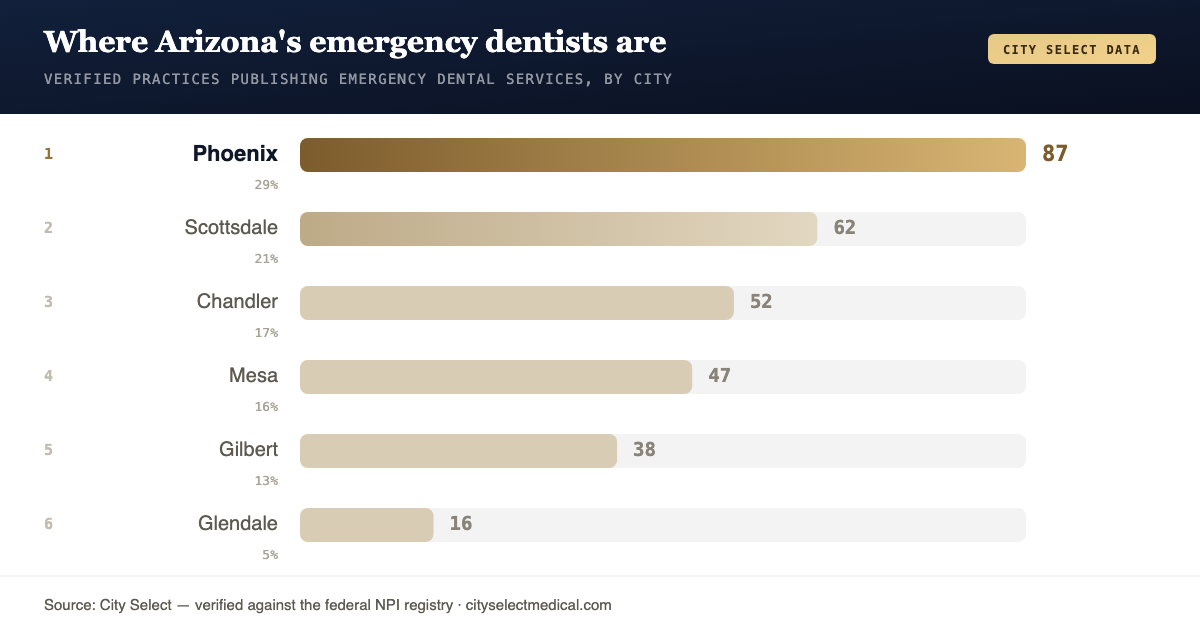
The bottleneck is rarely whether an office takes emergencies — most do. It's finding one with a slot, at a price you can ask about without a fight.
The sentence that works: "I'm in pain, I'm self-pay, can you see me today — and what's your emergency exam cost?" Four facts, one sentence. Front desks triage on exactly that. And when they're full, ask: "Who nearby would you send me to?" They know their neighbours' schedules better than any website does.
Don't skip the second half
Emergency care stabilises. It rarely finishes. The extraction site needs checking. The temporary filling needs a permanent one. The root canal needs its crown — here's why, and what it costs.
Uninsured patients disproportionately skip that follow-up, and end up back in emergency care for the same tooth, paying twice. Before you leave the emergency visit, get the follow-up plan and its price in writing — then decide with real numbers rather than dread. If coverage is the recurring problem, the membership-plan and marketplace options are compared in our dental insurance guide.
The bottom line
First, rule out the emergency room: spreading facial swelling, trouble swallowing or breathing, fever with swelling, uncontrolled bleeding, or a suspected broken jaw means the ER, now. A spreading dental infection is genuinely dangerous, and cost is not the consideration in that moment.
Otherwise: call for self-pay emergency rates (fastest), with community health centres and dental schools as the cheapest treatment path — and if you're on AHCCCS, use the $1,000 emergency benefit that exists for exactly this. Speed beats price with an infection, and follow-up beats a second emergency on the same tooth. None of it requires insurance. It requires a verified list and the right sentence: start here.
Frequently asked questions
When should I go to the ER instead of a dentist for tooth pain?
Go to the emergency room — now — if you have facial swelling spreading toward your eye or down your neck, difficulty swallowing or breathing, uncontrolled bleeding, a high fever with the swelling, or a suspected jaw fracture. Those signal an infection or injury that has moved beyond the tooth, and a spreading dental infection can become life-threatening. For a severe toothache, a cracked tooth, a lost crown, or an abscess without spreading swelling, an emergency dental visit is usually faster, cheaper, and more useful than an ER.
Will the ER pull my tooth?
Almost never. Emergency departments generally manage the pain and the infection — medication, sometimes IV antibiotics — and refer you to a dentist for the tooth itself. That's genuinely valuable when an infection is winning. For a purely dental problem, you'll typically pay for an ER visit and still need the dentist afterwards.
My tooth was knocked out. What do I do right now?
The American Association of Endodontists says to act within 30 minutes. Pick the tooth up by the crown — the chewing surface — and never touch the root. If it's dirty, rinse it gently with water only: no soap, no chemicals, don't scrub it, don't dry it, and don't wrap it in a tissue. Put it straight back into the socket if you can and hold it there. If you can't, keep it moist in milk, inside your cheek, or in a tooth-preservation kit — not in tap water, which the root cells can't tolerate for long. Then get to a dentist or endodontist immediately and bring the tooth. Say 'avulsed' when you call. This applies to permanent teeth: a knocked-out baby tooth should not be replanted, as it can damage the permanent tooth developing underneath.
How much does an emergency dental visit cost without insurance?
A self-pay emergency exam commonly runs $50–$150; many Arizona offices advertise a flat-rate emergency exam-and-X-ray. Treatment is where the cost moves: Delta Dental of Arizona publishes a Phoenix-metro median of $340 for an extraction and $1,230 for a root canal. Ask for both numbers when you call — the exam price, and the likely treatment range.
Does AHCCCS cover emergency dental for adults?
Yes. AHCCCS members 21 and older have up to $1,000 per contract year (October 1 to September 30) for emergency dental — and the covered list is broader than its reputation suggests: not just exams, X-rays and extractions, but root canals for acute infection, apicoectomy, re-implanting a knocked-out tooth, recementing a loose crown, and cast crowns to restore a root-canal-treated tooth. No prior authorization is required and you can self-refer.
What if I can't pay the whole bill today?
Say so, out loud, at the front desk. Many private practices will phase treatment — handle the urgent part now, plan the rest. Federally qualified community health centers with dental programs charge on a sliding scale based on income, and dental schools treat emergencies at a substantial discount. What you should not do is wait: dental infections get more expensive and more dangerous with time.
What can I do for tooth pain while I wait for an appointment?
Over-the-counter pain relievers used exactly as directed on the label, a cold compress against the outside of the cheek, and gentle salt-water rinses are the standard stopgaps. Do not place aspirin directly against the gum — it burns the tissue. And do not wait out facial swelling: swelling that spreads toward the eye or the throat is an emergency-room situation, today.
Is a dental abscess an emergency?
Treat it as urgent. An abscess is an active infection, and infections spread. If it comes with facial swelling, fever, or difficulty swallowing or breathing, go to the emergency room now. If it's localised and you have no systemic symptoms, get an emergency dental appointment as soon as you can — the same day if possible. Antibiotics alone don't fix the underlying tooth.
Can I just take antibiotics and wait?
Antibiotics can control an infection temporarily, but they don't treat the cause — the tooth still needs definitive care, and the infection can return, sometimes worse. Antibiotics are a bridge to treatment, not a substitute for it. Ask your provider what the definitive treatment is and when it's happening.
What should I say when I call a dental office?
Four facts in one sentence: 'I'm in pain, I'm self-pay, can you see me today, and what's your emergency exam cost?' Front desks triage on exactly that. If they're full, ask the follow-up that actually works: 'Who nearby would you send me to?' Dental front desks know their neighbours' schedules better than any website does.
Find a verified dentist in Arizona
Every dentist on City Select is sourced from the federal NPI registry and organized by city and specialty — no pay-to-rank, no mystery. Filter by your city and insurance:
 Insurance & Costs
Does AHCCCS Cover Dental for Adults? Arizona's $1,000 Rule, Explained
If you're on AHCCCS and your tooth hurts, the answer is "yes, but" — and there are five exceptions written into the policy that don't touch your $1,000 at all.
 Insurance & Costs
Root Canal and Crown Costs in Arizona: What You'll Actually Pay
The root canal quote is only half the bill. Here's the number nobody says out loud at the first appointment — and why your plan's annual maximum quietly turns "80/50 coverage" into far less.
 Insurance & Costs
Dental Insurance in Arizona, Decoded: What "We Accept Your Plan" Really Means
Dental insurance isn't health insurance — it's closer to a prepaid discount card with a spending cap. Once you see the structure, every confusing EOB starts making sense.
Written by the City Select editorial team and edited by Alan S., Senior Editor. Drafted with AI assistance and checked against the official sources below. City Select is not a healthcare provider, and this guide is not medical advice. Our editorial & data standards →
- American Association of Endodontists — knocked-out (avulsed) teeth: the five steps
- American Association of Endodontists — traumatic dental injuries
- American Dental Association — dental emergencies
- AHCCCS Medical Policy Manual 310-D1 — adult emergency dental benefit
- AHCCCS — Emergency Dental Benefit for members 21+
- Delta Dental of Arizona — usual & customary fees (median dentist fees, ZIP prefix 850)
- FAIR Health Consumer — dental cost lookup by ZIP and CDT code
- HRSA — find a federally qualified health center
- Arizona State Board of Dental Examiners — license verification
- How we verify
This guide is for general information and isn't medical, legal, or insurance advice. Coverage, prices, and policies change — verify current details with the relevant provider, plan, or agency, and confirm with the practice before booking. Last updated July 12, 2026.