
Does AHCCCS Cover Dental for Adults? Arizona's $1,000 Rule, Explained
If you're an adult on AHCCCS and your tooth hurts, the answer is "yes, but" — and the "but" is worth understanding before you book anything.
Here's what almost nobody tells you: there are five categories written into the policy that don't count against your $1,000 at all. This guide covers what's actually in the benefit, what those exceptions are, and how to find one of the 158 Arizona dental practices that publish that they take AHCCCS — which, as you'll see, is the hardest part.
- Yes — but only for emergencies. AHCCCS covers up to $1,000 per member, per contract year (Oct 1 – Sep 30) in emergency dental for members 21+.
- A "dental emergency" has a legal definition: an acute disorder of oral health resulting in severe pain and/or infection as a result of pathology or trauma.
- Five categories don't touch the $1,000 at all — medical/surgical dental, transplant prep, cancer prep, ventilator patients, and care at IHS/638 tribal facilities.
- No prior authorization. You can self-refer.
- Not covered: cleanings, preventive care, routine fillings, dentures, bridges, braces, cosmetic work. TMJ diagnosis and treatment is excluded except for reduction of trauma.
- Under 21? Comprehensive dental — a completely different, much broader benefit.
01 · INSURANCEWhat the $1,000 actually covers
AHCCCS pays to stop pain and infection — not to restore or maintain your teeth. That's the organising principle, and once you have it, most of the rules make sense.
- Emergency oral exam (problem-focused)
- Radiographs of the symptomatic teeth
- Extractions for relief of pain
- Root canals and pulpotomies for acute infection or pain
- Apicoectomy for acute infection
- **Cast crowns — to restore a root-canal-treated tooth**
- Prefabricated crowns for a recent tooth fracture
- Composite resin for a recently fractured front tooth
- Recementing a crown or bridge that's come loose
- Re-implanting a knocked-out front tooth
- Initial treatment of abscesses and infection
- Anaesthesia and pain medication
- Follow-up needed to stabilise the tooth
- Routine cleanings and checkups
- Preventive care (sealants, fluoride)
- Routine fillings and routine root canals
- **Dentures**
- **Fixed bridgework** to replace missing teeth
- Braces and orthodontics
- Cosmetic work
- **TMJ diagnosis and treatment** — except for reduction of trauma
Correction worth making loudly, because we got this wrong ourselves: an earlier version of this guide said the crown after an emergency root canal "generally is not" covered. That's wrong. AHCCCS policy expressly covers cast crowns limited to the restoration of root-canal-treated teeth. If a dentist tells you AHCCCS won't crown a tooth it just root-canalled, ask them to check 310-D1, section III.B.1.n.
The benefit is narrower than a normal dental plan but wider than its reputation. "Emergency-only" does not mean "extractions only" — it means the care has to be tied to acute pain, infection or trauma. Within that, AHCCCS will often pay to save the tooth.
Ask the office to check the policy by section, not from memory. Front-desk staff are working from habit, and the adult benefit is widely misremembered as extractions-only. "Can you check 310-D1 for cast crowns on root-canal-treated teeth?" is a completely reasonable request, and it can be worth several hundred dollars.
"It's emergency-only, so it's basically just extractions." Not true. The covered list includes root canals, apicoectomies, pulpotomies, re-implanting a knocked-out tooth, recementing a loose crown, and cast crowns on root-canal-treated teeth. AHCCCS will often pay to save the tooth, not only to pull it. The constraint is the $1,000 — not the ambition.
The five exceptions that don't count against your $1,000
This is the part almost nobody knows, and it can be worth thousands.
| Exception | What it covers |
|---|---|
| Medical/surgical dental | Services a dentist performs that would be a physician service if a doctor did them — tied to acute pain (not TMJ), infection, or fracture of the jaw. Includes exam, radiographs, complex oral surgery such as maxillofacial fracture treatment, anaesthesia, antibiotics and pain medication. |
| Transplant prep | If you need dental work as a prerequisite to an AHCCCS-covered organ or tissue transplant: cleanings, periodontal treatment, extractions, and simple restorations — after a transplant evaluation finds you're a candidate. |
| Cancer prep | Prophylactic extraction of teeth in preparation for radiation treatment of cancer of the jaw, neck or head. |
| Ventilator patients | Cleanings for inpatients on a ventilator, or physically unable to perform oral hygiene, done by a hygienist under a physician's supervision. |
| IHS / 638 tribal facilities | Dental services provided to American Indian / Alaska Native members within an IHS or 638 tribal facility are not subject to the $1,000 limit at all. |
If your dental problem involves a jaw fracture, a transplant workup, cancer radiation prep, or you're an AI/AN member at an IHS or 638 facility — the $1,000 cap may not apply to you at all. Say so explicitly at the front desk. Nobody will volunteer it.
Ask one precise question if you're an AI/AN member: "Is this being provided within an IHS or 638 tribal facility?" If yes, the $1,000 adult emergency limit does not apply to those services. This is one of the most valuable and least-known provisions in the whole policy.
02 · COSTThe rules that decide what you pay
The contract year: use it or lose it
The $1,000 runs on AHCCCS's contract year — October 1 to September 30, not the calendar year, and members are expressly not permitted to carry unused benefit into the next year. Use $200 in November and you have $800 until September 30; on October 1 the meter resets to $1,000 regardless.
The limit is also member-specific and portable — it travels with you if you switch health plans mid-year, and it's the contractor's job to tell the new plan what your remaining balance is.
The $1,000 is a fire extinguisher, not a maintenance plan. It resets every October 1 — and it does not roll over.
If the treatment costs more than $1,000
A provider cannot simply bill you for the overage. The policy sets out a specific process, and it protects you:
They must tell you first, in a way you understand
The provider has to inform you that the requested service exceeds the $1,000 limit and is not covered by AHCCCS.
They must give you a document to sign — BEFORE the service
It has to describe the type of service and the charge, and state that you understand AHCCCS won't fully pay and that you agree to pay the excess.
You must sign it in advance
The member has to sign before receiving the service in order for the provider to bill for it. If you never signed anything in advance, that requirement wasn't met.
Ask them to phase the treatment
Often the urgent part — infection control, extraction — fits inside the benefit, and the rest can be planned separately or across the October reset.
"They told me afterwards that it went over the limit, so I have to pay." The policy requires the provider to inform you and obtain your signature in advance, on a document describing the service and the charge. Retroactive notice isn't the process AHCCCS describes. If you're being billed for over-cap emergency dental you never agreed to in writing, ask the office to show you the signed advance consent.
"Once AHCCCS pays, it's settled." Not necessarily. All services are subject to retrospective review to determine whether they actually met the criteria for a dental emergency — and services found not to meet those criteria are subject to recoupment. This is a reason to make sure your clinical record genuinely reflects the emergency: the pain, the infection, the trauma.
How we source this
Every coverage rule on this page comes directly from the AHCCCS Medical Policy Manual, Policy 310-D1 — Dental Services for Members 21 Years of Age and Older, effective 04/14/23. We read the policy itself, not a summary of it, and we cite the sections.
That matters here more than usual, because this subject is dominated by second-hand summaries that quietly drop the exceptions. The $1,000 cap is widely repeated. The five categories that aren't subject to it are almost never mentioned — and they're right there in sections III.A.3 through III.A.6 and III.D.3.
The statutory basis for the $1,000 limit is A.R.S. §36-2907. Where a rule is our reading of the policy rather than a direct quotation, we say so. Coverage rules change — confirm current details with AHCCCS or your health plan before treatment.
03 · FROM THE WEBQuestions people are actually asking
I'm on AHCCCS and I need a root canal. Will they pay?
If the tooth is causing acute pain or has an active infection, root canals are on the covered emergency list — and so is the cast crown to restore that root-canal-treated tooth. Both draw on your $1,000. What's not covered is a *routine* root canal on a tooth that isn't acutely symptomatic.
Why won't AHCCCS cover my dentures?
Dentures are expressly excluded from the adult benefit, as is fixed bridgework to replace missing teeth. It's not a plan-by-plan quirk — it's written into the policy. If you're dual-eligible with Medicare, check whether a Medicare Advantage D-SNP plan offers dental separately.
Do I need a referral from my doctor for emergency dental?
No. Members may self-refer directly to a dental provider when they need emergency dental services, and **no prior authorization is required** — in fee-for-service or with a contracted plan.
My kid is on AHCCCS. Are their cleanings covered?
Yes — and this catches families out. **Members under 21 get comprehensive dental coverage**: checkups, cleanings, fluoride, fillings, and medically necessary orthodontics. Parents sometimes assume the adult emergency-only rule applies to the whole household and skip the kids' checkups. Don't.
158 of our 1,095 verified Arizona dental practices publish that they accept AHCCCS or Medicaid. Filter by city, then call to confirm — acceptance changes, and the practice is always the final word.
04 · THE VISITFinding a dentist who takes AHCCCS — the honest picture
This is the hardest part of the whole benefit, and we're not going to pretend otherwise.
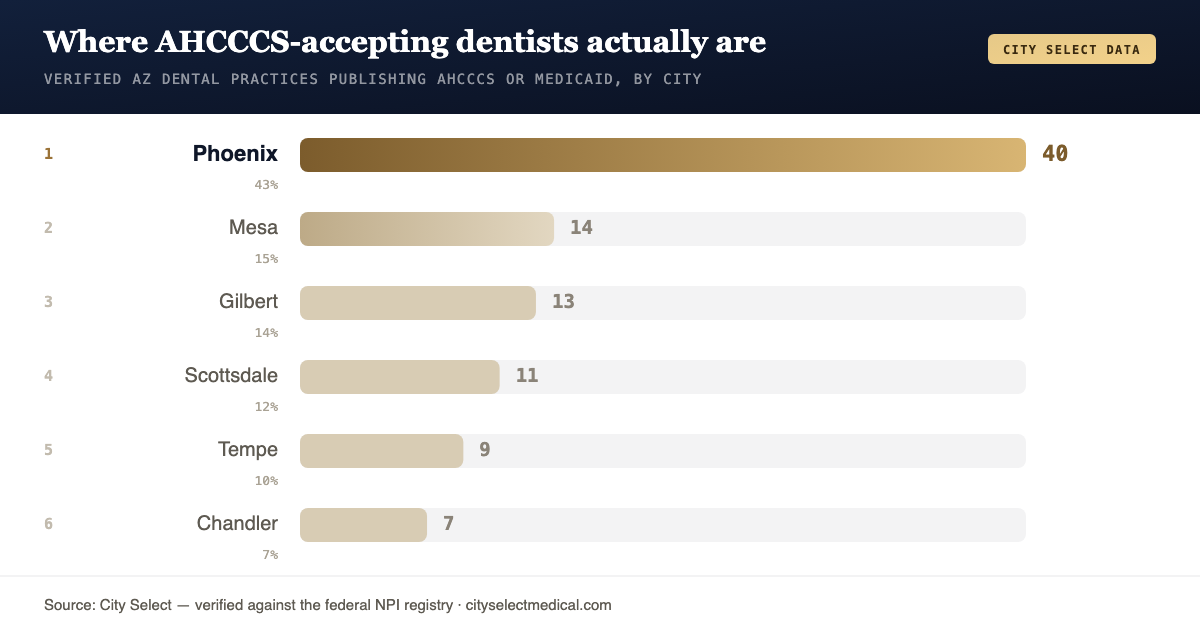
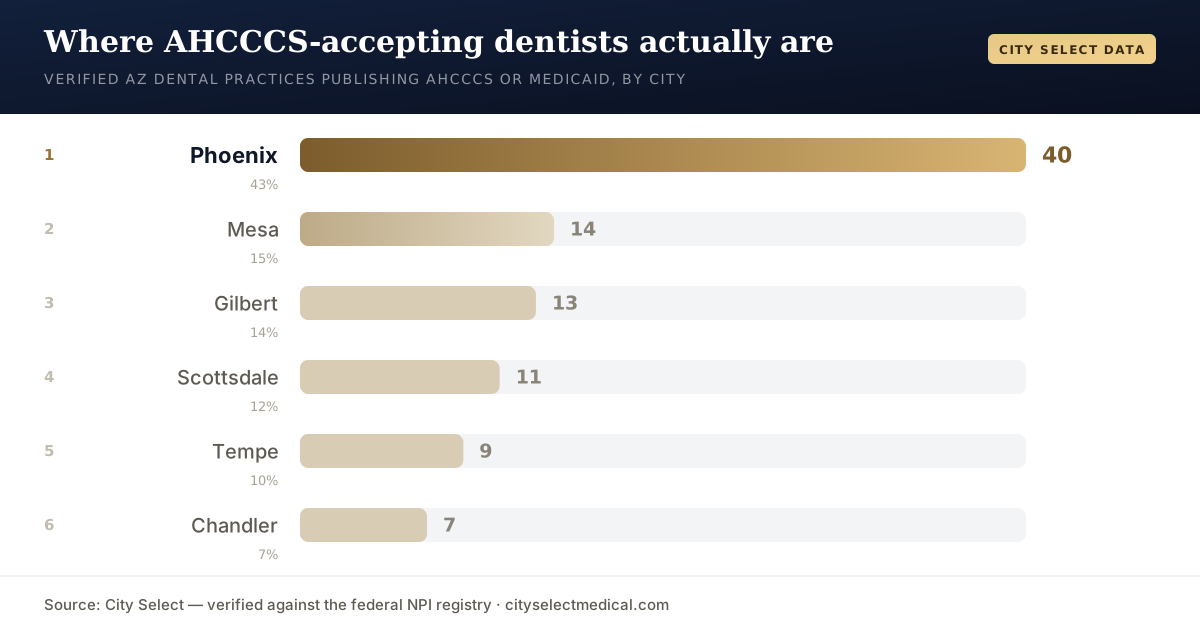
Read that caveat carefully, because it's the whole problem. For roughly 43% of Arizona dental practices, we could not find or confirm a single insurance plan they accept. That's why finding an AHCCCS dentist means calling — and it's exactly why we built the insurance filter.
The benefit exists. The hard part is finding the door. Most Arizona dental practices don't publish what they accept — so you call.
Arizona-specific: if you are an American Indian or Alaska Native member, care received within an IHS or 638 tribal facility is not subject to the $1,000 limit. In a state with 22 federally recognised tribes, this is one of the most consequential provisions in the policy — and one of the least publicised.
Three things to say on the phone, in this order: "I have AHCCCS — do you accept it for adult emergency dental, and are you taking new patients?" (some offices take AHCCCS for children but not the adult benefit); "Will you bill AHCCCS directly?" (rather than you paying and seeking reimbursement); and if they can't see you, "who nearby can?" — dental front desks usually know.
05 · CHOOSINGGetting the most out of the benefit
Go promptly — don't ration it
Infections get more expensive and more dangerous with time, and unused benefit evaporates on September 30 anyway. There is no prize for saving the $1,000.
Say the magic words about exceptions
If a jaw fracture, transplant workup, cancer radiation prep, ventilator care, or an IHS/638 facility is involved, say so — those services may not count against your cap at all.
Ask for the treatment plan in writing
The policy requires informed consent and a written treatment plan, signed by both parties, for irreversible procedures. You're entitled to a copy of the complete plan.
Never sign an over-cap agreement you don't understand
The document must describe the service and the charge. If you're being asked to agree to pay an unspecified amount, stop and ask for specifics.
Ask about the October reset for multi-visit care
Treatment that straddles September and October may draw from two separate benefit years. Have the office map it out — but never delay clinically necessary care to chase a benefit year.
If you're on ALTCS, ask a different question entirely. ALTCS members aged 21 and older may be eligible for additional medically necessary non-emergency dental services under a separate policy — AMPM 310-D2. If that's you, don't assume the $1,000 emergency cap is your whole benefit; ask your case manager about 310-D2 by name.
For work that falls outside the benefit, the options in our guide to emergency dental care without insurance in Arizona — dental schools, community health centres, membership plans — apply to over-cap costs too.
The bottom line
For Arizona adults on AHCCCS, dental coverage is real but narrow: $1,000 a year, emergencies only, resetting every October 1 with no rollover. It covers more than people think — root canals, apicoectomies, even the cast crown on a root-canal-treated tooth — but not cleanings, not fillings, and not dentures.
The two things worth remembering: five categories don't count against the $1,000 at all (jaw fracture and medical/surgical dental, transplant prep, cancer prep, ventilator patients, and IHS/638 tribal facilities) — say so if any apply to you. And a provider can only bill you above the cap if you signed a document describing the service and the charge, in advance. If you never signed one, ask them to show it to you.
Frequently asked questions
Does AHCCCS cover dental for adults in Arizona?
Yes, but narrowly: emergency dental services up to $1,000 per member per contract year (October 1 to September 30) for members 21 and older. A dental emergency is defined as an acute disorder of oral health resulting in severe pain and/or infection from pathology or trauma. Routine cleanings, regular fillings, dentures and braces are not covered for adults.
What does NOT count against the $1,000 AHCCCS dental limit?
Five things, and they are rarely mentioned in summaries of this benefit. Medical and surgical dental services tied to a medical condition (acute pain, infection, or jaw fracture); dental work required before an AHCCCS-covered organ or tissue transplant; prophylactic extractions before radiation for cancer of the jaw, neck or head; cleanings for inpatients on a ventilator or unable to perform oral hygiene; and services provided to American Indian/Alaska Native members within an IHS or 638 tribal facility. None of these draw on your $1,000.
Does AHCCCS cover a crown after an emergency root canal?
Yes, in a specific case. AHCCCS policy expressly covers cast crowns limited to the restoration of root-canal-treated teeth, as part of the emergency benefit and subject to the $1,000 limit. Prefabricated crowns are also covered to eliminate pain from a recent tooth fracture. Routine crowns outside that context are not covered.
Does AHCCCS cover dentures for adults?
No. Dentures are expressly not covered under the adult benefit, and neither is fixed bridgework to replace missing teeth. Members under 21 are covered under a separate, comprehensive benefit. Some dual-eligible members may have denture benefits through a Medicare Advantage D-SNP plan — check that plan separately.
Do I need prior authorization or a referral for emergency dental on AHCCCS?
No prior authorization is required for emergency dental services, whether you're in fee-for-service or with a contracted health plan. You may also self-refer directly to a dental provider when you need emergency dental care — you don't have to go through your primary care provider first.
Does AHCCCS cover wisdom tooth removal?
Only when it meets the emergency criteria — acute pain or active infection. Removing symptom-free wisdom teeth on a dentist's recommendation is preventive, and the adult benefit doesn't cover preventive care.
Does the $1,000 include the exam and X-rays?
Yes. The emergency exam, the radiographs, the treatment, anesthesia, and related medications all draw from the same $1,000 pool. Facility and anesthesia charges count against it too, even when the care happens in a surgery center or hospital.
What happens if my treatment costs more than $1,000?
The provider can only bill you for the excess if they follow a specific process: they must first tell you, in a way you understand, that the service exceeds the $1,000 limit and isn't covered — and then give you a document, describing the service and the charge, that you sign BEFORE receiving the care. If you didn't sign anything in advance, that billing requirement wasn't met.
Can AHCCCS take the money back after treatment?
Yes — all services are subject to retrospective review to determine whether they met the criteria for a dental emergency, and services found not to meet those criteria are subject to recoupment. That's a real reason to make sure the clinical documentation reflects the emergency.
Does the $1,000 roll over if I don't use it?
No. The benefit runs October 1 to September 30 and members are expressly not permitted to carry unused benefit into the next year. It also travels with you — the limit is member-specific and stays with you if you change health plans mid-year.
I'm on ALTCS. Is my dental benefit different?
It can be. ALTCS members aged 21 and older may receive additional medically necessary non-emergency dental services under a separate policy (AMPM 310-D2), beyond the emergency benefit described here. If you're on ALTCS, ask your case manager specifically about 310-D2 rather than assuming the $1,000 emergency cap is your whole benefit.
Find a verified dentist in Arizona
Every dentist on City Select is sourced from the federal NPI registry and organized by city and specialty — no pay-to-rank, no mystery. Filter by your city and insurance:
 Insurance & Costs
Emergency Dentist With No Insurance: Your Real Options in Arizona
A dental emergency without insurance feels like a trap. It isn't — there are five real doors, and knowing their order saves you hundreds and possibly your tooth.
 Insurance & Costs
Root Canal and Crown Costs in Arizona: What You'll Actually Pay
The root canal quote is only half the bill. Here's the number nobody says out loud at the first appointment — and why your plan's annual maximum quietly turns "80/50 coverage" into far less.
 Insurance & Costs
Dental Insurance in Arizona, Decoded: What "We Accept Your Plan" Really Means
Dental insurance isn't health insurance — it's closer to a prepaid discount card with a spending cap. Once you see the structure, every confusing EOB starts making sense.
Written by the City Select editorial team and edited by Alan S., Senior Editor. Drafted with AI assistance and checked against the official sources below. City Select is not a healthcare provider, and this guide is not medical advice. Our editorial & data standards →
- AHCCCS Medical Policy Manual 310-D1 — Dental Services for Members 21 and Older (eff. 04/14/23)
- AHCCCS — Emergency Dental Benefit for members 21+
- AHCCCS — Dental coverage for members under 21
- A.R.S. §36-2907 — the statute behind the $1,000 emergency dental limit
- AHCCCS — Dental fee-for-service fee schedule (CDT codes)
- Arizona State Board of Dental Examiners — license verification
- NPPES NPI Registry
- How we verify
This guide is for general information and isn't medical, legal, or insurance advice. Coverage, prices, and policies change — verify current details with the relevant provider, plan, or agency, and confirm with the practice before booking. Last updated July 12, 2026.