Dental Specialists Explained: Who Do You Actually Need?
Dentistry has a specialist system, exactly like medicine. Nobody explains it to you, so most people find out the hard way — after a referral loop, a repeat set of X-rays, or a consultation with the wrong person.
Twelve dental specialties are formally recognised. You'll realistically meet about six of them. This guide explains who does what, when the referral genuinely matters, and — the part that catches people — which impressive-sounding titles aren't specialties at all. We list 160 verified Arizona dental specialty practices alongside 1,095 general practices.
- Your general dentist is the quarterback: exams, cleanings, fillings, crowns, simple extractions — and diagnosis.
- Endodontist → inside the tooth. Root canals and retreatments. (2–3 yr residency)
- Periodontist → gums and supporting bone. Gum disease, grafts, many implants. (3 yr)
- Oral & maxillofacial surgeon → surgical extractions, wisdom teeth, jaws, implants. (4–6 yr, hospital-based — the longest training in dentistry)
- Prosthodontist → rebuilding what's missing. Complex crowns and bridges, dentures, full-mouth reconstruction. (3 yr)
- You can usually self-refer. No permission slip required.
- ⚠️ "Cosmetic dentist" is not a recognised specialty. Neither is "implant dentist."
01 · INSURANCEThe title on the door isn't always a credential
Start here, because it's the part that actually costs people money.
Specialty recognition in dentistry runs through the National Commission on Recognition of Dental Specialties and Certifying Boards — an ADA-affiliated body. It recognises twelve specialties. To call yourself an endodontist, a periodontist, an orthodontist, an oral surgeon, a prosthodontist or a paediatric dentist, you complete a formal residency after dental school and earn board certification.
"Cosmetic dentist" and "implant dentist" are specialties. They are not. Neither is "sedation dentist." Those titles describe what a practice focuses on — they are not protected credentials, and any licensed dentist may use them. That doesn't make those dentists bad; plenty are outstanding, and many have serious postgraduate training. It does mean the title itself tells you nothing verifiable. So ask the only question that does: "What formal training did you complete in this, and where?"
- Endodontist — root canals (2–3 yr residency)
- Periodontist — gums, bone, implants (3 yr)
- Oral & maxillofacial surgeon — surgery, jaws (4–6 yr)
- Prosthodontist — reconstruction, dentures (3 yr)
- Orthodontist — alignment and bite (3 yr)
- Pediatric dentist — children (2 yr)
- "Cosmetic dentist" — not a recognised specialty
- "Implant dentist" — not a recognised specialty
- "Sedation dentist" — not a recognised specialty
- "Smile designer" and similar — marketing
You can verify any of this in about sixty seconds. The Arizona State Board of Dental Examiners runs a free public Professional License Search — it will tell you what licence someone actually holds. The Board even runs a public campaign urging patients to use it. Every City Select listing is separately checked against the federal NPI registry.
So how do you tell a real specialty from a marketing description? Three questions, and none of them are rude:
"Is that an ADA-recognised specialty?"
There are twelve. If the answer is a pause, you have your answer — and it isn't necessarily a bad one, it's just not what the title implied.
"Where did you do your residency, and how long was it?"
A genuine specialist answers instantly and with some pride. Endodontics is 2–3 years; periodontics, prosthodontics and orthodontics 3; oral surgery 4–6.
"Are you board certified?"
Board certification is the formal step beyond finishing a residency. Not every excellent specialist pursues it — but if someone claims it, it is checkable.
Check the licence yourself
The Arizona State Board of Dental Examiners' Professional License Search is free, public, and takes a minute. It tells you what they actually hold, rather than what the website says.
02 · COSTWho does what — and who's more expensive
| Provider | Training after dental school | Their territory | You'd see them for |
|---|---|---|---|
| General dentist | — | The whole mouth | Checkups, fillings, crowns, simple extractions, diagnosis |
| Endodontist | 2–3 yr residency | Inside the tooth | Root canals, retreatments, cracked-tooth diagnosis |
| Periodontist | 3 yr residency | Gums & supporting bone | Gum disease, recession grafts, implants |
| Oral & maxillofacial surgeon | 4–6 yr, hospital-based | Surgery & jaws | Wisdom teeth, impacted or broken teeth, jaw surgery, implants |
| Prosthodontist | 3 yr residency | Rebuilding what's missing | Complex crowns and bridges, dentures, full-mouth reconstruction |
| Orthodontist | 3 yr residency | Alignment & bite | Braces, aligners, bite correction |
| Pediatric dentist | 2 yr residency | Children | Kids, including those with special healthcare needs |
On cost: specialists frequently charge more, and we're not going to give you a percentage — because no source we trust publishes one, and the last version of this article printed a "15–30% premium" figure that had nothing behind it. We removed it.
Instead of a fictional percentage, do the thing that actually works: get an itemised quote with CDT codes from both providers, and compare them directly. Codes are what make two quotes comparable — without them you're comparing adjectives. You can look each code up for your own ZIP at FAIR Health Consumer.
Where a specialist genuinely earns the difference is complexity. A molar with curved or extra canals. A retreatment of a failed root canal. Bone grafting or a sinus lift. A medically complicated patient. On a straightforward case, your general dentist is frequently the right value — and a good one will tell you so.
Ask your general dentist the question directly: "Would you refer this out if it were your mouth?" It's a fair question, it's not rude, and it reframes the conversation from selling you a procedure to advising you on one. A dentist who says "honestly, a molar this curved should go to the endodontist" has just told you they're worth keeping.
The system works like medicine: one provider who knows your whole mouth, and specialists who do one thing thousands of times. Use each for what it's for.
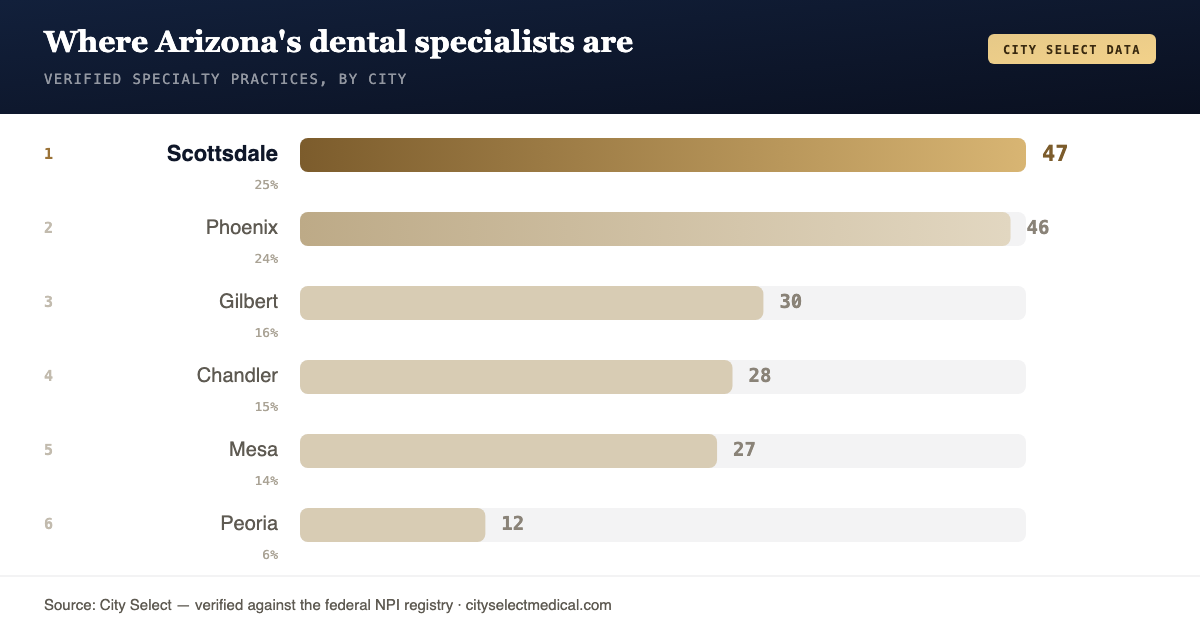
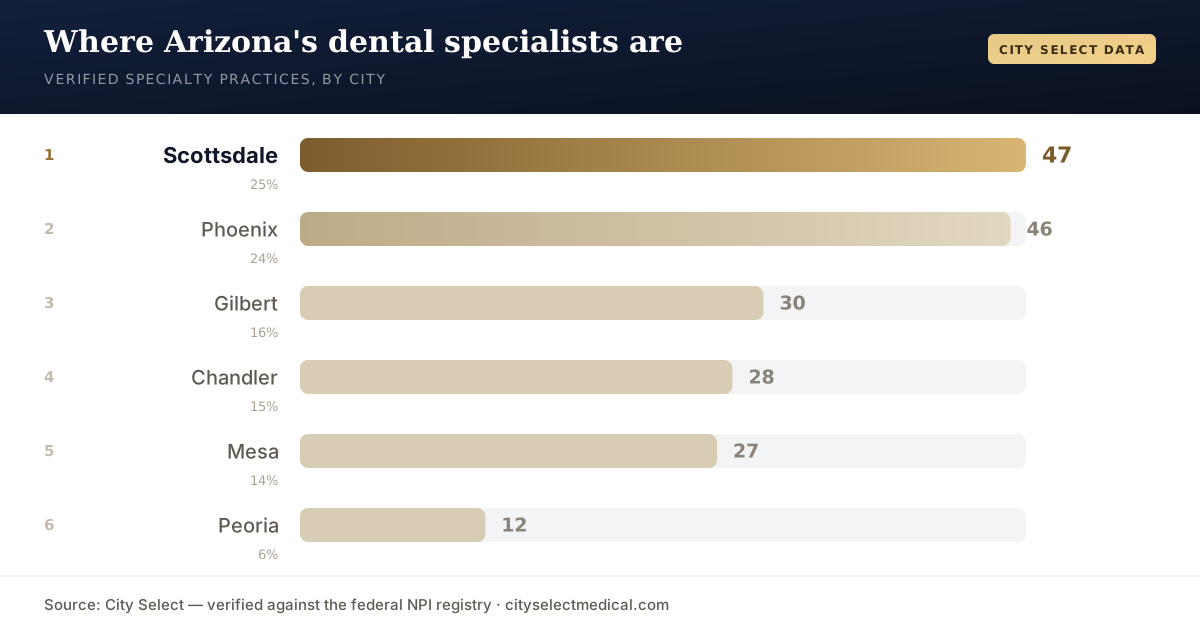
Arizona-specific: dental specialists concentrate heavily in Phoenix and Scottsdale. If you live outside the central metro, a specialist referral may mean a genuine drive — worth knowing before you agree to a multi-visit treatment plan, because a root canal and its follow-ups are not a one-trip commitment.
How we source this
Specialty definitions and the count come from the National Commission on Recognition of Dental Specialties and Certifying Boards (NCRDSCB) — the ADA-affiliated body that actually recognises dental specialties. Not from a dental practice's blog, which is where most articles on this subject get their information, and which is why so many of them describe "cosmetic dentistry" as a specialty. It isn't one. Residency lengths are from NCRDSCB and ADEA.
And a correction we owe you. The previous version of this guide stated — twice, as fact — that specialist fees run "15–30% above a general dentist." That figure had no source. We looked for one and could not find it, so we removed it rather than dress it up. Where we can't source a number, we say so and tell you how to get the real one yourself: ask for the CDT codes and look them up.
Directory counts are our own, recounted at every build and always framed as a floor rather than a census.
03 · FROM THE WEBQuestions people are actually asking
Do I need an endodontist or a periodontist?
This is *the* most common mix-up, and the split is simple: **the endodontist works inside the tooth; the periodontist works on what holds it in.** Pain coming from the nerve or pulp — a root canal, a retreatment — is endodontics. Bleeding gums, receding gums, deepening pockets, bone loss around a tooth: periodontics. If you genuinely can't tell which, that's a diagnosis question — see your general dentist first, because a wrong self-referral costs you a consultation fee and gets you no closer.
Will a root canal done by a general dentist last as long as one done by an endodontist?
We won't quote you success rates — we don't have a source we'd stand behind, and anyone confidently giving you a percentage probably doesn't either. What we can tell you is what actually drives the outcome: **case complexity, and how often the person doing it does that case.** A straightforward front tooth is routine work for a general dentist. A molar with curved or extra canals, or a retreatment of a failed root canal, is exactly where an endodontist's volume and microscope earn their keep. **The question to ask is not "which is better?" but "how many cases like mine did you do last year?"**
Should I see an endodontist or a general dentist for a root-canal *retreatment*?
Retreatment is the case type endodontists exist for — reopening a previously treated tooth, finding what was missed, and working around old filling material. It's meaningfully harder than a first-time root canal. Most general dentists will refer it out, and if yours offers to do it in-house, it's fair to ask how many retreatments they handle a year.
My molar was extracted — which specialist do I see about replacing it?
Usually two people, not one. An **oral surgeon or periodontist** places the implant post; your **general dentist or a prosthodontist** builds the crown on top. Which of the two surgical specialists depends on the case — significant bone grafting or medical complexity steers toward the oral surgeon. **Get both phases quoted before you commit to either.**
160 verified Arizona dental specialty practices, checked against the federal NPI registry. Filter by city — then bring your X-rays with you.
04 · THE VISITThe three referral paths, decoded
The gum-disease path. Your dentist measures the pockets around your teeth at cleanings. Deepening pockets or bone loss triggers a periodontist referral — for deep cleaning (scaling and root planing), surgery, or grafting. Going early matters here more than almost anywhere else in dentistry: gum treatment gets more invasive the longer it waits, and lost bone doesn't grow back on its own.
The root-canal path. Front teeth and simple premolars are commonly treated in-house. Complex molars, retreatments, and unclear cracked-tooth pain go to the endodontist. A fair question if your dentist wants to keep a tricky molar in-house: "How many molar root canals do you do a month?" (What the whole thing costs.)
The extraction path. Simple extractions stay with your dentist. Impacted wisdom teeth, teeth broken at the gumline, and anything requiring sedation go to the oral surgeon — who is also the one trained for the medical-side complications, being the hospital-trained member of the family.
The pattern behind all three paths is the same: your general dentist owns the diagnosis; the specialist owns the difficult version of the procedure. If someone is doing the other one's job, ask why. Sometimes there's a good answer — and asking is how you find out.
A referral isn't a demotion of your dentist. It's the system working exactly as designed.
Implants: the procedure that confuses everyone
An implant is two jobs — the surgical one (placing the titanium post in bone) and the restorative one (building the visible tooth) — and they're frequently done by two different providers. Oral surgeons and periodontists handle the surgical phase, especially where bone grafting is involved. Your general dentist or a prosthodontist typically restores it.
"I got a quote from the surgeon, so I know what my implant costs." Very possibly not. A surgeon's quote may cover the post and nothing else — no abutment, no crown. That's not a trick; it's just their half of the job. Ask the question that closes the gap: "Does this price include the abutment and the crown, and if not, who does those and what do they charge?" The full cost anatomy: dental implant costs in Arizona.
05 · CHOOSINGWhen to skip the middleman — and when not to
Go straight to a specialist when the problem is unambiguous
Wisdom teeth already flagged, a failed root canal, advanced gum disease diagnosed elsewhere, denture or full-mouth work. Self-refer without drama.
Stay with your general dentist when the problem is vague
"Something hurts back there" is a diagnosis problem, and diagnosis is their job. A wrong self-referral costs you a consultation fee and gets you no closer.
Take your X-rays with you
You're entitled to copies. Bringing them saves a repeat set of images — and repeat imaging is a cost that surprises people.
Ask how many cases like yours they did last year
It's a normal question and a good provider answers it without flinching. It's also more informative than any credential, once you've confirmed the credential is real.
Keep your general dentist
Specialists fix their territory and hand you back. Nobody else is watching the whole mouth.
Verify the specialty before you assume it. A practice can market itself as focusing on implants, cosmetics, or sedation without holding any recognised specialty — perfectly legally. Check the licence at the Arizona State Board of Dental Examiners, and if the credential matters to you, ask where they did their residency. A genuine specialist will answer immediately; they're proud of it.
The bottom line
Match the provider to the problem: general dentist for diagnosis and everyday care, endodontist for the root canals worth doing right, periodontist for gums and many implants, oral surgeon for anything impacted, surgical or medically complex, prosthodontist when a lot needs rebuilding.
Two things to carry with you. Self-referral is allowed — take your X-rays and skip the loop when the problem is obvious. And the title on the door isn't always a credential: "cosmetic dentist" and "implant dentist" are not recognised specialties, so verify the licence and ask where they trained. Start where the credentials are already checked: verified Arizona dental specialists.
Frequently asked questions
How many dental specialties are there?
Twelve are recognized by the National Commission on Recognition of Dental Specialties and Certifying Boards, the ADA-affiliated body that decides this. The ones patients meet most are endodontics, periodontics, oral and maxillofacial surgery, prosthodontics, orthodontics and pediatric dentistry. The rest — dental anesthesiology, dental public health, oral medicine, orofacial pain, oral and maxillofacial pathology, and oral and maxillofacial radiology — exist but you're less likely to be referred to one.
Is 'cosmetic dentist' a real dental specialty?
No. Cosmetic dentistry is not among the twelve recognized specialties, and neither is 'implant dentist' or 'sedation dentist.' Those are descriptions of what a practice focuses on, not protected credentials — any licensed dentist may use them. That doesn't make them bad dentists; plenty are excellent. It does mean the title tells you nothing verifiable, so ask what training they actually completed.
Do I need a referral to see a dental specialist?
Usually not — dental specialists generally accept self-referred patients, unlike much of medicine. A referral from your general dentist still helps, because it carries your X-rays and history, and dentists tend to refer to specialists whose work they've seen. Ask for your X-rays either way, so you don't pay for repeat imaging.
Who should place my dental implant, and who makes the crown?
Often two different people. An oral surgeon or periodontist typically places the implant post; your general dentist or a prosthodontist restores it with the crown. Experienced general dentists also place straightforward single implants end-to-end. The critical question when comparing quotes: does this price include BOTH phases? A surgeon's quote may exclude the crown entirely.
What does a periodontist treat besides gum disease?
Gum grafting for recession, crown lengthening, bone grafting, and implant placement. Periodontists are the gum-and-bone specialists — which is exactly why implant work often lands with them, since an implant lives in bone.
Is an endodontist only for root canals?
Largely, and that's the point. Endodontists complete two to three years of residency after dental school and do root canals and retreatments all day, with operating microscopes and specialised instruments. Complex molars, failed prior root canals, and unclear cracked-tooth pain are exactly when the referral earns its keep.
Do dental specialists cost more than a general dentist?
Often, yes — but we don't publish a percentage, because no source we trust publishes one. Ask both providers for an itemised quote with CDT codes and compare them directly; the codes are what make two quotes comparable. Where a specialist genuinely earns the difference is case complexity — a molar with curved canals, a failed retreatment, bone grafting. On a straightforward case, your general dentist is frequently the right value.
What's the difference between an oral surgeon and a periodontist for implants?
Both place implants and both are legitimate. Oral and maxillofacial surgeons complete the longest residency in dentistry — four to six years, hospital-based — and handle impacted teeth, jaw surgery, and medically complex cases. Periodontists complete three years focused on gums and supporting bone. For a straightforward implant either is fine; for significant bone grafting, a sinus lift, or a medically complex patient, the case tends to steer toward the oral surgeon.
Can I go straight to a specialist without seeing a dentist first?
Yes, when the problem is unambiguous and specialist-shaped — wisdom teeth already flagged, a failed root canal, advanced gum disease diagnosed elsewhere, denture or full-mouth work. Stay with your general dentist first when the problem is vague ('something hurts back there'), because diagnosis is their job and a wrong self-referral wastes a consultation fee.
Should I keep a general dentist while seeing a specialist?
Yes. Specialists fix their own territory brilliantly and then hand you back. Nobody else is watching the whole mouth — the cleanings, the other teeth, the change over time. Losing your general dentist while under specialist care is one of the more common ways people end up with a second problem.
Find a verified dental specialist in Arizona
Every dental specialist on City Select is sourced from the federal NPI registry and organized by city and specialty — no pay-to-rank, no mystery. Filter by your city and insurance:
 Insurance & Costs
Dental Implant Costs in Arizona: Single Tooth to Full Arch
The quote you get by phone is rarely the number you'll pay. Here's how implant pricing actually breaks down — component by component — and where the real savings are.
 Insurance & Costs
Root Canal and Crown Costs in Arizona: What You'll Actually Pay
The root canal quote is only half the bill. Here's the number nobody says out loud at the first appointment — and why your plan's annual maximum quietly turns "80/50 coverage" into far less.
 Choosing Care
How to Choose a Dentist in Arizona: The Checklist That Actually Works
Most people choose the dentist closest to work and hope. Ten focused minutes of checking does better — here's exactly what to check, and the red flags that matter.
Written by the City Select editorial team and edited by Alan S., Senior Editor. Drafted with AI assistance and checked against the official sources below. City Select is not a healthcare provider, and this guide is not medical advice. Our editorial & data standards →
- National Commission on Recognition of Dental Specialties and Certifying Boards — the recognized specialties
- American Association of Endodontists — dentist vs. endodontist
- American Academy of Periodontology — what is a periodontist
- American Association of Oral and Maxillofacial Surgeons
- American Dental Association — CDT procedure codes
- Arizona State Board of Dental Examiners — Professional License Search
- FAIR Health Consumer — dental cost lookup by ZIP and CDT code
- NPPES NPI Registry
- How we verify
This guide is for general information and isn't medical, legal, or insurance advice. Coverage, prices, and policies change — verify current details with the relevant provider, plan, or agency, and confirm with the practice before booking. Last updated July 12, 2026.