
Dental Implant Costs in Arizona: Single Tooth to Full Arch
Getting a dental implant quote shouldn't feel like a shell game, but it usually does: one office says $1,800, another says $4,500, and both are telling the truth — they're quoting different parts of the same job.
This guide lays out the three things that trip people up — what your plan actually pays, what an implant really costs here, and who should place it — and points you to 557 verified Arizona practices that list dental implants when you're ready to compare.
- Cost: a single implant runs $3,000–$6,000 all-in — post, abutment, and crown. The placement alone carries a Phoenix-metro median of $2,278, so a quote near that figure is post-only.
- Coverage: plans commonly exclude the post; many PPOs pay toward the crown, but a $1,500–$2,000 annual cap holds real help to $1,000–$2,000. AHCCCS doesn't cover implants at all.
- Choosing: general dentists, periodontists, and oral surgeons all place implants — match the provider to your case, and never accept a quote that isn't itemized.
01 · INSURANCEWhat insurance (and AHCCCS) covers
Before the price, the first question is always the same: will my plan pay for this? Here's the line that clears up most of the confusion: dental insurance treats the implant post as elective. It will often pay toward the crown — the visible tooth — and sometimes the abutment. The post, which is the expensive part, is usually excluded outright.
- The crown — often ~50% under PPO plans
- The abutment, on some plans
- Extraction of the failing tooth
- Imaging, on some plans
- Portions billed to medical after an accident
- The implant post itself, on many plans
- Anything above your annual maximum
- Teeth lost before your coverage started
- Implants under AHCCCS — emergency-only benefit
- Purely cosmetic upgrades
The cap is the whole story. With a typical $1,500–$2,000 annual maximum, realistic insurance help on a $4,500 implant is often $1,000–$2,000 — not half the bill. The crown and any covered prep work draw from the same pool, and it resets each plan year. That creates the single best move available to an insured patient: sequence the implant across two plan years — post in December, crown in January — and you can effectively double the benefit. Many dentists will build the timeline that way if you ask them to.
Common trap — "my plan covers implants." Read that as covers part of the crown, up to the cap. Ask your insurer one question, using the billing code: "What do you pay toward CDT code D6010?" The answer is very often zero.
Medicare and AHCCCS are the two questions we get most, and they have short answers.
Original Medicare doesn't cover dental implants — it doesn't cover routine dental care at all. Some Medicare Advantage plans bundle a dental rider that may pay toward the crown, but those riders carry their own annual cap, often $1,000–$2,000, and many exclude implants by name. If you're on an Advantage plan, the only reliable move is to pull the plan's Evidence of Coverage and look for the implant exclusion before you schedule anything.
AHCCCS, Arizona's Medicaid program, is clearer: the adult dental benefit is emergency-only, and implants are excluded. The extraction that precedes an implant may qualify in an acute situation — a genuinely painful, infected tooth — but the implant that replaces it won't, at any point. The full picture: Does AHCCCS cover dental for adults?
If you're on Medicare or AHCCCS, plan on paying for the implant yourself — and read the "how to pay less" section below before you get a single quote. That's where the real money is.
Ask whether any part can be billed to medical. If the tooth was lost to an accident or disease, the imaging, graft, or anesthesia sometimes route through medical insurance instead of dental — where there's no $2,000 cap. Offices that place implants daily know how to check.
02 · COSTWhat a dental implant actually costs in Arizona
Once you know what's covered, the question is what you'll actually pay. And the reason implant quotes are so hard to compare is structural: an implant isn't one thing, it's three. The post is a titanium screw set into the jawbone. The abutment is the connector. The crown is the tooth you see. They're usually billed separately, often placed by different clinicians, across three to six months.
So when one office quotes $1,800 and another quotes $4,500, they're frequently quoting different subsets of the same job.
| Component | AZ self-pay | With insurance | Phoenix median |
|---|---|---|---|
| Implant post (CDT D6010) | $1,000–$3,000 | Rarely covered | $2,278 |
| Abutment | $400–$1,000 | Sometimes covered* | Not published |
| Crown | $800–$3,000 | Often covered* — ~50% | $1,349 |
| All three ("all-in") | $3,000–$6,000 | $1,000–$2,000 of help | — |
The median placement fee is close to what some offices quote as the entire implant — which is exactly how an $1,800 quote happens. It isn't a bargain. It's a partial quote.
Costs also don't scale linearly with the number of teeth, because multiple implants share hardware — four to six posts can carry an entire arch.
| Scope | AZ self-pay | With insurance | Posts required |
|---|---|---|---|
| Single tooth | $3,000–$6,000 | $1,000–$2,000 of help | 1 |
| Implant-supported bridge (3–4 teeth) | $5,000–$16,000 | Capped at your annual max | 2 |
| Full arch, implant-supported (per arch) | $15,000–$30,000+ | Rarely covered | 4–6 |
Then there are the add-ons — the reason a $4,000 estimate becomes a $7,000 bill. None of them are scams. They're real procedures. They just belong in your quote on day one instead of week six.
| Add-on | AZ self-pay | With insurance | Phoenix median |
|---|---|---|---|
| Extraction of the failing tooth | $150–$650 | Often covered* | $340 |
| Bone graft (receded jaw) | $300–$1,200 | Sometimes covered* | Not published |
| Imaging (3D / CBCT) | $150–$500 | Sometimes covered* | $159 |
| IV sedation | $250–$800+ | Rarely covered | $277 / 15 min |
| Temporary crown while healing | $200–$500 | Sometimes covered* | Not published |
Get every quote itemized, in writing, with the CDT codes on it. Codes let you look each procedure up yourself at FAIR Health Consumer using your own ZIP — and they make two quotes genuinely comparable for the first time. An office that won't itemize by code is telling you something.
Ask for the self-pay price out loud. Cash pricing is frequently lower than the "insurance rate," and it is almost never volunteered. Paying without insurance? Say so at the front desk, before the estimate is printed.
The question that cuts through every implant quote: "Is that the post, the abutment, AND the crown — and what could still get added?"
How we source these numbers
Most articles about dental costs quote a range and never say where it came from. Here's ours, because you should be able to check it. There is no free, authoritative national dental fee benchmark anymore — the ADA discontinued its Survey of Dental Fees in 2023, and federal law now bars the association from publishing or recommending fees at all. So instead of trusting one source, we triangulate three public ones:
- Delta Dental of Arizona publishes usual-and-customary fees based on median dentist fees in ZIP prefix 850 — the Phoenix metro. That's our Arizona anchor, and it's the closest thing to a real local market figure available publicly.
- FAIR Health Consumer lets you look up any procedure by CDT code and your own ZIP, drawn from billions of claim records. That's our cross-check — and you can run it yourself, which is the point.
- The AHCCCS fee schedule tells us what the state reimburses. We use it for coverage questions, never as a market price: Medicaid reimbursement is a floor, not what a cash patient pays.
Where those sources disagree, we give you the range and say so. Where a number simply doesn't exist publicly, we say that too — that's why you'll see "not published" in the tables above, rather than a figure we invented.
Get two or three itemized quotes
Implant pricing varies by thousands within the same city. Comparing itemized written quotes — not phone estimates — is the single highest-value hour in this process.
Split the billing across two plan years
Post in December, crown in January. With an annual maximum, this one move can roughly double what your plan contributes.
Look at dental school clinics
Supervised residents at accredited programs place implants at a substantial discount. Worth knowing: teaching clinics price below market to attract cases, so treat this as the cheapest door available to you — not as the going rate.
Check in-house membership plans
Many offices sell their own plan (~$300–$500/yr) with 10–20% off major work. On a single implant case, that occasionally beats employer dental insurance outright.
Read the financing terms before you sign
CareCredit and similar advertise 0% promotional periods. These are deferred-interest offers: if the balance isn't cleared inside the window, interest is charged retroactively on the original amount, often above 25%.
Where you shop matters as much as who you shop. Implant providers are not spread evenly across Arizona — two metros hold most of the supply, and supply is what creates price competition. Here's the actual distribution, counted from our directory:
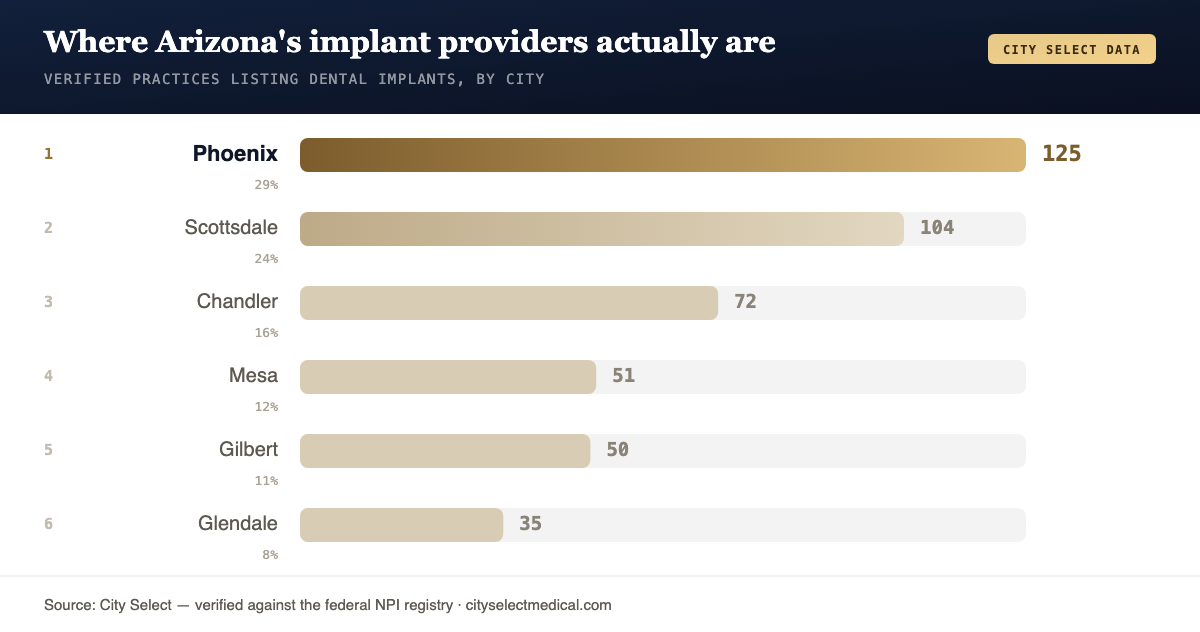
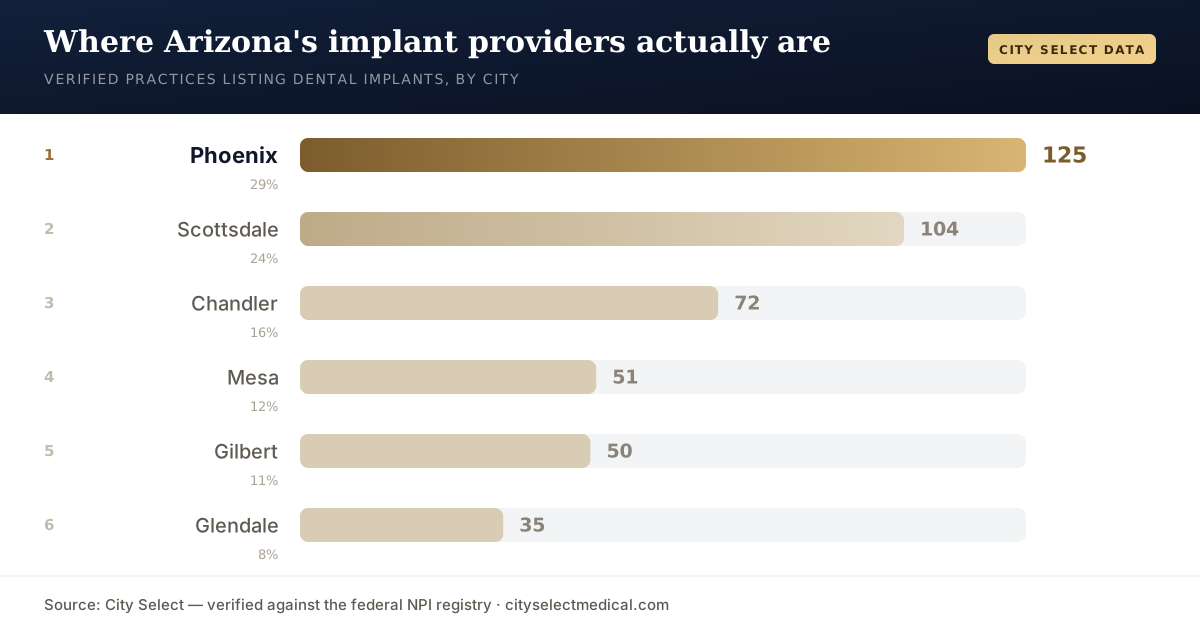
Arizona-specific: Phoenix and Scottsdale together hold most of the state's implant supply. That cuts both ways — more providers competing on price, but Scottsdale in particular skews premium and cosmetic. If you're in the East Valley, price the same case in Scottsdale and in Mesa or Gilbert before you decide. The drive is twenty minutes; the spread can be four figures.
03 · FROM THE WEBQuestions people are actually asking
Why is one implant quote $1,800 and another $4,500?
Almost always because they're quoting different things — one is post-only, the other is post, abutment, and crown. Get both itemized with CDT codes and the gap usually collapses to a few hundred dollars.
What's the cheapest way to get a dental implant?
Dental school clinics, by a wide margin — but they price below market to attract teaching cases, so treat that as the cheapest door rather than the going rate. After that: ask for the self-pay price, compare three itemized quotes, and sequence billing across two plan years.
Will insurance cover any of my implant?
Usually part of the crown, sometimes the abutment, rarely the post. With a $1,500–$2,000 annual cap, expect $1,000–$2,000 of real help on a $4,500 implant — and check your plan's missing-tooth clause first.
Should I just get a bridge instead?
Sometimes, and it's cheaper up front. But a bridge grinds down the healthy teeth on either side and typically needs replacing every 10–15 years. Ask your provider to price both over a 15-year horizon before you decide on the year-one number.
557 Arizona practices in our directory list dental implants among their services. Filter by your city and the insurance they publish, then get itemized quotes from three of them.
04 · THE VISITWhat to expect
An implant isn't an appointment — it's a sequence, usually spread across three to six months. Most of that time is spent waiting for bone to fuse to the post, not sitting in a chair.
| Stage | Typical timing | What actually happens |
|---|---|---|
| Consultation + 3D imaging | Week 0 | The scan decides everything — whether you need a graft, and who should place it |
| Extraction, if needed | Week 0–2 | Healing follows; the socket has to close before anything else |
| Bone graft, if needed | +3–6 months | The single biggest timeline variable. Many people skip this entirely |
| Implant placement | 1 appointment | Usually local anesthetic. Shorter than people brace for |
| Osseointegration (the wait) | 3–6 months | Bone fuses to the post. Nothing to do but wait |
| Abutment + final crown | 2–3 visits | The tooth you can actually see |
That timeline is the part nobody mentions up front, and it matters twice over: it's why the billing can be split across two plan years, and it's why "how long until I actually have a tooth?" is a fair question to ask at the consultation. Patients commonly describe the surgery day as far less dramatic than expected — and the months of waiting as the tedious part.
If a graft is on your plan, add three to six months before you even get to the placement. Ask at the consultation whether you need one — the 3D scan already knows.
And ask the question nobody wants to ask: what happens if it fails?
Most implants don't fail. But a small percentage do, and the risk isn't random. Smoking, uncontrolled diabetes, untreated gum disease, and poor hygiene all raise it — which is exactly why a good provider will want those addressed before placing anything. A surgeon who waves off your smoking or your A1C is not doing you a favor.
"If it fails, they'll just fix it." Not necessarily — and not for free. A failed implant is not covered by your insurance a second time, because you've already drawn down the annual maximum on the first one. The practice's own failure policy is the real warranty, and it varies enormously: some offices replace a failed implant at no charge inside a defined window, some charge for the hardware but not the labor, and some charge full freight.
Get the failure policy in writing, at the consultation, before you sign anything. Two questions: "If this implant fails, what do I pay — and for how long does that apply?" An office with a clear written answer has thought about it. An office that improvises one has not.
The failure policy is the warranty. Ask for it in writing — before the drill, not after.
05 · CHOOSINGHow to choose — and verify — an implant provider
General dentists, periodontists, oral surgeons, and prosthodontists all legitimately place implants — often in combination, with one clinician placing the post and another restoring the crown. Which arrangement fits depends on your bone quality, your gum health, and where the tooth sits. A straightforward single tooth in healthy bone is routine work for many general dentists; grafting, sinus lifts, and complex anatomy are usually a job for an oral surgeon or periodontist. The full breakdown: dentist vs. periodontist vs. prosthodontist vs. oral surgeon.
Verify the license yourself
Every practicing dentist and specialist holds an Arizona license — check it at the Arizona State Board of Dental Examiners. Every City Select listing is separately checked against the federal NPI registry.
Ask how many they place a year
Implants are a volume skill. "How many cases like mine did you do last year?" is a fair, normal question, and a good provider answers it without flinching.
Get the failure policy in writing
A small percentage of implants fail. Ask what happens if yours does — who pays for the replacement, and over what window. On paper, before you sign.
Confirm who does which part
If the post and the crown are placed by different clinicians, ask who is accountable for the final result — and whether both fees are inside the quote you're holding.
The bottom line
Expect $3,000–$6,000 all-in for a single implant in Arizona. Treat any dramatically lower quote as a partial quote until it's itemized in writing, and assume insurance contributes $1,000–$2,000 at best — more if you sequence it across two plan years. AHCCCS won't contribute at all.
Three moves do most of the work: get itemized, CDT-coded written quotes from two or three providers; ask "post, abutment, AND crown?" verbatim at every one; and price the add-ons before the drill comes out. Then choose on experience and follow-up care — not on the lowest number.
Frequently asked questions
How much does a dental implant cost in Arizona without insurance?
Plan on $3,000–$6,000 all-in for a single tooth, self-pay. Delta Dental of Arizona publishes a Phoenix-metro median of $2,278 for the implant placement alone — the abutment and crown are billed on top of that. Ask for the self-pay price explicitly; it's often lower than the insurance rate, and it's rarely volunteered.
Does AHCCCS cover dental implants?
AHCCCS generally does not cover routine adult dental implants. Its adult dental benefit is primarily limited to qualifying emergency services, generally capped at $1,000 per contract year. An extraction may qualify in an acute situation; routine implant placement is not among the covered adult emergency services.
Does Medicare cover dental implants?
Original Medicare generally does not cover routine dental care, including implants — though limited dental services may be covered when closely connected to certain covered medical treatment. Some Medicare Advantage plans offer dental benefits, but implant coverage and exclusions vary by plan. Check the plan's Evidence of Coverage.
Why do implant quotes vary so much between offices?
Usually because they're quoting different things. One office quotes the post; another quotes post plus abutment plus crown. Add different implant brands, different crown materials, different specialists, and genuinely different overhead. That's why itemized written quotes are non-negotiable.
Are dental implants worth it compared to a bridge or denture?
Implants cost more up front but don't grind down neighboring teeth the way a bridge does, and they don't need the periodic replacement dentures do. Over 15–20 years the total cost often converges, while function and bone preservation favor the implant. It's case-specific — ask providers to price the 10-year picture, not just year one.
How long do dental implants last?
The titanium post can last decades — frequently a lifetime — with good hygiene. Crowns typically need replacement every 10–15 years, at crown-only cost.
Can implants fail, and who pays if one does?
A small percentage fail — smoking, uncontrolled diabetes, and untreated gum disease raise the risk. The financial exposure is the part people miss: a failed implant is not covered a second time, because you've already drawn down your annual maximum. Practice policies vary enormously, so get the failure policy in writing at the consultation.
How much does a dental implant cost in Phoenix vs. Scottsdale?
We don't publish city-level implant prices, because no reliable source does — and inventing them would be worse than useless. What we can tell you is where the supply is: Phoenix and Scottsdale hold most of Arizona's implant providers, and Scottsdale skews premium and cosmetic. More supply means more price competition, so getting quotes across two metros is genuinely worth the drive.
How long does the whole dental implant process take?
Typically three to six months from consultation to final crown. Consultation and 3D imaging come first, then any extraction or bone graft with its own healing time, then the placement surgery, then several months while bone integrates with the post. The crown goes on last. That timeline is also why the billing can often be split across two plan years.
What is CDT code D6010?
D6010 is the billing code for surgical placement of the implant body — the titanium post only. It does not include the abutment or the crown, which carry their own codes. If a quote references D6010 and nothing else, you are looking at a post-only price. Asking for a CDT-coded treatment plan is the single easiest way to make two quotes comparable.
Can a dental implant be billed to medical insurance?
Sometimes, in part. If the tooth was lost to an accident or a disease process rather than ordinary decay, portions — imaging, bone grafting, anesthesia — occasionally route through medical insurance, where there's no $2,000 dental cap. Offices that place implants daily know how to check. It's worth asking explicitly; it's rarely offered.
Is it cheaper to get dental implants in Mexico?
Often, substantially — and that's a real decision many Arizonans make. The honest tradeoffs are follow-up and recourse: an implant is a multi-stage procedure with a months-long healing window, and complications are far harder to manage across a border. If you go that route, plan for who handles the restoration and any failure, and get the treatment plan in writing before you travel.
Do I need a bone graft for a dental implant?
Only if there isn't enough bone to hold the post — which is common after a tooth has been missing for a while, since the jaw resorbs without a root stimulating it. A 3D scan at the consultation answers this. Budget $300–$1,200 for a standard graft if you need one; sinus lifts run more.
Find a verified dentist in Arizona
Every dentist on City Select is sourced from the federal NPI registry and organized by city and specialty — no pay-to-rank, no mystery. Filter by your city and insurance:
 Insurance & Costs
Root Canal and Crown Costs in Arizona: What You'll Actually Pay
The root canal quote is only half the bill. Here's the number nobody says out loud at the first appointment — and why your plan's annual maximum quietly turns "80/50 coverage" into far less.
 Insurance & Costs
Dental Insurance in Arizona, Decoded: What "We Accept Your Plan" Really Means
Dental insurance isn't health insurance — it's closer to a prepaid discount card with a spending cap. Once you see the structure, every confusing EOB starts making sense.
 Choosing Care
Dental Specialists Explained: Who Do You Actually Need?
Dentistry has a specialist system just like medicine — and knowing who does what saves you referral loops, repeat exams, and occasionally the wrong surgery.
Written by the City Select editorial team and edited by Alan S., Senior Editor. Drafted with AI assistance and checked against the official sources below. City Select is not a healthcare provider, and this guide is not medical advice. Our editorial & data standards →
- Delta Dental of Arizona — usual & customary fees (median dentist fees, ZIP prefix 850)
- FAIR Health Consumer — dental cost lookup by ZIP and CDT code
- AHCCCS Medical Policy Manual 310-D1 — adult dental benefit
- AHCCCS — Dental fee-for-service fee schedule (CDT codes)
- American Academy of Periodontology — dental implant procedures
- American Association of Oral and Maxillofacial Surgeons — dental implant surgery
- Arizona State Board of Dental Examiners — license verification
- How we verify
This guide is for general information and isn't medical, legal, or insurance advice. Coverage, prices, and policies change — verify current details with the relevant provider, plan, or agency, and confirm with the practice before booking. Last updated July 11, 2026.