
How to Choose an OB-GYN: The Checklist for Every Stage
The most useful thing anyone said about choosing an OB-GYN comes from a pregnancy forum, not a medical journal: "Shopping for your OB is like dating — the concerns you have up front only magnify over time." That's the whole framework. A doctor who rushes you at the first visit will rush you at the delivery; a practice that shrugs off your first question will shrug off your fifth.
Whether you're booking a first gynecologic exam, planning a pregnancy, or navigating menopause, the vetting is the same set of checks — you just weight them differently. Here's the method, the five-minute phone script that resolves most of it, and the signs it's time to switch.
- Verify board certification (ABOG, an ABMS board), the Arizona licence, and — with both the office and your insurer — in-network status.
- For pregnancy, you're really choosing a hospital. The delivery happens where your OB has privileges, so check the hospital's network status and maternity/NICU level first.
- Ask who covers at 2 a.m. In group practices — the norm — someone other than your doctor may deliver you.
- Comfort and communication are qualification criteria, not luxuries. A provider you avoid calling can't help you.
- Read reviews for the pattern, not the outliers — and don't stay anywhere out of guilt.
01 · THE CHECKLISTEight checks, in order
1. Board certification and licence
Confirm ABOG board certification (free at abog.org — it's the ABMS member board for OB-GYN, and diplomates maintain it over time). Then check the Arizona licence and any disciplinary history: MDs at azmd.gov, DOs at azdo.gov. City Select listings are pre-checked against the federal NPI registry, so a verified directory clears part of this step.
2. In-network status — both sides
Ask the office and check your insurer's directory; they disagree more often than you'd think. OB care is a long billing relationship — pregnancy alone is usually a single "global" package — so a network mistake is expensive. (What's free as preventive care.)
3. New-patient availability, honestly
Wait times run long in high-demand areas. Ask for the next new-patient slot; if you're pregnant, say so — prenatal intake is triaged differently.
4. The hospital — because that's what you're really choosing
For obstetric care, delivery happens where your OB holds privileges. Is that hospital in your network? Does its maternity unit fit your needs (NICU level, VBAC support)? A doctor you love at the wrong hospital is still the wrong pick.
5. Who covers when they're off — and who actually delivers
The question hardly anyone asks: "If you're unavailable when I go into labor, who delivers my baby?" In group practices, any of several might — so ask whether you'll rotate through all providers prenatally, so none is a stranger at delivery.
6. Philosophy of care, on YOUR issues
Birth: their approach to induction, VBAC, C-section rates. Contraception: full-spectrum or a narrow menu. Menopause: engaged or dismissive. Ask direct questions; listen for reasoning, not slogans.
7. The logistics you'll actually live with
Location (prenatal care is 10–15 visits), hours, telehealth for routine follow-ups, and how after-hours questions are handled (nurse line, portal, or voicemail?).
8. Communication, judged as a medical qualification
Do they explain without condescension? Do they ask what you want? Are your questions welcomed or managed? In a specialty this personal, this isn't a soft factor — it's the product.
"A big name, a fancy office, or a wall of certificates means better care." Not reliably — and optimizing for prestige can cost you the things that actually matter here. The credentials that are worth verifying are specific and free to check: ABOG board certification and a clean state licence. Past that, the differentiators are practical and personal — the hospital, the call coverage, and whether the provider listens — not the marble in the lobby or the reputation on a billboard. A famous practice where you rotate through eight strangers and feel rushed is not a better choice than a modest one where you're known and heard.
For pregnancy, try running the search backwards — from the hospital, not the doctor. As one veteran of the process put it: "Look up the hospitals in your area, specifically the maternity and NICU departments, pick the one you want to deliver at, then find OB offices allowed to deliver there." Because the hospital is the thing you can't easily change late in pregnancy, choosing it first — for network fit and NICU level — and then filtering for providers with privileges there is often the cleaner path than falling for a doctor and discovering their hospital is out of network.
For pregnancy, you're not choosing a doctor. You're choosing a doctor, their call group, and a hospital — as one package. Vet the package.
Arizona verification, in the right places: OB-GYNs who are MDs are licensed by the Arizona Medical Board; DOs by the Board of Osteopathic Examiners; and if you're seeing a certified nurse-midwife, she's licensed by the Arizona State Board of Nursing — three different boards, and searching only one is how people wrongly conclude a perfectly licensed provider "isn't listed." Board certification (ABOG) is separate from state licensure, and you want to confirm both: the licence says they may practice in Arizona; ABOG says they met and maintain the national specialty standard.
02 · THE SCRIPTThe five-minute first call
Six questions for the front desk, and most of the checklist resolves before you ever book:
The front desk is the first date. If they're vague about who delivers your baby now, imagine that phone call at 3 a.m.
"Are you in-network with [my plan]?"
The single most expensive thing to get wrong.
"When's your next new-patient appointment?"
Add "I'm pregnant — when would my first prenatal visit be?" if it applies.
"Which hospital does Dr. [name] deliver at?"
Then confirm that hospital is in your network.
"If Dr. [name] is unavailable during my labor, who covers?"
The 2 a.m. question. How they answer matters as much as the answer.
"Do you offer telehealth for routine follow-ups?"
Ten-to-fifteen visits go easier when some can be virtual.
"How do I reach a nurse after hours?"
A real line, a portal, or a voicemail into the void tells you a lot.
The front desk is a preview of the practice, so listen to how they answer, not just what they say. A receptionist who's warm, patient, and gives you clear answers is telling you something about the whole operation; one who's curt, rushed, or vague about who covers deliveries is telling you something too. You'll interact with this front office dozens of times — for a pregnancy, at some of the most stressful moments of your life — so the phone call isn't just data-gathering. It's the first date.
03 · FROM THE WEBWhat actually helped people choose
"How do I pick an OB most likely to take me seriously?"
The stories cut against easy assumptions — one person's two female OBs in a city were *"dismissive and rude,"* while the provider she ended up trusting most was the male OB in a rural town she'd been nervous about. **The lesson: judge the individual and the fit, not the demographic — and screen hardest against dismissiveness, which is the complaint that recurs across every women's-health forum.**
"How did you actually choose?"
A frequently repeated practical method: **start from the hospital.** *"Look up hospitals in your area — the maternity and NICU departments — pick the one you want to deliver at, then find OBs allowed to deliver there."* It's the reverse of how most people search, and it prevents the classic late-pregnancy scramble when the doctor's hospital turns out to be wrong.
"I want to switch but I feel guilty."
The community is unanimous and worth hearing: *"Shopping for your OB is like dating — the concerns you have up front will only magnify as time goes on."* And if a practice **pushes back when you raise a concern or ask to switch,** that's itself the red flag confirming you should. **Guilt is not a reason to stay.**
"How much should I trust the online reviews?"
Read the pattern. As the clinicians quoted in the guides note, *unhappy patients write reviews more than happy ones,* so one or two bad ones among many are noise — but **a consistent theme across dozens** (rushing, dismissiveness, billing surprises, high staff turnover) is a real signal. Look for reviewers describing a visit you'd actually want to have.
Ask your primary-care doctor for a name before you start cold-searching. The most common way people find an OB-GYN they're happy with is a referral from a clinician who already knows the local landscape — who's thorough, who listens, who has privileges at which hospital. It's a shortcut past a lot of the checklist, because a good PCP has effectively pre-screened for the soft factors reviews can't capture. Then run the network and hospital checks yourself, since even a great referral has to fit your plan.
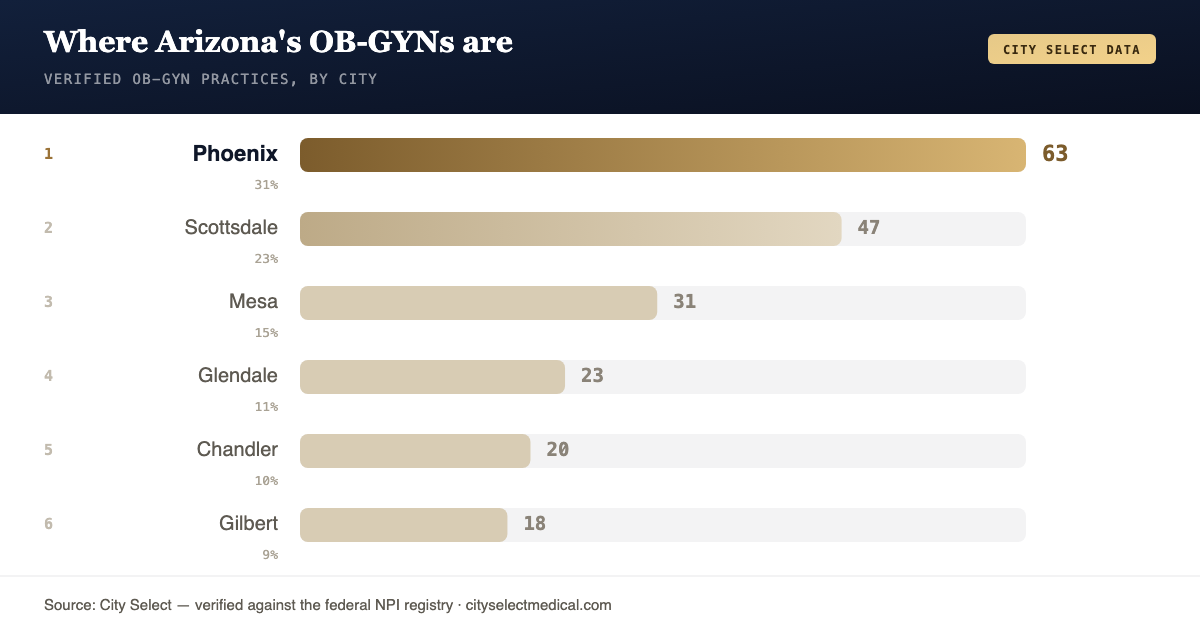
136 NPI-verified OB-GYN practices across Arizona — and because **group practices are the norm** in obstetric care, built-in call coverage (check #5) is the rule, not the exception. Filter by city and insurance before you start calling.
04 · BY LIFE STAGESame eight checks, different weights
Which checks dominate depends on why you're looking:
You almost never need all eight checks at full weight — you need the two or three that match your situation. A twenty-something booking a first Pap should optimize for a provider she's comfortable with and can actually get in to see; a thirty-something planning a pregnancy should optimize for the hospital and the call group; a woman in perimenopause should optimize for a provider who engages with the evidence. Spending your energy on the checks that matter for your stage — rather than treating all eight as equally urgent — is what turns a daunting list into a fifteen-minute decision.
First gynecologic visit / routine care
Weight #8 (communication) and #3 (availability) heaviest — the exam-room experience is nearly the whole product. What that visit involves: well-woman exam, what to expect.
Pregnancy — current or planned
#4 (hospital) and #5 (call coverage) move to the top, alongside network confirmation for the global package. Weighing an OB vs. a midwife vs. family medicine? That comparison.
Perimenopause / menopause
#6 (philosophy) dominates — ask directly, "How do you approach hormone therapy conversations?" A provider who engages with the evidence beats one who waves the topic off. Menopause care, done right.
Gynecologic problems (fibroids, endometriosis, abnormal bleeding)
Add a ninth check — surgical volume. If treatment might mean surgery, ask how many of that procedure they did last year and check for the relevant ABOG subspecialty (e.g., a urogynecologist for pelvic-floor issues, an MFM for high-risk pregnancy).
"Switching doctors mid-pregnancy is too dramatic / too late / a betrayal." None of those are true, and the belief keeps people in bad care. Practices onboard transfers routinely, your records move on request, and no explanation is owed — people switch even at 38 weeks for good reason. The red flags that justify it are concrete: a pattern of poor reviews, high provider or staff turnover, poorly run facilities, and pushback when you raise a concern. If your gut says the fit is wrong, that instinct is data. The right time to switch is when you know — not when it's convenient.
Book a brief meet-and-greet before you commit, if the practice offers one — many do. Fifteen minutes in the room tells you what no review or checklist can: whether you feel heard. Go in with two or three real questions (your birth preferences, how they handle after-hours calls, their approach to whatever matters most to you) and notice whether you leave feeling like a partner or a number. This is the "dating" the forums keep describing — and early is exactly when it costs nothing to keep looking.
05 · CHOOSINGPutting it together
How we source this
This is the practical hub the rest of our women's-health guides point into, so we kept it concrete and added the one thing it was missing.
- Board certification is now an explicit check. ABOG is the ABMS member board for obstetrics and gynecology, verifiable free at abog.org — and it's the kind of thing a "how to choose" guide shouldn't leave out. We route licence checks to the correct Arizona board (MDs vs DOs).
- The reverse-search method — hospital first — comes from people who've done it, and it's genuinely better advice than "find a doctor you like," because the hospital is the piece you can't easily change late in pregnancy.
- The review-reading guidance is honest about the bias: unhappy patients over-write reviews, so we tell you to read the pattern, not react to the loudest single story.
- We treat communication and comfort as qualifications, not extras, because the entire women's-health cluster's harvest points to the same thing: dismissiveness is the number-one complaint, and the fix is choosing — and switching — for fit without guilt.
The bottom line
Choosing an OB-GYN is really three choices in one: a provider whose communication you trust, a call group that will actually be there at the moment that matters, and a hospital that fits your insurance and your plans.
Verify the board certification and the network, run the six-question phone call, and weight the checklist by your life stage — hospital and coverage for pregnancy, philosophy for menopause, communication always. Read reviews for the pattern, and remember it's like dating: the concerns you notice early only grow.
Start from a verified list so the credential work is already done: Arizona OB-GYN practices, filterable by city and insurance.
Frequently asked questions
Do I need an OB-GYN, or can my regular doctor handle it?
Family-medicine providers capably handle routine gynecologic care — well-woman exams, Paps, contraception. See an OB-GYN for pregnancy (or plans for one), complex gynecologic conditions, or by preference, and many women use both. For a pregnancy specifically, there's a third option — a certified nurse-midwife — and the trade-offs are worth understanding before you choose.
What should I actually verify before booking?
Three things clear most of the risk. First, board certification: an OB-GYN board-certified by ABOG (the American Board of Obstetrics and Gynecology, an ABMS member board) has met and maintains a rigorous national standard — verify it free at abog.org. Second, licence status and any disciplinary history at the Arizona Medical Board (MDs) or Board of Osteopathic Examiners (DOs). Third, in-network status, confirmed with both the office and your insurer, because they disagree more often than you'd expect.
When should I switch from my current OB-GYN?
When communication has failed, when your life stage has outgrown their strengths, when logistics make you skip appointments, or when you notice a pattern of red flags — high provider or staff turnover, or a practice that pushes back when you raise a concern. Switching is routine: request your records (you're entitled to them) and the new practice handles the transfer. Mid-pregnancy switches are allowed and far more common than people assume, so don't stay out of guilt.
Male or female OB-GYN — does it matter?
Only your comfort matters, and it's a completely legitimate selection criterion in this specialty — filter for it without guilt. What you're willing to disclose in that room directly affects your care, so choosing a provider you'll be honest with isn't a preference, it's part of getting good medicine.
How do I read the online reviews without being misled?
Read for the pattern, not the outliers. Unhappy patients write reviews far more often than satisfied ones, so one or two negative reviews among many good ones is usually noise — but dozens of similar complaints (dismissiveness, long waits, billing surprises, rushed visits) is a real signal. Look specifically for reviewers describing a visit you'd actually want to have, and weigh recurring themes over any single dramatic story.
How far in advance should I book?
For routine annual visits, 4–8 weeks out is common for established patients and longer for new ones. For pregnancy, call as soon as you have a positive test — first prenatal visits schedule at 8–10 weeks, and popular practices fill, so getting on the schedule is the time-sensitive part even though the visit itself is weeks away.
Find a verified ob-gyn in Arizona
Every ob-gyn on City Select is sourced from the federal NPI registry and organized by city and specialty — no pay-to-rank, no mystery. Filter by your city and insurance:
 Choosing Care
The Well-Woman Exam: What Actually Happens, and How to Make It Yours
One visit a year, and most of the worry is about the part that takes two minutes. Here's what actually happens — and the accommodations you're entitled to ask for.
 Choosing Care
OB-GYN vs. Midwife vs. Family Doctor: How to Actually Choose
It's usually sold as a philosophy decision. It's a risk-level decision first, a philosophy decision second — and for a lot of women, the honest answer is 'both.'
 Conditions
Menopause Care: What Good Care Looks Like — and How to Find a Provider Who Listens
Half the population goes through it, and it's still routinely dismissed. Here's what good menopause care looks like — so you can recognize it, and insist on it.
Written by the City Select editorial team and edited by Alan S., Senior Editor. Drafted with AI assistance and checked against the official sources below. City Select is not a healthcare provider, and this guide is not medical advice. Our editorial & data standards →
This guide is for general information and isn't medical, legal, or insurance advice. Coverage, prices, and policies change — verify current details with the relevant provider, plan, or agency, and confirm with the practice before booking. Last updated July 14, 2026.