
OB-GYN vs. Midwife vs. Family Doctor: How to Actually Choose
The OB-GYN-vs-midwife question is almost always framed as a philosophy choice — high-tech versus holistic, medical versus natural. That framing is backwards. It's a risk-level choice first, and a philosophy choice second — and for a lot of women, once the risk question is settled, the honest answer turns out to be "both."
This guide sorts the three provider types precisely (including a distinction specific to Arizona that most articles miss), lets risk make the first cut, lays out what the actual evidence says for low-risk pregnancies, and covers the collaborative model that's quietly become the sweet spot.
- OB-GYN — a physician (medical school + 4-year residency) who manages any pregnancy, including high-risk, and performs C-sections.
- Certified nurse-midwife (CNM) — an advanced-practice nurse (graduate degree + national certification) who manages low-risk pregnancies; most U.S. CNM births are in hospitals.
- Family physician with obstetrics — handles routine pregnancies and the whole family's care; a shrinking, mostly rural group.
- ⭐ Risk decides first. High-risk → OB. Low-risk → all three doors open, and the evidence for midwife-led care is genuinely good.
- ⭐ In Arizona, "midwife" means two different licenses — a CNM (Board of Nursing, hospital-capable) or a Licensed Midwife (Dept of Health Services, home birth). Ask which.
01 · THE THREE PROVIDERSPrecisely — including Arizona's twist
OB-GYN
Physician, 4-yr OB-GYN residency. Manages any risk level, does surgery. The default for high-risk, and a completely reasonable choice for low-risk too.
Certified nurse-midwife (CNM)
Advanced-practice nurse, graduate degree + national cert. Low-risk pregnancies, mostly in hospitals, with OB backup. The provider behind most U.S. midwife births.
Family physician (with OB)
Physician who also does routine obstetrics — and then cares for the whole family. A shrinking, mostly rural option; ask whether they still attend births.
Licensed Midwife (LM), in Arizona
Direct-entry midwife licensed by the state Health department for out-of-hospital / home birth — a different credential from the CNM (see below).
OB-GYN — a physician with four years of medical school plus a four-year obstetrics-and-gynecology residency (some add fellowship training, such as maternal-fetal medicine for high-risk care). Full surgical scope: C-sections, operative deliveries, and management of hemorrhage and complex complications.
Certified nurse-midwife (CNM) — a registered nurse with a graduate degree in nurse-midwifery, nationally certified. Provides full prenatal, birth, postpartum, and routine gynecologic care for low-risk patients, with prescriptive authority. Most CNM-attended births in the U.S. happen in hospitals.
Family physician (with obstetrics) — a physician whose residency included obstetric training. Manages routine pregnancies, then keeps seeing you, your baby, and the rest of the household afterward. The catch: a shrinking share of family doctors still attend births, and those who do are concentrated in community and rural settings.
The Arizona distinction most guides get wrong: "midwife" here is two different licenses, under two different state agencies.
Certified Nurse-Midwife (CNM) — an advanced-practice nurse licensed by the Arizona State Board of Nursing (azbn.gov). Requires a graduate nurse-midwifery degree and national (AMCB) certification, carries prescriptive authority, and is the credential behind most hospital midwife births.
Licensed Midwife (LM) — a "direct-entry" midwife licensed by the Arizona Department of Health Services (azdhs.gov), through a different training route (the NARM/CPM pathway). Scope is out-of-hospital care — primarily home birth — for normal pregnancies, plus prenatal, postpartum, and newborn care.
These are different providers with different scopes and settings. When you're choosing a midwife in Arizona, the first two questions are: "Which credential do you hold — CNM or LM?" and "Which board licenses you?" Neither is "better"; they're for different situations. But conflating them is how people end up with a setting or scope they didn't intend. When this article says CNM, it means the nurse-midwife.
In Arizona, "midwife" is two different licenses under two different agencies. The word alone doesn't tell you which one you're hiring.
02 · RISK FIRSTLet risk make the first cut, before philosophy gets a vote
If your pregnancy is — or becomes — high-risk, the OB-GYN question answers itself. Factors that commonly move a pregnancy out of low-risk territory: chronic hypertension or diabetes, twins or more, a prior C-section (VBAC candidacy needs case-by-case OB input), placenta previa, a history of preeclampsia, some age-and-health risk profiles, and conditions that emerge mid-pregnancy.
If you're low-risk — most pregnancies are — all three doors are open, and the real differentiators become visit style, birth-setting preference, and how you want labor supported.
Book a "meet the provider" or first visit with more than one type before you commit — it's allowed, and it's the fastest way to feel the difference. A 15-minute OB visit and a 45-minute midwife visit are genuinely different experiences, and reading about them is nothing like sitting in the room. Many practices offer a brief meet-and-greet; some first visits are even virtual. You're interviewing them as much as they're assessing you, and early pregnancy is exactly when switching is easiest.
"I picked my provider, so my risk category is settled." Risk isn't only where you start — it's what can develop, and that's the part people underweight. One mother who chose an OB team described a low-risk pregnancy that turned high-risk after a fall at 27 weeks required an induction and a difficult delivery — and she was, in her words, "VERY grateful to have an OB." The lesson isn't "everyone needs an OB." It's that whoever you choose, the backup plan for a category change matters — which is exactly why a midwife with clear OB collaboration, or a hospital setting, is reassuring even for a textbook-low-risk pregnancy.
Ask the risk question out loud at the first visit, and ask it again if anything changes: "Given my history, am I low-risk — and what specifically would move me into a higher-risk category and change who manages my care?" A good provider of any type will answer this clearly and without defensiveness. The answer tells you both where you stand and how honestly this practice will handle it if your situation shifts.
03 · THE EVIDENCEWhat the research actually shows for low-risk care
For low-risk pregnancies, midwife-led care has real evidence behind it — and it's worth stating precisely rather than as a vibe. The Cochrane review of midwife-led continuity models (the highest tier of evidence synthesis) found that, compared with doctor-led or shared care, women in midwife-led continuity care experienced:
- Fewer interventions — fewer epidurals, fewer episiotomies, fewer instrumental (forceps/vacuum) births, and fewer caesarean sections;
- More spontaneous vaginal births, and a higher chance of being cared for in labor by a midwife they'd come to know;
- Higher satisfaction with their care;
- At least comparable outcomes for mothers and babies, with no identified adverse effects.
| OB-GYN | Certified nurse-midwife (CNM) | Family doctor (with OB) | |
|---|---|---|---|
| Training | MD/DO + 4-yr OB-GYN residency | RN + graduate midwifery degree + national cert | MD/DO + family-med residency (+ OB training) |
| Risk level managed | Any, including high-risk | Low-risk | Low-to-moderate; refers out |
| Performs C-sections | Yes | No (partners with OB) | Usually no (varies) |
| Birth settings | Hospital | Mostly hospital; also birth centers/home (LM for home) | Hospital |
| Epidural available | Yes | Yes in hospitals (anesthesiologist gives it) | Yes |
| Typical visit style | Shorter, medically focused | Longer, education- and support-heavy | Continuity across the family |
| Routine gyn care too | Yes | Yes | Yes |
The evidence rewards continuity, not just the credential — and that's the actionable part. Much of what the Cochrane review measured is the effect of being cared for through pregnancy and labor by a provider (or small team) you actually know. So when you're comparing practices, ask specifically: "Will I see the same one or two people throughout, and will one of them likely be at my birth?" A midwife practice with high turnover and an OB practice with a tight, familiar team can deliver more similar experiences than the labels suggest. Continuity is the ingredient; pick for it directly.
Two honest boundaries on that evidence, because precision is the point. First, it's about low-risk women in continuity models — largely hospital and integrated settings — not a blanket statement that any birth in any setting carries the same risk. Second, none of it diminishes what OBs are for: the complications, the surgical capability, the high-risk expertise that a midwife-led model explicitly hands off. The finding isn't "midwives beat doctors." It's "for low-risk pregnancies, midwife-led care is a safe, satisfying, lower-intervention option" — which is a different and more useful claim.
"Midwife means no epidural." False in the setting where most midwife births actually happen. CNMs don't administer epidurals — anesthesiologists do — so in a hospital birth with a CNM, an epidural is exactly as available as with an OB. What's true is that epidurals aren't available at freestanding birth centers or home births (that's the setting, not the credential), and midwife-led care tends to offer non-pharmacologic comfort measures first for patients who want that. The question to ask isn't "does my provider allow epidurals" — it's "where I'm delivering, who provides anesthesia, and how fast?"
04 · FROM THE WEBHow people actually decided
"How did you decide between a midwife and an OB?"
The most common pro-midwife theme, for low-risk pregnancies: *"midwives tend to have fewer interventions for equally good outcomes,"* and *"the midwives care more about how I'm doing as a whole person."* Longer appointments and a continuity relationship come up again and again — and match what the evidence shows.
"Thoughts on midwife vs OB?"
The thoughtful pro-OB view, also for a low-risk pregnancy: *"I appreciated that OBs have significantly more training and are well-equipped to handle complications if they arise."* And a telling compromise: *"If I go the midwife route next time, I'd choose one that was under an OB or OB office."* Both instincts are reasonable; they weight the same trade-off differently.
"How did you choose — midwife, OB, hospital, home, birth center?"
The answer that captures the modern sweet spot: *"a hospital with a midwife practice… very collaborative, very hands-on, but very much in my hands… they have an OB on staff for high-risk and deliver at a hospital."* This is the both/and model, and it's increasingly the default rather than the exception.
"What if I go into it low-risk and something changes?"
The community's blunt, correct summary: *"if you're high-risk, they'll refer you to an OB anyway."* Midwife-led care is *designed* to escalate — which is why the transfer and collaboration questions matter more than the philosophy label.
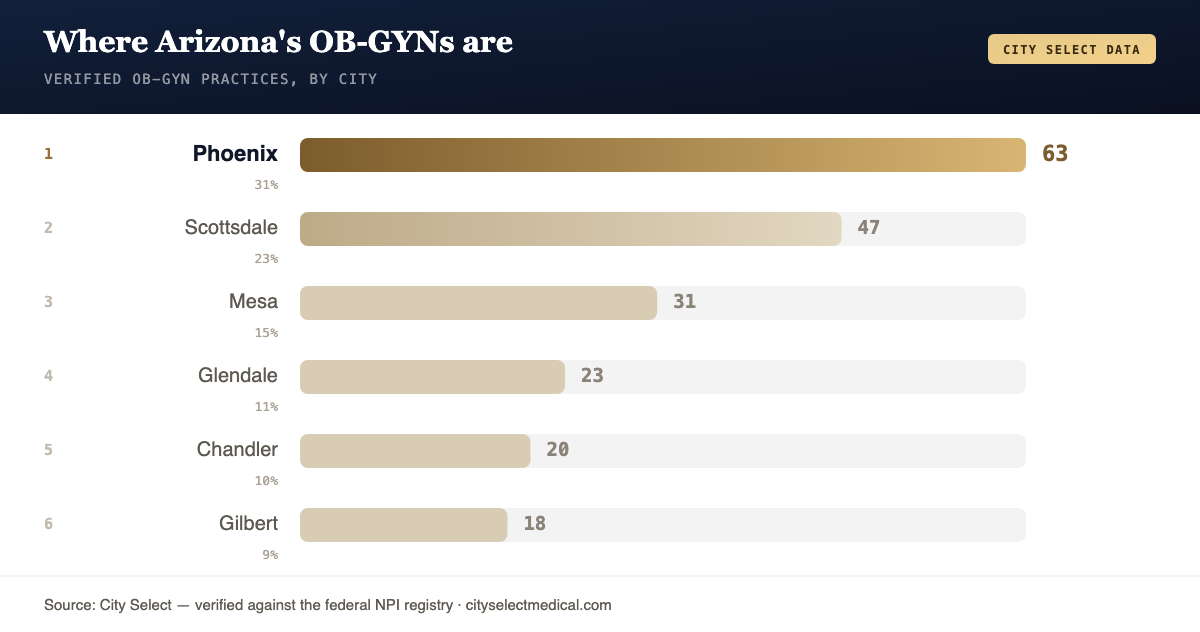
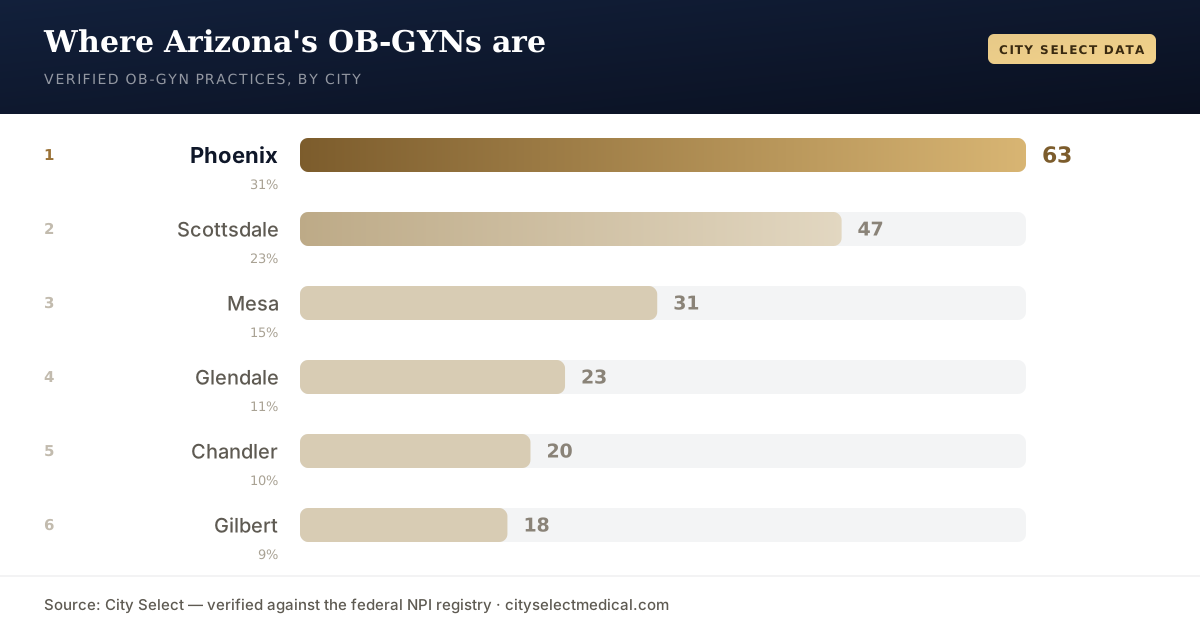
136 NPI-verified OB-GYN practices across Arizona — many are multi-provider groups that include **CNMs on staff**, which is exactly the collaborative model most low-risk families end up wanting. Filter by city and insurance before you call.
05 · THE BOTH/ANDThe collaborative model, the cost caveat, and choosing
CNM-plus-OB collaborative practices are increasingly the norm, not the exception — midwives handle prenatal care and normal birth; OBs are on-site for the surgical or high-risk moments. Many Arizona hospital groups run exactly this model, and for a lot of families it's the honest resolution: midwifery visit style, with surgical capability down the hall.
If you want the both/and model, search for it directly — "hospital-based midwife practice" or "midwifery group with OB collaboration," not just "midwife." That phrasing filters for the exact setup most low-risk families end up wanting: the longer, relationship-driven visits and lower intervention rates of midwife-led care, with an OB and an operating room in the same building. Ask a prospective practice point-blank: "Is this a collaborative practice, and where do you deliver?" If the answer is a hospital with OBs on staff, you've found the sweet spot the evidence and the forums both point to.
"If I need a C-section, who does it and how fast can it start?"
The single most important question for any birth plan — the answer reveals how real the OB backup is.
"What share of your patients transfer to OB care, and why?"
A specific number signals a practice that tracks and is honest about it.
"Will the midwife stay with me through labor, or check in periodically?"
Continuity in labor is much of what the evidence is measuring.
"For an out-of-hospital birth: what's your transfer rate, criteria, and receiving hospital?"
Non-negotiable for a birth center or home birth — and note the LM-vs-CNM credential here.
You can switch providers at any point in pregnancy — it's common, routine, and no explanation is owed. Practices onboard transfers all the time and records move on request. It's trivially easy before about 28 weeks, routine before 36, and still possible later (call and ask rather than assuming). If your risk level changed, the transfer often starts from the provider's side; if your comfort changed, initiating it yourself is a legitimate act of judgment, not disloyalty. Don't stay somewhere that isn't working because you think it's too late — it usually isn't.
You're not choosing a credential. You're choosing a team and a building — so ask who's in the building at 3 a.m.
How we source this
We rebuilt this article to put real evidence under the safety question and to fix a distinction that's specific to Arizona.
- The safety and intervention claims come from the Cochrane review of midwife-led continuity models — not from any provider's or hospital's marketing page — and we scoped them carefully: low-risk women, continuity models, largely integrated settings, with comparable outcomes and no identified adverse effects. We did not stretch that into a claim about any birth in any setting.
- The Arizona two-license distinction is verified against the state boards: CNMs through the Board of Nursing, Licensed Midwives through the Department of Health Services. Most national articles blur "midwife" into one thing; in Arizona it isn't one thing, and the difference changes the setting and scope.
- We kept this evenhanded on purpose. This is a decision with genuine values in it, so we let risk make the first cut, presented the real trade-offs on both sides — including a low-risk pregnancy that turned high-risk — and did not advocate a birth philosophy. The reader decides; we make the decision legible.
- Cost is framed as ballparks with the caveat that insurance, network status, and facility fees decide the real number.
The bottom line
Let risk make the first cut: high-risk means an OB-GYN, full stop. Low-risk opens all three doors — and for low-risk pregnancies, midwife-led care has genuine evidence behind it: fewer interventions, higher satisfaction, comparable safety, with the OB backup built in for the moments that change category.
Don't buy the epidural myth, take collaborative CNM-plus-OB practices seriously as the both/and answer, and in Arizona ask which midwife credential you're actually getting — the Board of Nursing CNM and the Health-Services Licensed Midwife are different providers.
Then vet whoever you choose with the choosing checklist and confirm network status for the provider and the facility, starting from a verified list: Arizona OB-GYN practices.
Frequently asked questions
Is a midwife as safe as an OB-GYN?
For low-risk pregnancies, the evidence is reassuring. The Cochrane review of midwife-led continuity models found fewer interventions (fewer epidurals, episiotomies, and caesareans), higher satisfaction, and at least comparable outcomes for mothers and babies, with no identified adverse effects, versus doctor-led or shared care. The important caveats: this evidence is about low-risk women in continuity models (largely hospital and integrated settings), and the safety question is really about risk-match and the backup plan, not the credential itself. High-risk pregnancies belong with an OB-GYN.
In Arizona, is 'midwife' one thing?
No — and this is a distinction most articles skip. Arizona licenses two different kinds of midwife under two different agencies. A Certified Nurse-Midwife (CNM) is an advanced-practice nurse licensed by the Arizona State Board of Nursing, with a graduate degree and hospital privileges — the kind who attends most U.S. midwife births, in hospitals. A Licensed Midwife (LM, or 'direct-entry' midwife) is licensed by the Arizona Department of Health Services through a different training route and practices out-of-hospital, primarily home birth. When you're choosing a midwife here, ask which credential they hold and which board licenses them, because they are different providers with different scopes and settings.
Can a midwife deliver in a hospital, and can I still get an epidural?
Yes to both, and this is the most common misunderstanding. Most U.S. CNM-attended births happen in hospitals, with an anesthesiologist available for an epidural exactly as with an OB — because CNMs don't administer epidurals, anesthesiologists do, regardless of who your primary provider is. Epidurals aren't available at freestanding birth centers or home births, but that's about the setting, not the midwife. The real question isn't 'does my provider allow epidurals' — it's 'where I'm delivering, who provides anesthesia, and how quickly?'
What happens if a complication develops during midwife-led care?
In a hospital, the collaborating OB steps in — up to and including an immediate C-section. At a birth center or home, transfer protocols activate, which is why asking any out-of-hospital provider three questions is non-negotiable: what's your transfer rate, what are the transfer criteria, and which hospital receives you? Risk can change mid-pregnancy or mid-labor, so the quality of the backup plan matters no matter who you choose.
Do midwives only handle births?
No. CNMs provide well-woman exams, contraception, STI screening, and routine gynecologic care across the lifespan, and some women use a CNM as their primary women's-health provider for years without a pregnancy ever being involved.
Can my family doctor deliver my baby?
Only if they still practice obstetrics — ask directly, because a shrinking share of family physicians attend births, and those who do are concentrated in community and rural settings. Where they do, you get genuine continuity: the same doctor for your pregnancy, your newborn's checkups, and the rest of the family.
I'm low-risk now but 'geriatric' / older — does that force an OB?
Not automatically. Age is one factor among many that a provider weighs, and being over 35 doesn't by itself make a pregnancy high-risk. The honest approach is to start with an assessment of your actual risk profile, revisit it as the pregnancy progresses, and let it — not a single label — guide the choice. Many older low-risk pregnancies are well served by midwife-led or collaborative care.
Find a verified ob-gyn in Arizona
Every ob-gyn on City Select is sourced from the federal NPI registry and organized by city and specialty — no pay-to-rank, no mystery. Filter by your city and insurance:
 Choosing Care
How to Choose an OB-GYN: The Checklist for Every Stage
Booking a first exam, planning a pregnancy, or navigating menopause — the vetting is the same eight checks, weighted differently. Here's the whole method, plus the phone script.
 Choosing Care
Your First Prenatal Visit: The Wait, the Tests, and What It Costs in Arizona
Positive test in hand, and the internet is yelling nine things at once. The calm version: why you wait, what really happens, and the Arizona coverage that can start immediately.
 Insurance & Costs
What Women's Preventive Care Is Actually Free — and the Traps That Un-Free It
A long list of women's health care is legally free with almost every insurance plan — and a short list of billing traps quietly un-frees it. Both lists, plus how to dispute a wrong bill.
Written by the City Select editorial team and edited by Alan S., Senior Editor. Drafted with AI assistance and checked against the official sources below. City Select is not a healthcare provider, and this guide is not medical advice. Our editorial & data standards →
- Cochrane — midwife continuity of care models versus other models of care
- American College of Nurse-Midwives (ACNM)
- American Midwifery Certification Board (AMCB)
- Arizona State Board of Nursing — Certified Nurse-Midwife scope
- Arizona DHS — Licensed Midwives
- AHCCCS — health insurance for pregnant women (Arizona)
- NPPES NPI Registry
- How we verify
This guide is for general information and isn't medical, legal, or insurance advice. Coverage, prices, and policies change — verify current details with the relevant provider, plan, or agency, and confirm with the practice before booking. Last updated July 14, 2026.