
15 Questions to Ask at a Plastic Surgery Consultation
Ask people who are unhappy with their results what they'd do differently, and the answer is rarely about the surgeon they chose. It's about the questions they didn't ask. One put it plainly: "I just wish I'd asked a thousand questions."
So here are fifteen. They're grouped so you can work through them in order, and a couple of them are ones people only learn to ask after the bill arrives.
The reframe that makes this easy: you are not auditioning for surgery. The surgeon is auditioning for you.
Four things to establish, in this order:
- Credentials — which board? (ABPS is the ABMS member board) and is the operating facility accredited?
- Experience with your procedure — how many in the last 12 months, what's the complication rate, and when were those before-and-after photos taken?
- Safety — who gives the anesthesia, what's the emergency plan, and the nicotine conversation (it's not just smoking).
- Money and aftercare — is this quote binding or an estimate?, what's the revision policy, and who answers the phone at 2 a.m. A surgeon worth choosing welcomes all fifteen. The ones who flinch have answered the only question that matters.
01 · CREDENTIALSQuestions 1–4
1. "Which board certified you?" The answer you want for surgery is the American Board of Plastic Surgery — the only ABMS member board for plastic surgery. Anything else isn't automatically disqualifying, but it means the credential doesn't carry the meaning most people assume. Verify it yourself in about a minute: the 5-minute check.
2. "Is this facility accredited, and by whom?" This is the question that actually protects you — more than privileges, more than the certificates on the wall. You want AAAASF, AAAHC, or the Joint Commission, or a licensed ambulatory surgical centre. Ask for the accrediting body by name and the most recent inspection date.
3. "Where do you hold hospital privileges, and what's the transfer plan?" Worth asking, for a specific reason: a hospital credentials surgeons independently, so privileges mean a second organisation checked the work. But a surgeon operating in a properly accredited facility is not disqualified by lacking them — that's a common overstatement, and we used to make it on this page. What you're really listening for is the transfer plan: if you need a hospital mid-operation, what happens?
4. "Who will actually perform my surgery?" In some practices, the person who markets the procedure isn't the person holding the scalpel. Get the operating surgeon's name — then run questions 1–3 on them.
"Board-certified is board-certified." It isn't — and the gap is where people get hurt. "Cosmetic surgeon" is a marketing title, not a protected credential, and a physician can hold a certification from a body that isn't an ABMS member board while training in an entirely different specialty. Neither fact makes any individual doctor bad. But it means the phrase "board-certified" on its own tells you almost nothing, and the follow-up — "certified by which board?" — tells you almost everything. In Arizona, that question has extra weight: state law requires the board to be named.
Do questions 1 and 2 before you ever book the consultation. Both are free, public, and take five minutes at your kitchen table. Arriving already knowing the answers changes the whole dynamic of the room — and it means you're spending the consultation on judgement and fit, which is the part you can't look up.
02 · EXPERIENCEQuestions 5–8
5. "How many of this exact procedure did you perform in the last 12 months?" Recent frequency beats career totals. You want a surgeon in current, regular practice in your operation — not "hundreds, over my career."
6. "What's your complication rate for this procedure, and what were the complications?" Every honest surgeon has complications. The red flag isn't the number — it's a claimed rate of zero, or an unwillingness to discuss it at all.
7. "Can I see before-and-afters of your own patients who started where I'm starting — and when were the photos taken?" The second half of that question is the one almost nobody asks, and patients in surgical communities are blunt about why: "Results are relevant a few months after surgery, not on the operating table." An immediately-post-op photo shows swelling and positioning, not a result. Ask for similar starting anatomy and photos taken months out — and treat a practice that has no before-and-afters at all as a real question mark.
8. "Am I a good candidate — and what would make you decline to operate on me?" The second half is the whole question. A surgeon who never declines anyone is selecting for revenue, not outcomes.
Ask question 8 last, and then stop talking. It's the only question in this list a salesperson can't answer well, because a good answer requires the surgeon to argue against their own invoice. What you want to hear is something specific and slightly unwelcome — "if you can't stay off nicotine," "if your expectations are for a result this operation can't produce," "if your BMI is here rather than there." A surgeon with real limits will name them without being pushed. Silence, or "you're a perfect candidate," is itself the answer.
Photos are evidence, but only if you read them properly. Three things make a before-and-after meaningful: it's their own patient, that patient started roughly where you're starting, and the "after" was taken months post-op, not on the table. Miss any one of those and you're looking at decoration. Ask when the photo was taken — it's a completely ordinary question, and the reaction to it is informative all by itself.
"If they recommend more work, they must see something I don't." Maybe. But the most consistently cited red flag among patients is exactly this: "a doc that suggests more work than you asked for." You came in for one thing. If you're leaving with a proposal for three, that's not necessarily expertise — it can simply be an upsell, and you are allowed to say "I'd like to discuss only what I came in for." Watch what happens next; it's informative.
03 · SAFETYQuestions 9–11, and the one about nicotine
9. "Who administers the anesthesia — and are they present the entire time?" An anesthesiologist and a CRNA are both legitimate. What you're confirming is that a dedicated, qualified anesthesia provider — not the operating surgeon — is managing you throughout.
10. "What is the emergency plan if something goes wrong in the OR?" Accredited facilities have transfer agreements and rehearsed protocols. The quality of this answer tells you more than any brochure. A vague one is your answer.
11. "Given my health history, what are my specific risks?" Bring everything — medications, supplements, prior surgeries, and honest nicotine use. Then judge whether they engage with your history specifically or wave it through.
The nicotine question deserves its own paragraph, because it is the single most underestimated risk factor a patient controls. Nicotine constricts blood vessels, and surgery depends on blood supply reaching healing tissue. The consequence is tissue death: reported risk of facial skin necrosis after facelift runs as high as roughly 15% in smokers, and areola necrosis in breast surgery around 6% in smokers versus under 1% in non-smokers.
The critical, widely-missed part: the problem is the nicotine, not the smoke. Vapes, patches, gum and pouches all count. People quit cigarettes, switch to a vape, and believe they've complied.
The literature supports stopping at least four weeks before surgery — recommendations range from three to eight weeks pre-op — and staying off it while you heal. Be honest with your surgeon; some practices test for it. This isn't a rule to get around. The tissue at risk is yours.
You are not auditioning for surgery. The surgeon is auditioning for you.
04 · MONEYQuestions 12–15
12. "What is the all-in cost, in writing — and is it binding, or an estimate?" The second half is the question people learn too late. One patient described being billed for an increase in operating-room fees, plus $2,500 of fat grafting that "was not included in the original quote." Ask for surgeon's fee, anesthesia, facility, implants or materials, garments, and every scheduled follow-up — then ask what could change it, and by how much.
13. "What does the revision policy actually cover, and what would a revision cost me?" In writing: what qualifies, within what window, and — the part that gets skipped — which costs you still pay (facility, anesthesia) even if the surgeon waives their own fee.
14. "What's the deposit, and what's refundable?" Ask before you pay anything. Patients who went ahead with a surgeon they had real doubts about frequently mention the non-refundable deposit as the reason they didn't walk away. Don't let a deposit make a decision you'd otherwise reverse.
15. "Who do I call at 2 a.m. if something feels wrong?" You want a specific answer — a surgeon's line, a named covering physician. "Go to the ER" as the only plan is not an aftercare plan.
The consultation is the part where walking away is free. Afterwards, it isn't.
Ask what aftercare actually includes — by number. "How many post-op visits are in the price, and what does an extra one cost?" Patients consistently describe the strongest surgeons as the ones who wanted to see them repeatedly afterwards, who asked out-of-town patients to stay nearby, and who were reachable when something felt wrong. Generous aftercare is expensive to provide, which is exactly why it's a signal. A practice that has priced it in has planned for the bad day.
Ask what your recovery really looks like — for your life, not in general
Days off work, when you can drive, lift a child, exercise. The honest version, not the brochure's.
Ask what could delay the surgery on the day
Bloodwork, blood pressure, an infection, nicotine. Better to know now than at 6 a.m. in a gown.
Ask what "unhappy" triggers a revision
A specific standard beats a warm promise. "We'll take care of you" is not a policy.
Ask who does your follow-ups
The surgeon, or a nurse, or whoever's free? There's no wrong answer — but there's a wrong surprise.
| You ask | A good answer sounds like | An evasive answer sounds like |
|---|---|---|
| Which board? | "The American Board of Plastic Surgery." | "I'm fully board-certified, don't worry about it." |
| Facility accredited? | "AAAASF, last inspected [date]." | "It's a private suite, very exclusive." |
| Complication rate? | "Around X% — mostly [specifics] — here's how we manage them." | "I don't really have complications." |
| Photos? | Their own patients, similar anatomy, taken months post-op. | On-the-table photos, or a brand catalogue. |
| Binding quote? | Itemised, in writing, valid for a stated period. | "It depends — but if you book today…" |
| Revision policy? | Written: what qualifies, the window, your cost exposure. | "We'll take care of you. We always do." |
| 2 a.m. problem? | "You call this number. I or Dr. X answers." | "The ER is always open." |
The four questions people say they wish they'd asked — none of them are about surgical technique: "When were these photos taken?" · "Is this quote binding?" · "What's refundable?" · "What would make you decline to operate on me?" Add them to whatever else you ask, and you've covered the ground most regret is actually made of.
05 · CHOOSINGWhat the room is telling you
Pay attention to pressure, because it's the most reliable signal in the building.
Patients describe clinics pushing for a fast deposit to "lock in" a price — and, when asked why the price would change, being given no answer at all. A plastic surgeon quoted in the press called that kind of pressure a psychological tactic that "has no place in medicine." Surgery prices do not expire.
And the quieter version: people who went ahead with a surgeon they didn't quite trust almost always describe noticing it at the consultation and proceeding anyway — because of a deposit, or momentum, or not wanting to seem difficult.
"I'd be rude to walk out." You would not. This is elective surgery on your own body, and the consultation is the part where walking away is free. Afterwards, it isn't. A practice that makes you feel awkward for asking these questions has given you the most useful information of the whole appointment — and it cost you nothing to find out.
Before: verify
The 5-minute check — board, licence, accredited facility. Free, and done at home.
Before: write the questions down
Consultation adrenaline erases memory. Bring the list on paper or your phone, and bring a second person if you can.
During: ask all fifteen, and watch how they land
The content of the answers matters. How the answers are given matters just as much.
After: don't decide in the room
Go home. Compare written quotes side by side. Sleep on it. Nothing good is lost by waiting a week.
Then: consult at least twice
If two surgeons disagree on approach, that's not confusion — that's you finally seeing the real decision.
How we source this
Two things on this page were wrong, and we'd already corrected both of them elsewhere — which is precisely why they were dangerous here.
- We used to say that a surgeon with no hospital privileges was flying a red flag. That overstates it: an accredited ambulatory facility is a legitimate setting, and the disqualifying condition is an unaccredited operating room. Overstating a risk costs a reader's trust just as fast as understating one.
- We used to write that most Arizona plastic surgery practices "list no insurance participation" — implying they refuse it. We can't know that. What we can measure is that most don't publish insurance information. That's a gap in our data, not a finding about their billing, and we won't dress one up as the other.
The nicotine figures come from the peer-reviewed plastic surgery literature, not from clinic marketing. The credentialing facts are routed through ABMS, because ASPS and The Aesthetic Society are interested parties in that argument. The questions people wish they'd asked were harvested from patients describing their own regret, not invented by us — which is why several of them are about paperwork rather than surgery.
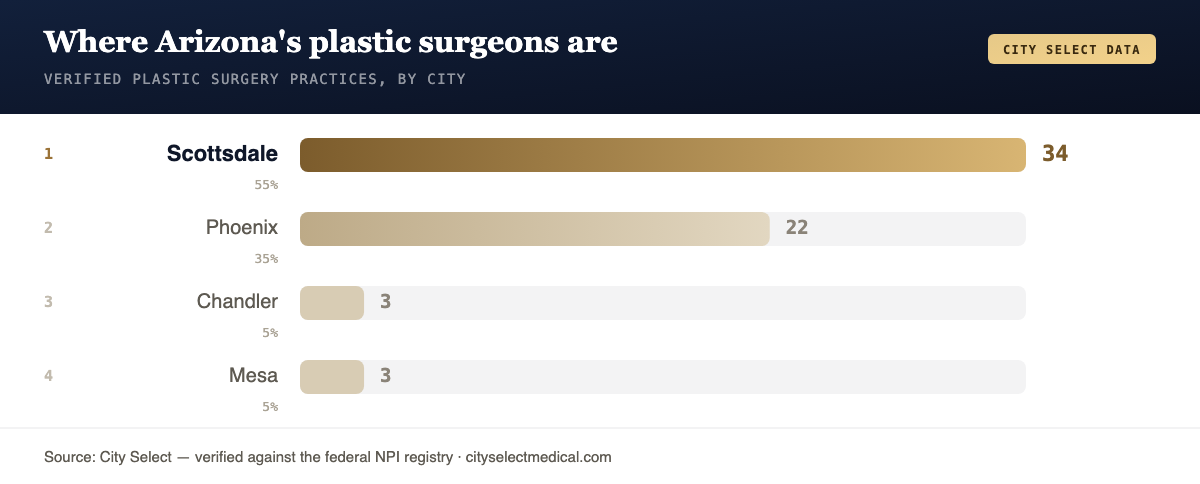
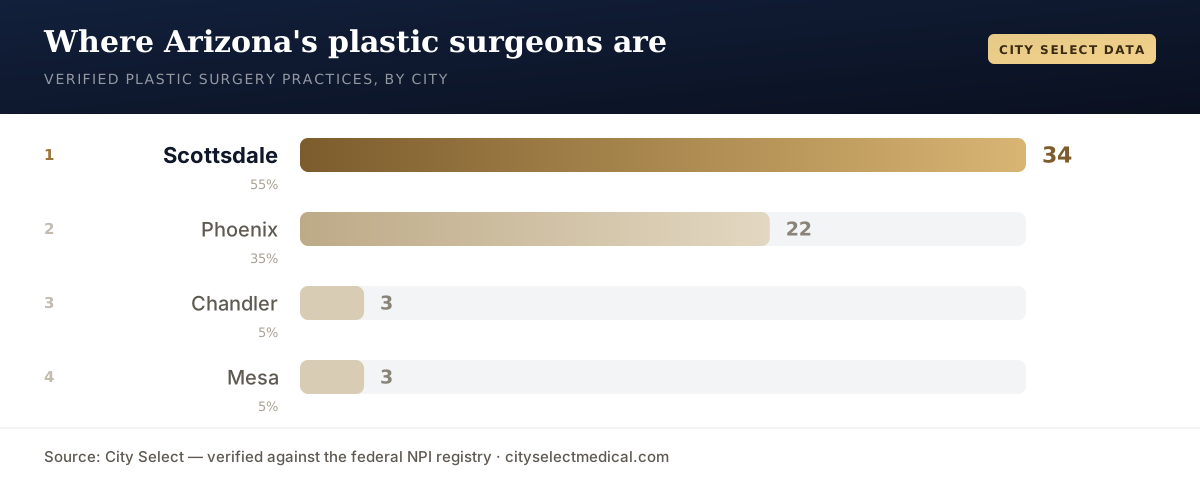
48 NPI-verified Arizona plastic surgery practices. Take the same fifteen questions to each — then compare the written answers side by side.
The bottom line
Fifteen questions, four themes: prove the credentials, prove the experience with your procedure, prove the safety plan, and get the money in writing.
Ask the four that people learn too late — when were the photos taken, is the quote binding, what's refundable, and what would make you decline to operate on me — and tell the truth about nicotine, because the tissue at risk is yours.
Then go home and decide there. Verify first, consult twice, and build the shortlist from verified Arizona practices.
Frequently asked questions
Should I pay for a consultation?
Consultation fees are common among experienced surgeons and often credit toward the surgery. A fee isn't a red flag — it's a filter that works in both directions. Free consultations are fine too; just apply the same questions with the same rigour, and remember that a free consult is a sales channel as well as a service.
How many consultations should I get?
At least two for any significant procedure, and a third if the first two disagree on approach. Disagreement is informative, not alarming — it shows you the real decision space instead of one surgeon's preference presented as the only option.
Is it rude to ask about complication rates and revision costs?
It's the opposite, and experienced surgeons say so. These are the questions that earn respect. A surgeon who is irritated by informed questions before surgery is showing you exactly how your concerns will be received after it.
Why does nicotine matter so much — I only vape?
Because the problem is the nicotine itself, not just the smoke. Nicotine constricts blood vessels and impairs wound healing, which is why the reported risk of tissue death rises sharply in nicotine users: facial skin necrosis after facelift has been reported as high as roughly 15% in smokers, and areola necrosis in breast surgery around 6% versus under 1% in non-smokers. Vapes, patches, gum and pouches all deliver nicotine. The literature supports stopping at least four weeks before surgery and staying off it afterwards. Be honest with your surgeon about this — some practices test for it, and the risk is to your own tissue.
What if I feel pressured to book?
Leave. Booking pressure at the consultation stage is the most predictive red flag on this page. Patients describe clinics pushing a fast deposit to "lock in" a price and then being unable to explain why the price would change. Surgery prices do not expire. Your surgeon's schedule will still exist next week.
Is my quote binding, or just an estimate?
Ask, and get the answer in writing — this is a lesson patients report learning after the fact. One described being billed for an increase in operating-room fees plus $2,500 of fat grafting that hadn't been in the original quote. Ask two questions: "Is this binding or an estimate?" and "What could change it, and by how much?"
Is a non-refundable deposit normal?
Deposits are common; the terms vary enormously. Ask what's refundable and under what conditions before you pay anything — including what happens if the surgeon reschedules, or if you're medically cleared to proceed and then aren't. Patients who went ahead with a surgeon they had doubts about often mention the non-refundable deposit as the reason they didn't walk away. Don't let a deposit make a decision you'd otherwise reverse.
What should I bring?
Your medication and supplement list, your full medical history including prior surgeries, honesty about nicotine, reference photos of your goals, and this list — on paper or on your phone. Consultation adrenaline erases memories; notes don't. Bring someone with you if you can.
Find a verified plastic surgeon in Arizona
Every plastic surgeon on City Select is sourced from the federal NPI registry and organized by city and specialty — no pay-to-rank, no mystery. Filter by your city and insurance:
 Choosing Care
How to Verify a Plastic Surgeon Is Actually Board-Certified (the 5-Minute Check)
"Board-certified" is the most misused phrase in cosmetic medicine. Here's the free five-minute check — plus the Arizona law that makes a vague claim more than just a red flag.
 Insurance & Costs
Breast Augmentation Cost: The Real Total, Not the Quoted Fee
The advertised number is one of five line items. Here's the whole bill — plus the FDA boxed warning most cost guides never mention, and the reoperation rate nobody prices in.
 Choosing Care
Plastic Surgeon vs. Cosmetic Surgeon vs. Med Spa: Who Should Actually Treat You
Three kinds of providers share one vocabulary. The honest test isn't who has the longest training — it's who is qualified to handle the day it goes wrong.
Written by the City Select editorial team and edited by Alan S., Senior Editor. Drafted with AI assistance and checked against the official sources below. City Select is not a healthcare provider, and this guide is not medical advice. Our editorial & data standards →
- ABMS Certification Matters — verify board certification
- American Board of Plastic Surgery — verify a surgeon
- Smoking and plastic surgery — pathophysiology and recommendations (PubMed)
- The evils of nicotine: an evidence-based guide to smoking and plastic surgery (PubMed)
- Arizona Medical Board (MDs)
- Arizona Board of Osteopathic Examiners (DOs)
- ASPS 2024 Procedural Statistics — average surgeon/physician fees
- NPPES NPI Registry
- How we verify
This guide is for general information and isn't medical, legal, or insurance advice. Coverage, prices, and policies change — verify current details with the relevant provider, plan, or agency, and confirm with the practice before booking. Last updated July 13, 2026.