
The Well-Woman Exam: What Actually Happens, and How to Make It Yours
Most of the worry about a well-woman exam is about the part that takes two minutes — and most of what actually matters is the conversation around it. This guide walks through what really happens, why the visit is still yearly even though the Pap isn't, and the part almost nobody tells you: how much of the exam is yours to shape.
If you're nervous, you're in the large majority — nearly every first-timer is, and the single most useful thing you can do is say so out loud. A good clinician hears it constantly and will slow down, narrate, and adjust. Being anxious doesn't make you a difficult patient. It makes you a normal one.
- The visit is annual. The Pap is not. Cervical screening is now every 3–5 years for many women — but the yearly well-woman visit still stands.
- What happens: vitals + history → a talk about your concerns → a general and breast exam → often a pelvic exam → age-appropriate screenings → a plan. Usually 20–30 minutes.
- ⭐ The exam is a shared decision. You can ask for a smaller speculum, a chaperone or support person, to keep some clothing on, and to stop at any point — these are rights, not favors.
- Cost: covered with no cost-sharing on most plans in-network; roughly $100–$300 self-pay. (Coverage details → the coverage guide.)
- Come with your questions written down. The exam needs almost no prep; the conversation is where the value is.
01 · WHAT HAPPENSThe visit, start to finish
A well-woman exam is a preventive visit — its job is to catch quiet problems early and keep your care on schedule, not to fix something that already hurts. The usual sequence:
Vitals and history
Weight, blood pressure, and an update on what's changed — periods, medications, family history, mood, anything new since last year.
The conversation
Contraception, pregnancy planning, perimenopause, sexual health, anything on your mind. This is the most valuable part, and it's why arriving with a written list matters.
Physical and breast exam
A general check plus a clinical breast exam.
Pelvic exam — if it's needed this time
An external and internal check. Usually brief. Not every visit includes one, and you can ask whether yours does.
Screenings for your age and history
A Pap and/or HPV test if it's due (they're periodic, not annual), STI testing if relevant, and referrals for mammograms or bone-density scans when age-appropriate.
The plan
Refills, referrals, vaccines, and when to come back.
A first visit tilts toward talking, not examining. If it's your first time, expect more history-taking and questions, and — if you'd prefer — you can ask to skip or defer the pelvic exam while you build trust with a new clinician, especially if nothing about your health makes one urgent.
Most of the anxiety is about the two-minute part. Most of the value is in the twenty-minute part.
Write your questions down and hand the list over at the start. "Here's what I wanted to cover today" does two things: it makes sure your real reasons for coming don't get lost, and it lets the clinician pace the visit around them. Consultation nerves erase memory — the paper doesn't. Put your most important question first, in case time runs short.
02 · WHY EVERY YEARThe visit isn't the Pap — and that trips everyone up
Here's the confusion worth clearing up, because it makes people skip years they shouldn't. Cervical cancer screening intervals lengthened — for many women a Pap or HPV test is now every 3 to 5 years, not annually. A lot of people heard that as "I don't need to go every year anymore."
That's not what it means. As ACOG puts it plainly: annual Pap smears are history, but routine OB-GYN visits are not. The screening got less frequent. The visit did not.
"My Pap isn't due, so I can skip the visit." No — and this is the single most common reason people fall out of care. The Pap is one test inside a visit that does far more: it tracks your blood pressure, updates your contraception, catches perimenopause and mood changes, keeps your other screenings (breast, bone, STI) on their own schedules, and — quietly the most important part — keeps a clinician who knows your history in your corner. Skipping the year because the Pap isn't due is like skipping an oil change because the tires are fine.
Think of it as one annual anchor with periodic tests hanging off it. The visit is yearly. The Pap/HPV is every 3–5 years. The mammogram starts around 40 on its own interval. The bone-density scan comes later. They don't all happen every time, and that's by design — the yearly visit is what makes sure each one happens when it should. The exact screening intervals, and why they changed, are in the Pap & HPV schedule guide.
If it's been years since your last visit, book anyway — and say so. People stay away out of embarrassment about the gap far more often than they need to, and clinicians genuinely do not care how long it's been; they care that you came back. "It's been about five years and I wasn't sure what I still needed" is a completely normal opening sentence, and it's the fastest way to get the visit tailored to where you actually are.
03 · YOUR TERMSThe part nobody tells you: the exam is a shared decision
This is the section we most want you to have, because it's the one that changes how the visit feels. If the pelvic exam is a source of dread — because it's your first, because it's uncomfortable, or because of a past experience — you have real, specific rights, and asking for them is completely ordinary.
Medical bodies are explicit about this. ACOG holds that a pelvic exam should be a shared decision between you and your clinician, with clear informed consent. The nursing body AWHONN supports your right to request a chaperone or support person. And trauma-informed care guidance is specific about what that looks like in the room.
Say you're anxious, and ask them to narrate
"This is hard for me — will you tell me what you're doing before each step?" A good clinician does this gladly. It is the single most-recommended thing by people who've been there.
Ask for the smallest speculum that works
Trauma-informed guidance is to use the smallest instrument that still allows an adequate exam. You can ask for it by name.
Request a chaperone or bring your own person
A support person or a staff chaperone in the room is your right, not an imposition. Ask when you book so it's arranged.
Keep what clothing you can
Many people feel far more at ease keeping a top or a skirt on. Ask; it's almost always fine.
Keep the word "stop"
You can say slow down, give me a moment, or stop — at any point, for any reason. A clinician worth seeing will not be annoyed. If one is, that tells you something important about whether to go back.
The clinician you want is the one who welcomes these requests, and that's information you can gather on the first visit. How a provider responds when you say "I'm nervous, will you talk me through it?" tells you almost everything about whether to keep seeing them. Warmth, narration, and a genuine "of course" is the standard to hold out for — and if you don't get it, switching is easy and normal. You are choosing a long-term relationship, not just booking a test.
"If I ask for accommodations, I'll be a difficult patient." You will not — and believing this is what keeps people out of care for years. Every request above is standard, expected, and supported by the profession's own guidelines. Trauma-informed care explicitly avoids things like leaning over you, exposing you without warning, or barking "just relax." A clinician who makes you feel small for asking to feel safe is not practicing good medicine, and there are 136 others in Arizona. The goal isn't to endure the exam. It's to be a participant in it.
The goal of a pelvic exam isn't to get through it. It's to be a participant in it — and that's a choice you're allowed to make out loud.
04 · FROM THE WEBWhat people wish they'd known
"First OB-GYN appointment in a few hours — what do you wish someone had told you?"
The most common answer, by a wide margin: **tell them you're nervous.** *"Definitely tell her you've never had a gyne exam and you're nervous. Ask her to explain everything as she does it."* It's the advice everyone who's been through it gives, because it works.
"What actually happens — and will it hurt?"
The honest, reassuring version from people who've done it: expect *discomfort, not sharp pain*, and — crucially — *"you can tell the doctor to slow down, back off, or even stop if anything is painful, and they won't be mad."* Pain is a signal to speak up, not something to grit through silently.
"I'm terrified of my first exam — what helped?"
Practical, specific wins people reported: **a pre-appointment phone call** with the clinician to talk through fears beforehand, and **keeping some of their own clothes on.** If a full exam feels like too much at once, ask about a get-to-know-you visit first, with no exam.
"I'm scared I'll be judged."
You won't be — this is the reassurance the threads return to again and again. Clinicians do this all day; nothing about your body or your history is new or shocking to them, and the questions that feel embarrassing to ask are the ones they most want you to.
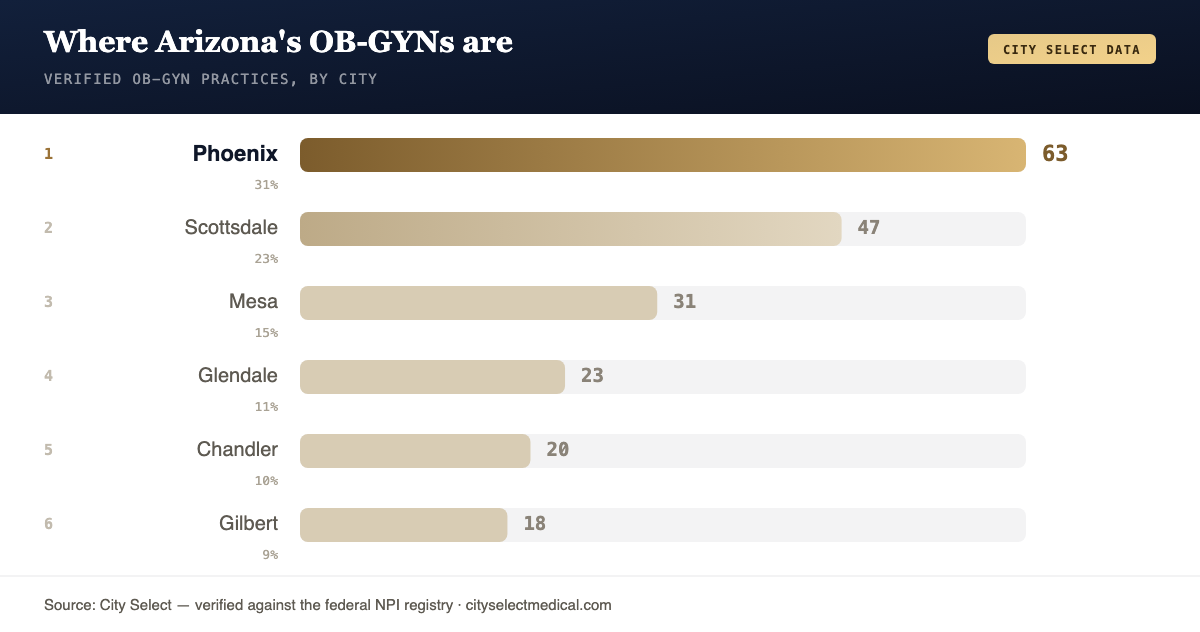
136 NPI-verified OB-GYN practices across Arizona — many of them multi-provider groups, which usually means a shorter wait for a first appointment. Comfort is part of the care, so it's worth choosing rather than settling.
05 · PREPAREGetting the most out of the visit
Preparation is almost entirely about the conversation — the exam itself needs very little.
Bring the essentials
Your medication list, the date of your last period, family-history updates, and your written questions (most important first).
Time it around your cycle if a Pap is due
Book for a week you don't expect your period — but don't cancel over spotting, and never delay a worrying symptom over timing. Call and ask.
Skip vaginal products for ~48 hours before a Pap
No douching or vaginal medications, which can affect results.
Flag accommodations when you book, not at the door
A chaperone, a female clinician, extra time, a pre-visit chat — arranging it in advance means it's ready when you arrive.
You do not need to already "have an OB-GYN" to book a well-woman exam — you need one taking new patients, in your network. That second filter is where most booking attempts stall. Filter the directory by your insurance before you call, so the first office you reach is one that can actually see you. If you're weighing candidates, the eight-check choosing guide includes a first-call script.
Arizona notes: with most insurance the preventive well-woman visit is covered in-network with no cost-sharing (the coverage guide has the billing details and the traps). AHCCCS covers well-woman care for eligible members. Uninsured, community health centers and Title X clinics provide well-woman care on a sliding scale, and the Well Woman HealthCheck Program covers breast and cervical screening for eligible lower-income women — so a lack of insurance is not a reason to skip the year.
How we source this
We rebuilt this article to do one job the old version blurred: tell you what the visit is actually like, and how much of it you're allowed to shape.
- The "annual visit vs. annual Pap" distinction is ACOG's own framing, and it matters because the confusion causes people to skip years of preventive care. We keep the exact screening intervals in a dedicated guide and the coverage mechanics in another, so this page can stay about the experience.
- The patient-control section is sourced to ACOG and AWHONN, not to us: the pelvic exam as a shared decision, informed consent, the right to a chaperone, the smallest-speculum principle, and trauma-informed practice. We present these as rights you may request, because that's what they are.
- The reassurance is drawn from people who've been through it, because "you'll be fine" means more from a room full of former first-timers than from a brochure.
- This is health-and-wellbeing content, so our aim is to lower fear, not raise it — we describe the visit honestly and put the reader in control, which is the opposite of what most "what to expect" pages do.
The bottom line
The well-woman visit is a yearly anchor, and it is not the same thing as a yearly Pap — the screening got less frequent, the visit didn't, and skipping the year because the Pap isn't due is how people quietly fall out of care.
Most of the dread is about the shortest part of the visit — and that part is more in your control than anyone tells you. You can ask for a smaller speculum, a chaperone, your own clothes, and the word stop. Those are rights, not favors, and asking for them is what a good clinician expects.
Come with your questions written down, keep your screenings on schedule, and — if not having a doctor is the reason you've been putting it off — that's the easiest part to fix: find an Arizona OB-GYN taking new patients, filtered by your insurance.
Frequently asked questions
Do I need a well-woman exam every year even if I feel fine, and even if I don't need a Pap?
Yes — and this is the most common point of confusion, so it's worth being clear. The annual well-woman visit and the Pap test are two different things. Pap/HPV screening now happens every 3 to 5 years for many women, but the yearly visit itself is still recommended. As ACOG puts it, annual Pap smears are history, but routine OB-GYN visits are not. The visit does far more than the Pap: blood pressure, contraception, mental health, screenings on their own schedules, and a standing relationship with someone who knows your history. 'Feeling fine' is what most early problems feel like.
What actually happens at the exam?
Usually: vitals and a health-history update, a conversation about any concerns or goals, a general physical and clinical breast exam, often a pelvic exam, and any age-appropriate screenings, ending with a plan and any prescriptions or referrals. Time with the provider is typically 20 to 30 minutes, and a first visit skews toward more talking and less examining. Not every visit includes a pelvic exam or a Pap — it depends on your age, history, and what's due.
I'm really nervous about the pelvic exam. What can I actually ask for?
More than you might realize, and these are rights, not favors. You can tell the clinician you're anxious and ask them to explain each step before they do it. You can request a chaperone or bring a support person. You can ask for the smallest speculum that still allows an adequate exam. You can ask to keep as much of your own clothing on as possible. And you can say slow down, or stop, at any point — a good clinician will not be upset, because the pelvic exam is meant to be a shared decision, not something done to you. If a visit is only for other care, you can also ask whether a pelvic exam is even needed this time.
Is a Pap smear the same as a well-woman exam?
No. The Pap is one test that may happen during the visit — and many well-woman visits don't include one at all, because cervical screening intervals with normal results are now every 3 to 5 years for many women. The exam is the annual anchor; the Pap is a periodic test inside it. Full intervals are in our screening-schedule guide.
Can my regular doctor do it, or does it have to be an OB-GYN?
Many family-medicine and internal-medicine providers perform complete well-woman exams, including Paps, and it counts as your covered annual visit. An OB-GYN makes sense for complex gynecologic issues, pregnancy planning, or personal preference. Either way, choose someone you feel comfortable being honest with — comfort is not a luxury here, it's part of getting good care.
What does it cost?
With most insurance, the preventive well-woman visit is covered in-network with no cost-sharing under the ACA — the details, and the billing traps that can add a charge, are in our coverage guide. Without insurance, a self-pay well-woman visit commonly runs about $100 to $300, with lab fees on top if a Pap or other tests are done, and community health centers and Title X clinics offer sliding-scale pricing.
Should I reschedule if I have my period?
You can, but you usually don't have to. Bleeding can interfere with a Pap, so if one is due it's often better to book for a week you don't expect your period — but don't cancel over light spotting, and never delay care for a symptom that worries you because of timing. Call the office and ask; they'll tell you whether to keep the appointment.
Find a verified ob-gyn in Arizona
Every ob-gyn on City Select is sourced from the federal NPI registry and organized by city and specialty — no pay-to-rank, no mystery. Filter by your city and insurance:
 Choosing Care
How to Choose an OB-GYN: The Checklist for Every Stage
Booking a first exam, planning a pregnancy, or navigating menopause — the vetting is the same eight checks, weighted differently. Here's the whole method, plus the phone script.
 Conditions
Pap Smears and HPV Tests: The Schedule by Age — and What an Abnormal Result Really Means
Screening got less frequent and less invasive. Here's the schedule by age — and, because it's the question that actually scares people, what an abnormal result really means.
 Insurance & Costs
What Women's Preventive Care Is Actually Free — and the Traps That Un-Free It
A long list of women's health care is legally free with almost every insurance plan — and a short list of billing traps quietly un-frees it. Both lists, plus how to dispute a wrong bill.
Written by the City Select editorial team and edited by Alan S., Senior Editor. Drafted with AI assistance and checked against the official sources below. City Select is not a healthcare provider, and this guide is not medical advice. Our editorial & data standards →
- ACOG — why annual Pap smears are history but routine OB-GYN visits are not
- ACOG — sexual misconduct & informed consent for sensitive exams
- HRSA — Women's Preventive Services Guidelines
- HealthCare.gov — preventive care benefits for women
- MyHealthfinder — get your well-woman visit every year
- NPPES NPI Registry
- How we verify
This guide is for general information and isn't medical, legal, or insurance advice. Coverage, prices, and policies change — verify current details with the relevant provider, plan, or agency, and confirm with the practice before booking. Last updated July 14, 2026.