
Your First Prenatal Visit: The Wait, the Tests, and What It Costs in Arizona
You have a positive test, and the internet is yelling nine different things at once. Here's the calm version.
Call your provider now — but expect the first visit to land at 8–10 weeks, and expect it to be a little less dramatic than you're picturing. Two of the most common feelings in early pregnancy are impatience (why so long?) and, after the appointment, "was that it?" — and both are completely normal reactions to a completely normal process.
Getting on the schedule is the urgent part. The visit itself can wait for the biology — that's the whole reason for the gap. This guide walks through the wait, what actually happens, what it costs, and the Arizona coverage that can start the day you apply.
- Call at the positive test. Most first visits are scheduled at 8–10 weeks from your last period — the timing that makes the early tests actually useful.
- The wait is normal, not neglect. Sooner slots are reserved for bleeding, severe pain, or high-risk history.
- It's often shorter than you expect — and the full workup is sometimes split across two early visits. Underwhelmed ≠ wrong.
- The early ultrasound is often internal (transvaginal). Consider this the heads-up.
- ⭐ Arizona: AHCCCS covers pregnancy with no copays, adds 12 months of postpartum coverage, and — through presumptive eligibility — can cover prenatal care the day you apply.
01 · THE WAITCall now, seen at 8–10 weeks — and why
Call now; be seen at 8–10 weeks. The gap surprises almost everyone, and it feels wrong when you're excited and anxious — but it's deliberate. By 8–10 weeks a dating ultrasound is accurate, a heartbeat is typically visible, and the standard lab panel gives its most useful baseline. An appointment at 5 weeks mostly can't answer the questions parents actually want answered, so practices hold those early slots for pregnancies that need them.
Be seen sooner if you have bleeding or severe one-sided pain
This can signal an ectopic pregnancy and is urgent — call the same day, or go to urgent care/ER.
Be seen sooner with a high-risk history
Prior ectopic, recurrent loss, or serious chronic conditions (diabetes, hypertension, thyroid disease, epilepsy) may need a same-week medication plan.
If you conceived with fertility treatment
Your fertility clinic usually monitors the early weeks and hands off to prenatal care later — follow their timeline.
Otherwise, use the nurse line
Medication questions, worrying symptoms, plain reassurance — that line exists for exactly this, and you won't be bothering anyone.
The waiting weeks have a short, genuinely useful to-do list — and then you can exhale. Start a prenatal vitamin with folic acid if you haven't; review your current medications with a pharmacist or the practice's nurse line (don't stop any prescription on your own); and skip alcohol and smoking. That covers the medically important part of early pregnancy. Everything else the appointment handles — so resist the urge to solve all seven months in the first seven days.
02 · WHAT HAPPENSThe visit — and why it might feel smaller than you imagined
Set your expectations here, because this is where people get thrown. Some practices do a long, do-everything first visit (60–90 minutes). Many others split it: a shorter first appointment that's mostly confirmation, history, and maybe a quick ultrasound, with the full lab panel and longer conversation at a second visit a few weeks later. Both are normal. If you walk out of a 30-minute confirmation feeling "was that it?", that's usually the clinic's workflow — not a sign anything is wrong.
If the "was that it?" feeling hits, ask one question before you leave: "What's the plan for the next few weeks?" A good answer — when the next visit is, what will happen at it, what to watch for meanwhile — turns an anticlimactic appointment into a reassuring one, and it's the fastest way to tell whether a quiet first visit reflects a calm plan or a disengaged practice. You're allowed to want the map, not just the confirmation.
Across the first one or two visits, here's what gets covered:
Dating
First day of your last period → an estimated due date, usually confirmed or adjusted by ultrasound.
A deep history
Your health, medications, surgeries, mental health, prior pregnancies, and family genetic history on both sides — bring your partner's side too, written down.
A physical exam
Vitals and a general exam; often a pelvic exam and, if it's due, a Pap (the schedule).
The lab panel
Blood type and Rh factor, blood count, immunity checks (rubella, varicella), and hepatitis B, HIV and syphilis screening — standard for everyone, because it's how transmission to the baby is prevented.
A dating ultrasound
Often transvaginal at this stage (a wand, internally — this is the part that surprises people). It confirms location (rules out ectopic), number (yes, this is the twins-reveal appointment), and heartbeat.
The genetic-screening conversation
Optional carrier screening and first-trimester options — a decision discussion, not a default blood draw.
"If they didn't do all the bloodwork and a big ultrasound at the first visit, something's off." Not at all — and expecting the full production at visit one is the fastest route to disappointment. Clinics sequence early pregnancy care differently, and a first visit that's brief and mostly administrative is extremely common. Judge the practice on how it communicates, not on how eventful the first appointment was. A calm, clear "here's our plan for the next few weeks" is exactly what you want to hear, even if the visit itself was short.
The first visit sets the tone for seven months of appointments. If you leave feeling rushed and unheard at week ten, believe the preview.
Bring one written page to the first visit and it does most of the work for you: your last period's start date, your current medications and doses, your and your partner's family medical history, and any questions you don't want to forget. Early-pregnancy nerves and the sheer volume of the appointment erase memory — the page doesn't. It also quietly signals to the practice that you're an engaged partner in your care, which tends to change how the conversation goes.
03 · FROM THE WEBWhat people actually experienced
"How do you wait so long before the first appointment?"
You are extremely not alone — this is one of the most-posted questions in every pregnancy forum. The reassurance that settles it: *"apparently it's quite normal — at least in the US — to not have your first appointment until 8 to 10 weeks."* The wait is standard, and the anxiety of it is standard too.
"Confused and underwhelmed after my first prenatal appointment."
This exact title recurs constantly, and the replies are reassuring: *"it was more like a confirmation and dating of pregnancy; my next appointment was where the normal stuff happened."* **If your first visit felt anticlimactic, you're in the large majority — the big workup is often the second visit.**
"What actually happens?"
A representative account: *"maybe 30 minutes including wait time — urine sample, blood pressure, weight and height, questions about medical history and last cycle, then the ultrasound."* Short, practical, not a spectacle. The transvaginal ultrasound is the recurring surprise — as one person put it, *"wait, you're putting what where?"*
"When exactly will they see me?"
It ranges — clinics commonly cite 7 to 12 weeks depending on their protocol and how booked they are, which is why they say *call early even though the visit is weeks out.* Getting on the schedule is the time-sensitive part; the visit itself can wait for the biology.
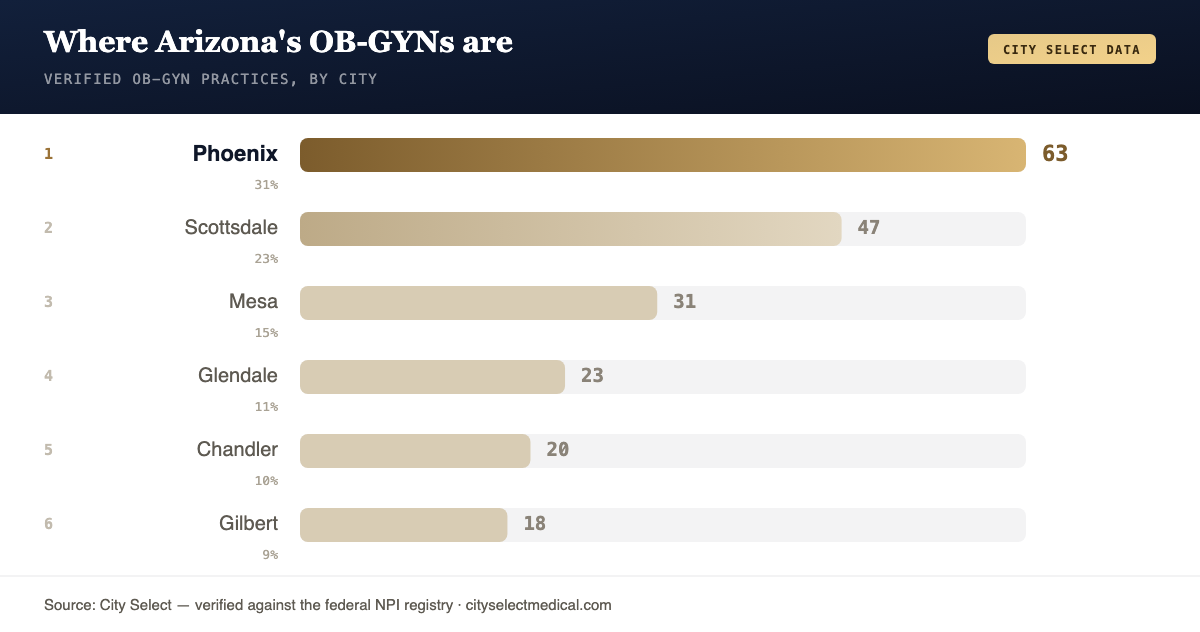
136 NPI-verified OB-GYN practices across Arizona, many of them multi-provider groups (faster first appointments, and built-in call coverage for your delivery). Book early even though the visit is weeks out.
04 · THE MONEYWhat it costs — and the Arizona coverage that starts fast
Most insured patients don't pay per prenatal visit. Routine prenatal care, delivery, and postpartum care are usually bundled into a single "global maternity package" billed after delivery — which is why individual visits mostly don't generate bills, but the occasional item does.
"I can't afford prenatal care, so I'll just start it later — or skip most of it." This is the most costly misunderstanding in the whole topic, on both health and money. Prenatal care is among the highest-value healthcare there is — it's cheap relative to what it prevents — and in Arizona cost is rarely the real barrier once you know the doors. AHCCCS presumptive eligibility can start coverage the day you apply; community health centers use sliding scales; and marketplace plans must cover maternity as an essential benefit. The move when money is tight isn't to skip care — it's to apply at HEAplus and call a community health center the same week.
Arizona coverage, and the part that's genuinely fast: AHCCCS covers pregnancy care — prenatal, labor and delivery, and postpartum — with no premiums and no copays for those who qualify (up to 156% of the federal poverty level; the 2026 figure is roughly $2,075/month for an individual, so check your number at HEAplus). Two things make it stand out:
★ Presumptive eligibility — you can have prenatal care covered right away when you apply, even before your income is fully verified. You don't have to wait out the full approval to start care.
★ 12-month postpartum coverage — since April 2023, AHCCCS coverage continues for a full year after pregnancy ends (up from 60 days), regardless of income changes during that year.
Apply at Health-e-Arizona Plus (healthearizonaplus.gov). If you're uninsured, this is the first door to try — and community health centers offer sliding-scale prenatal care as well. (Income thresholds change; confirm the current figure at azahcccs.gov.)
Ask three billing questions at your first visit, and you'll dodge nearly every maternity surprise bill: "What does the global fee include?" · "Which routine items — ultrasounds, labs — bill separately?" · "Is the hospital I'll deliver at, and its anesthesia group, in my network?" The last one is the big one: an out-of-network anesthesiologist at an in-network hospital is the classic delivery-bill shock, and it's worth confirming months ahead while you still have options.
05 · CHOOSINGPick your provider before you're too far along to switch easily
The first visit doesn't lock you in — but the earlier you choose deliberately, the easier the next seven months are. The decision has two layers: provider type (OB-GYN, certified nurse-midwife, or family physician — compared honestly here) and the specific practice, vetted with the choosing checklist, where hospital affiliation and call coverage matter most.
Steal this question list for visit one — the answers tell you as much about the practice as the exam does: "Who will actually deliver me — you, a rotation, or whoever's on call?" · "Which hospital, and can I tour it?" · "How do I reach a human at 2 a.m., and for which symptoms should I?" · "Which of my current medications need changing?" · "What does the global fee cover, and what bills separately?" · "What's your approach to [the thing you care about — VBAC, unmedicated birth, induction timing]?" How they answer the 2 a.m. question is especially telling.
How we source this
We rebuilt this article around the two things that actually trip people up in early pregnancy: the wait, and the money.
- The "why so long, and why so short" framing comes from what people actually report — the impatience before the visit and the "underwhelmed" feeling after. We set that expectation deliberately, because a first visit that's brief and split across two appointments is normal, and not knowing that turns a normal process into worry.
- The Arizona coverage is verified against AHCCCS, and we lead with the two facts many people don't know: presumptive eligibility (care can start the day you apply) and the 12-month postpartum extension. Income thresholds change, so we cite the percentage and send you to HEAplus for your own number.
- The billing section explains the global maternity package and the out-of-network-anesthesia trap, because those are the real sources of maternity surprise bills.
- Genetic screening is presented as an optional, values-based decision — we describe the choice and never steer it.
The bottom line
Call at the positive test, expect the real appointment at 8–10 weeks, and expect it to be calmer and shorter than the internet implies — often a confirmation and history, with the full workup a couple of weeks later. The transvaginal ultrasound is normal; the wait is normal; the "was that it?" feeling is normal.
Use the waiting weeks well (prenatal vitamin, medication review, choosing a provider on purpose), ask the three billing questions, and confirm your delivery hospital's network status early.
And if you're in Arizona and worried about cost, AHCCCS can cover prenatal care the day you apply and carries you a full year past delivery — so cost is not a reason to skip care. Start from a verified list: Arizona OB-GYNs.
Frequently asked questions
I'm 5 weeks pregnant and my first appointment isn't until week 9 — is that normal, or am I being neglected?
It's normal, and it's the single most common worry there is. For a pregnancy without bleeding, severe pain, or a high-risk history, being first seen at 8–10 weeks is standard scheduling, not neglect — it's the timing at which a dating ultrasound is accurate and a heartbeat is typically visible, so the visit can actually answer your questions. Call sooner if you have those exceptions, and use the practice's nurse line for medication or urgent questions while you wait.
Why is everyone saying their first visit was short and 'underwhelming'?
Because it often is, and knowing that in advance saves a lot of disappointment. Many practices split the early workup: a first visit that's mostly confirmation, history, and sometimes a quick ultrasound, with the full lab panel and the longer conversation at a second visit a few weeks later. Others do everything at once. Neither is wrong — but if you're picturing a big, movie-style event and get a 30-minute confirmation, that's the clinic's normal workflow, not a red flag.
Will I hear the heartbeat, and will the ultrasound be… internal?
At 8–10 weeks, a heartbeat is usually visible on ultrasound — and at this stage the ultrasound is often transvaginal (a wand, internally) rather than over the belly, because it's simply the clearer view this early. A lot of people are surprised by that, so consider this the heads-up. Handheld Dopplers over the belly often can't pick up a heartbeat reliably until 10–12 weeks, so don't panic if that tool stays in the drawer.
Do I have to do the genetic testing?
No — all of it is optional. The first (or second) visit's job is to explain what each screen can and can't tell you, including cost, so you can decide. It's a values decision as much as a medical one, and it's completely fine to take the information home and think about it rather than deciding on the spot. A good provider presents the options without pushing you toward or away from any of them.
What symptoms mean 'call now' instead of waiting for my appointment?
Vaginal bleeding beyond light spotting, severe or one-sided abdominal pain (which can signal an ectopic pregnancy and is urgent), a fever over 100.4°F, fainting, or persistent vomiting that keeps nothing down. A practice would far rather take that call than have you wait — that's exactly what the nurse line is for, and you will not be bothering anyone.
Should my partner or support person come?
If they can, the first visit is a good one to bring them to — it's the appointment with the family-history questions (both sides), the big information download, and often the first ultrasound. Practices generally welcome a support person; ask about their policy when you book, since some limit numbers in the ultrasound room.
I'm in Arizona and worried about cost or insurance — what are my options?
More than you might think, and one is genuinely fast. AHCCCS covers pregnancy care — prenatal, delivery, and postpartum — with no premiums or copays for those who qualify (up to 156% of the federal poverty level), and Arizona now continues that coverage for a full 12 months after pregnancy. Crucially, Arizona offers presumptive eligibility: you can have prenatal care covered right away when you apply, even before full income verification. Apply through Health-e-Arizona Plus. Community health centers also offer sliding-scale prenatal care. The one thing not to do is skip prenatal care over cost — there are paths in.
Find a verified ob-gyn in Arizona
Every ob-gyn on City Select is sourced from the federal NPI registry and organized by city and specialty — no pay-to-rank, no mystery. Filter by your city and insurance:
 Choosing Care
OB-GYN vs. Midwife vs. Family Doctor: How to Actually Choose
It's usually sold as a philosophy decision. It's a risk-level decision first, a philosophy decision second — and for a lot of women, the honest answer is 'both.'
 Choosing Care
How to Choose an OB-GYN: The Checklist for Every Stage
Booking a first exam, planning a pregnancy, or navigating menopause — the vetting is the same eight checks, weighted differently. Here's the whole method, plus the phone script.
 Insurance & Costs
What Women's Preventive Care Is Actually Free — and the Traps That Un-Free It
A long list of women's health care is legally free with almost every insurance plan — and a short list of billing traps quietly un-frees it. Both lists, plus how to dispute a wrong bill.
Written by the City Select editorial team and edited by Alan S., Senior Editor. Drafted with AI assistance and checked against the official sources below. City Select is not a healthcare provider, and this guide is not medical advice. Our editorial & data standards →
This guide is for general information and isn't medical, legal, or insurance advice. Coverage, prices, and policies change — verify current details with the relevant provider, plan, or agency, and confirm with the practice before booking. Last updated July 14, 2026.