
Pap Smears and HPV Tests: The Schedule by Age — and What an Abnormal Result Really Means
Two things about cervical cancer screening trip people up, and they pull in opposite directions. The first is the schedule — it got less frequent and less invasive, and a lot of people either don't know that or heard "less often" and drifted out of screening entirely. The second is the fear — an abnormal result arrives and the mind goes straight to cancer, when it very rarely means that.
This guide covers both, plainly. The schedule by age, what actually changed and why it's good news, and — because it's the part that genuinely frightens people — what an abnormal result really means.
- 21–29: a Pap every 3 years (with normal results).
- 30–65: HPV testing every 5 years is now the preferred option; a Pap every 3 years or co-testing every 5 are alternatives.
- Under 21: no screening. Over 65: can usually stop with an adequate history of normal results.
- The annual well-woman visit still stands — the exam is yearly; this test isn't. Don't skip one for the other.
- ⭐ An abnormal result usually is not cancer. Most HPV infections and minor changes clear on their own; abnormal means "look closer," not a diagnosis.
01 · THE SCHEDULEBy age, with normal results
These are ACOG's current intervals. They assume average risk and normal results — abnormal results and higher-risk histories follow their own closer schedules, set by your clinician.
| Age | What's recommended | Interval (normal results) |
|---|---|---|
| Under 21 | No screening | Screening starts at 21, regardless of sexual history |
| 21–29 | Pap (cytology) | Every 3 years |
| 30–65 | Primary HPV test — preferred | Every 5 years |
| 30–65 — alternatives | Co-test (Pap + HPV) · or Pap alone | Every 5 years · or every 3 years |
| Over 65 | Can usually stop | Only with adequate prior normal screening — confirm, don't assume |
| After total hysterectomy (benign, no high-grade history) | Can usually stop | If the cervix was removed and it wasn't cancer-related |
Two rules ride along with that table. First, an abnormal result resets the schedule — "every 5 years" applies only while results stay normal; after an abnormal one, follow-up is individualized and closer. Second, higher-risk histories — HIV, a weakened immune system, DES exposure before birth, or previously treated precancer — follow their own closer intervals, which your provider sets.
Don't try to time this to the calendar yourself — let the interval float to your visit. The "every 3 or 5 years" is a guideline, not a stopwatch; being a few months either way is fine. The practical move is to keep your annual well-woman visit and let your clinician tell you when the Pap or HPV test is actually due, rather than tracking it yourself and either double-testing or drifting years past. If you switch providers, bring or request your screening history so the clock isn't reset by accident.
The visit and the test are two different clocks, and confusing them is the mistake that matters. The well-woman visit is yearly. The Pap or HPV test is every 3–5 years. People hear "you don't need a Pap every year" and stop going altogether — but the yearly visit is what keeps all your screenings (this one, plus breast, bone, blood pressure) on their separate schedules. Keep the annual well-woman visit; let the Pap ride its longer interval inside it.
02 · WHAT CHANGEDLess often, and now less invasive
Two real shifts, both in the patient's favor.
HPV testing is now the preferred primary screen for ages 30–65. The reasoning: the HPV test looks for the virus that causes nearly all cervical cancers, so a negative result is powerful reassurance — strong enough to safely support the five-year interval. It catches risk before cells ever change, rather than waiting to spot cells that already have.
Self-collection now exists. In May 2024, the FDA approved self-collected samples for certain HPV tests: you collect your own vaginal swab, without a speculum, in a health care setting. This is not a mail-order home kit — it's done at the clinic — and it's rolling out unevenly, so you'll need to ask whether your provider offers it yet.
"The HPV vaccine means I don't need to be screened anymore." No — and this one genuinely matters, because it leads vaccinated women to skip screening. The vaccine prevents the highest-risk HPV strains, but not every strain that can cause cervical cancer. Vaccinated women follow the same screening schedule. Vaccination and screening are a team — the combination is what's driving cervical cancer rates down, and neither replaces the other.
If the speculum exam is the reason you've skipped screening, self-collection is worth a specific phone call. Ask the office, in these words: "Do you offer self-collected HPV testing?" For people who've stayed away because of past trauma, pain, or discomfort, this option removes the exact barrier that kept them out — and getting screened by some method you'll actually tolerate is far better than a perfect method you keep avoiding. Availability is patchy, so it may take a couple of calls to find a clinic offering it.
A note on the guideline landscape, because you'll see conflicting things online: the settled screening intervals above are ACOG's. The move toward HPV-primary testing and self-collection is backed by the FDA's 2024 approvals and professional bodies, and the USPSTF's updated cervical recommendation is still in draft as of this writing — so different sources may phrase the "preferred" method slightly differently while the guidance converges. When in doubt, your clinician screening you on ACOG's intervals is on solid ground, and this page tracks the guidelines as they finalize.
03 · THE ABNORMAL RESULTThe part that actually scares people
If you're here because you just got an abnormal result, start with this: it usually does not mean cancer. We're giving this its own section because it's the question that sends people into a spiral, and the facts are genuinely reassuring — without pretending the follow-up doesn't matter.
Here's what the common results mean, following the National Cancer Institute's guidance:
Normal / negative
Back on your regular schedule. Nothing to do.
HPV-positive, or ASC-US (mild cell changes)
The most common "abnormal" outcome — and usually closer follow-up, a repeat test or a colposcopy, not treatment. Most HPV infections and minor changes clear on their own, which is exactly why the response is watching rather than acting.
A colposcopy
A magnified look at the cervix, often with a small biopsy. It's an office procedure, not surgery. Being referred is the system working, not a verdict.
Higher-grade changes (e.g., HSIL)
A closer look and sometimes treatment of the precancerous area — a procedure like a LEEP that removes the abnormal tissue. This is the screening system catching a change years before it could become cancer, which is the entire point of screening.
"Abnormal result means I have cancer." It almost never does — and believing it does causes real, unnecessary suffering. An abnormal Pap or a positive HPV test is a signal to look closer, not a diagnosis. As people who've been through it put it in support forums, most HPV clears on its own, and most abnormal results turn out to be low-grade. The letter in your hand is a follow-up appointment, not a conclusion. What it is not is a reason to avoid the follow-up — the reassurance and the follow-through go together.
Cervical cancer is one of the few cancers we can reliably catch before it exists. An abnormal result is that system working, not failing.
The letter in your hand is a follow-up appointment, not a conclusion — and going to it is the whole point.
A word on the fear itself. Screening anxiety — dreading the test, spiraling after an abnormal result — is extremely common, and it keeps people away from the very thing that protects them. If that's you, two things are true at once: the odds are strongly in your favor, and it's completely reasonable to tell your clinician you're anxious and ask them to walk you through what your specific result means and what happens next. You don't have to carry the uncertainty alone between the letter and the appointment. If the anxiety is severe or persistent, it's worth mentioning to a doctor you trust.
The interval between an abnormal result and the follow-up is designed to be safe — the changes cervical screening looks for develop over years, not weeks. That's why a colposcopy scheduled a few weeks out is normal and not a sign anyone is worried. Use the waiting time to prepare questions, not to research worst cases: what exactly did my result say, what's the follow-up looking for, and what happens after that? A clinician would far rather answer those than have you arrive having frightened yourself with a search engine.
When you get any result — normal or not — ask for it in writing and ask what it means in plain words. "Can you tell me my exact result and what the next step is?" turns a vague, anxiety-inducing voicemail into something concrete. If it's normal, you'll know your next due date. If it's abnormal, you'll know precisely what kind, which is the difference between manageable worry and a spiral — the specific words (ASC-US, HPV-positive, HSIL) mean very different things, and your clinician can tell you which yours is.
04 · FROM THE WEBWhat people going through it say
"I got booked for a colposcopy after a positive HPV — is that bad news?"
A reassuring and accurate reply from the community: the wait itself can be *"actually a good sign — it shows they aren't overly concerned."* Urgent cases get pulled in fast; a routine-timed follow-up usually reflects a routine level of concern. **The waiting is the hardest part, and it is rarely the ominous part.**
"Colposcopy and HPV — I'm scared."
The reassurance that calms this thread down every time: **the great majority of HPV infections clear on their own**, and it's *"extremely rare for results to come back as anything beyond low-grade."* Not a promise for any one person, but the base rate is genuinely on your side — which is what the whole screening system is built around.
"Abnormal Pap, feeling very anxious."
These threads are full of people who *"waited so long"* and now fear the worst — and the through-line of the replies is compassionate and practical: **the delay is done, the appointment is the fix, and catching it now is the good outcome, not the bad one.** Being overdue is the most common story on these boards; it is not a personal failing.
"What actually happens to the sample?"
For a clinician-collected test, during the pelvic exam a small soft brush collects cells from the cervix — a few seconds of pressure or mild cramping. **Skip vaginal products for about 48 hours beforehand**, and reschedule around heavy bleeding if a Pap is due (call and ask rather than canceling).
A short prep list makes the test itself a non-event:
Time it away from your period if a Pap is due
Blood can interfere with the cytology. Light spotting is usually fine — call and ask rather than canceling.
Skip vaginal products for ~48 hours
No douching, vaginal medications, or spermicides, which can affect the sample.
Ask about self-collection when you book
If the speculum is the barrier, find out whether the clinic offers self-collected HPV testing.
Bring your screening history
Especially with a new provider, so your interval isn't reset by accident and nothing gets repeated unnecessarily.
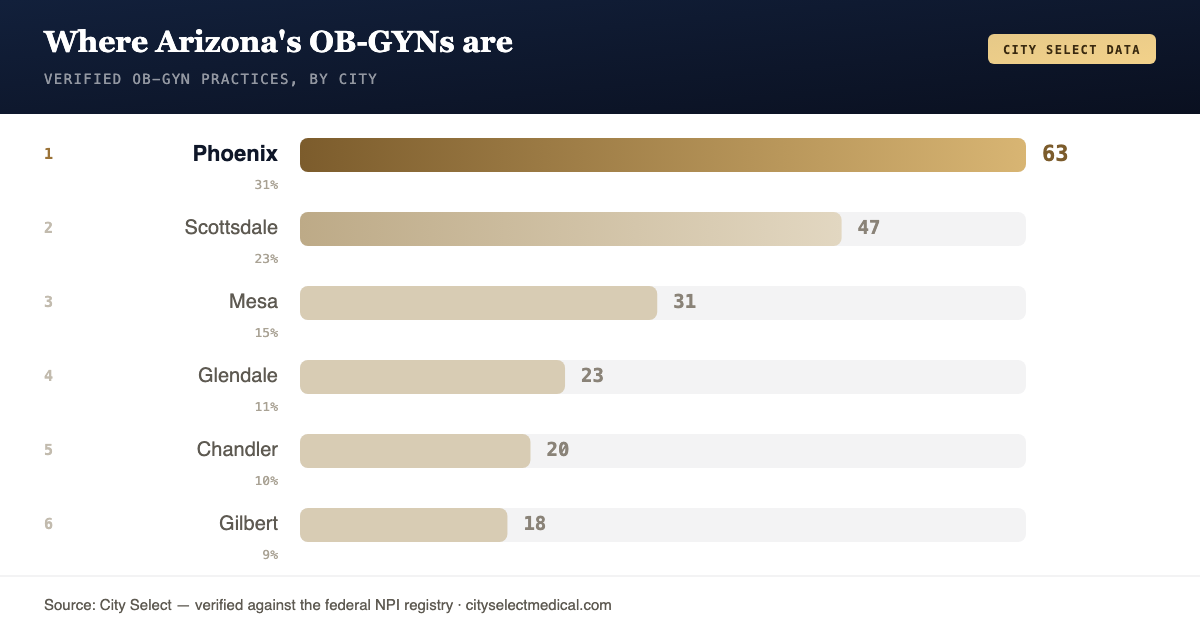
136 NPI-verified OB-GYN practices across Arizona, and primary-care practices screen too. Whatever the gap has been, one appointment closes it.
05 · COSTUsually free — with one wrinkle after an abnormal result
Cervical cancer screening is an ACA preventive service — covered at $0 by almost any ACA-compliant plan, in-network, on schedule. The coverage guide has the full picture, but two wrinkles are specific to screening:
How we source this
This is a health page, so we were careful about two things: getting the intervals exactly right, and not scaring people about abnormal results.
- The screening intervals are ACOG's current guidance. We attribute them to ACOG rather than to the USPSTF because the USPSTF's updated cervical recommendation is still a draft — so we describe HPV-primary testing and self-collection as the well-supported direction (backed by the FDA's 2024 approvals and professional bodies) rather than implying a single finalized federal rule.
- Self-collection is stated precisely: FDA-approved in May 2024, for certain HPV tests, collected at a clinic — not an at-home mail kit. We fixed an earlier version that overstated this.
- The abnormal-result section follows the National Cancer Institute, and we deliberately balanced reassurance with follow-through: abnormal usually isn't cancer, and the follow-up genuinely matters. We won't tell anyone their result is "nothing."
- Because screening anxiety is real and common, we wrote to lower fear, not raise it — and pointed readers toward talking to their clinician rather than carrying the worry alone.
The bottom line
The schedule is simpler than the anxiety around it: a Pap every 3 years in your 20s, HPV testing every 5 years from 30 to 65, stop after 65 with a clean history — and the annual well-woman visit continues regardless, because the exam and this test are on different clocks.
If you're staring at an abnormal result: it usually is not cancer, most HPV clears on its own, and the follow-up is the system catching a change early — which is the good outcome. Go to the appointment, and tell them if you're anxious; you don't have to sit with the uncertainty alone.
And if you're overdue — the single most common status there is — one visit closes the gap. Screening is free on schedule under almost any plan, and self-collection may now spare you the speculum. Find a verified Arizona provider, and pair it with your well-woman visit.
Frequently asked questions
Do I still need a Pap every year?
No — annual Paps stopped being the recommendation years ago, and this is the most common point of confusion. With normal results, ACOG's schedule is: every 3 years (Pap/cytology) in your 20s, and from 30 to 65 either primary HPV testing every 5 years (the preferred option), a Pap alone every 3 years, or co-testing every 5 years. The annual well-woman visit is still recommended — the exam is yearly, this one test isn't. Skipping the visit because the Pap isn't due is how people fall out of care.
What's the difference between a Pap and an HPV test?
A Pap (cytology) looks for cervical cells that have already started to change. An HPV test looks for the high-risk virus strains that cause nearly all cervical cancers — so it flags risk earlier, before cells change. Both use a similar sample. From 30 to 65, HPV-based testing is now the preferred approach, because a negative HPV result is strong enough reassurance to safely support a 5-year interval.
What does an abnormal result actually mean? I'm scared.
First, breathe — an abnormal result usually does not mean cancer, and this is the single most important thing to understand. Common results like ASC-US or a positive HPV test typically lead to closer follow-up, such as a repeat test or a colposcopy (a magnified look at the cervix), because most HPV infections and minor cell changes clear on their own. Higher-grade changes may need a closer look and sometimes treatment of precancerous tissue — which is the screening system doing exactly its job, catching changes years before they could ever become cancer. Abnormal means 'look closer,' not 'diagnosis.' If the waiting is causing real anxiety, you are not alone, and it's worth saying so to your clinician.
Can I collect my own sample now instead of a speculum exam?
Increasingly, yes. In May 2024 the FDA approved self-collection of the HPV sample for certain tests — you collect your own vaginal swab, without a speculum, in a health care setting rather than at home. It's rolling out unevenly, so ask your provider or clinic whether they offer it yet. This matters most for people who've skipped screening because the speculum exam itself was the barrier — past trauma, discomfort, or difficulty getting in.
Can I stop screening after a hysterectomy?
It depends on what was removed and why. If the hysterectomy removed the cervix and was for benign reasons (not cervical cancer or serious precancer), screening can generally stop. If the cervix remains, or the surgery was cancer-related, screening continues. Confirm your specific situation with your provider rather than assuming.
I had the HPV vaccine — do I still need to screen?
Yes. Vaccinated women follow the same screening schedule. The vaccine prevents the highest-risk HPV strains but not every strain that can cause cervical cancer, so vaccination and screening work together — that combination is what's driving cervical cancer rates down, and neither one replaces the other.
I'm years overdue and embarrassed. What do I do?
Book the appointment — that's the whole fix, and being overdue is one of the most common situations there is. Clinicians genuinely do not judge how long it's been; they're glad you came. If fear of an abnormal result is part of why you've delayed, remember that catching a change early is precisely the point of screening, and the earlier it's found the simpler it is to manage. 'It's been several years and I want to get caught up' is a completely normal thing to say when you book.
Find a verified ob-gyn in Arizona
Every ob-gyn on City Select is sourced from the federal NPI registry and organized by city and specialty — no pay-to-rank, no mystery. Filter by your city and insurance:
 Choosing Care
The Well-Woman Exam: What Actually Happens, and How to Make It Yours
One visit a year, and most of the worry is about the part that takes two minutes. Here's what actually happens — and the accommodations you're entitled to ask for.
 Insurance & Costs
What Women's Preventive Care Is Actually Free — and the Traps That Un-Free It
A long list of women's health care is legally free with almost every insurance plan — and a short list of billing traps quietly un-frees it. Both lists, plus how to dispute a wrong bill.
 Choosing Care
How to Choose an OB-GYN: The Checklist for Every Stage
Booking a first exam, planning a pregnancy, or navigating menopause — the vetting is the same eight checks, weighted differently. Here's the whole method, plus the phone script.
Written by the City Select editorial team and edited by Alan S., Senior Editor. Drafted with AI assistance and checked against the official sources below. City Select is not a healthcare provider, and this guide is not medical advice. Our editorial & data standards →
- ACOG — Screening for Cervical Cancer (screening intervals)
- National Cancer Institute — next steps after an abnormal HPV/Pap result
- ASCCP — screening guidelines & self-collection practice advisory
- USPSTF — cervical cancer screening (draft recommendation)
- HRSA — Women's Preventive Services Guidelines (coverage)
- Arizona DHS — Well Woman HealthCheck Program
- NPPES NPI Registry
- How we verify
This guide is for general information and isn't medical, legal, or insurance advice. Coverage, prices, and policies change — verify current details with the relevant provider, plan, or agency, and confirm with the practice before booking. Last updated July 14, 2026.