
How to Choose a Dentist in Arizona: The Checklist That Actually Works
Most people choose the dentist closest to work, or the one their insurance app listed first, and hope for the best. It usually works out. When it doesn't, it costs years and thousands.
Ten focused minutes of checking does considerably better. This guide covers what to verify before you book, the questions that actually reveal a practice, and the red flags worth walking away from — across 1,095 verified Arizona dental practices you can filter by city and insurance.
- Verify the licence yourself. The Arizona State Board of Dental Examiners has a free public Professional License Search — and actively urges patients to use it.
- Confirm in-network, not "we accept it." Those are different sentences with different prices.
- Get fees in writing before major work, and a pre-treatment estimate on anything over four figures.
- Match the services to your life, not just the location — kids, anxiety, sedation, emergencies.
- The red flags that matter: a treatment plan with a deadline, pressure to commit today, no written estimates, and an office that never asks for your old records.
01 · INSURANCEConfirm the money before you confirm the appointment
"We accept your insurance" and "we're in-network" are different sentences with different prices. Accepting means the office will send the claim. In-network means they've signed a contract agreeing to negotiated rates. Out-of-network, the office can bill you the balance above what your plan allows — and on major work, that gap runs four figures.
"The insurance app listed them, so they're in-network." Insurer directories go stale, contracts change mid-year, and front desks make mistakes. The two sources disagree often enough that checking both is the only reliable method. Ask the office in these exact words: "Are you in-network with my plan — not just accepting it?" Then verify with your insurer.
And here is the part nobody warns you about.
Arizona-specific: for 43% of Arizona dental practices, we could not find or confirm a single insurance plan they accept — most publish none at all. And 10% have no findable website whatsoever. That's why "I'll just Google them" fails as a vetting strategy, and it's exactly why our insurance filter exists: filter to a shortlist first, then call to confirm.
Ask for the plan's remaining annual maximum before booking major work. The office can run this in a minute. It's the single number that decides what you'll actually pay — more than any coverage percentage. The full mechanics: dental insurance in Arizona, decoded.
02 · COSTThe checks that take ten minutes and save years
Verify the licence — yourself, in about sixty seconds
Every practising Arizona dentist holds a state licence. The Arizona State Board of Dental Examiners runs a free, public Professional License Search, and the Board actively campaigns for patients to use it — its own public-facing message is "don't fall for an impostor." Separately, every dentist has an NPI number in the federal registry. Every City Select listing is pre-checked against the NPI registry, so starting from a verified directory clears that step before you dial.
Confirm they're accepting new patients — and ask for the real wait
Ask for the next new-patient appointment, which is often weeks behind the next existing-patient slot. If you have active pain, say so; triage slots exist and they're not the same queue.
Match the services to your actual life
Kids? Confirm they see children. Dental anxiety? Ask about sedation. Aging teeth? Crowns, implants and dentures under one roof beats a referral for every procedure. A practice's service list tells you whether you'll outgrow it in a year.
Demand fee transparency, in writing
Ask for costs in writing before work begins, and whether they submit pre-treatment estimates to your insurer for major work. An office that resists putting a $2,000 procedure in writing is telling you something.
Ask how emergencies actually work
"If I crack a tooth on a Saturday, what happens when I call?" Good answers: an emergency line, same-day slots, a named covering dentist. "Go to the ER" is a real answer too — just not a good one.
Ten minutes of checking beats ten years of a bad fit. The licence lookup alone takes sixty seconds.
What Arizona dentists actually offer — because "matching the services to your life" only works if you know what's out there:
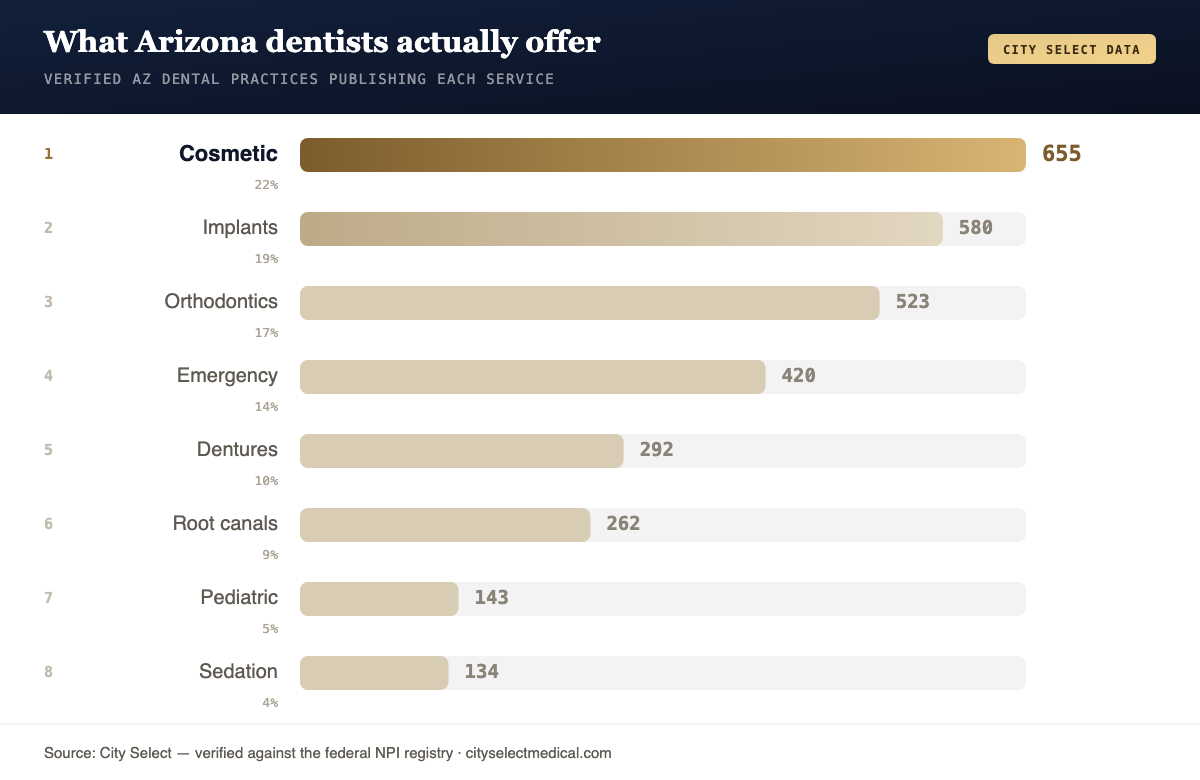
Sedation and pediatric care are the two that most often force a switch later. If you have dental anxiety, or children, check for them now — not after you've built a relationship with a practice that can't help you.
How we source this
The verification steps point at primary, public tools: the Arizona State Board of Dental Examiners' Professional License Search, and the federal NPPES registry. We're not asking you to trust us — we're telling you where to check for yourself, which is the whole point of a vetting guide.
The practice-trend figures come from the ADA Health Policy Institute, via ADA News (February 2024).
And a correction we owe you. An earlier version of this guide stated that ADA HPI data showed solo practice falling "from about two-thirds of dentists in 1999 to roughly half by 2019." We went back to the cited source and it says no such thing. What it actually reports is more useful: 17% of dentists who graduated in the last ten years are in solo practice, versus half of those who graduated more than twenty-five years ago — and 13% of U.S. dentists were DSO-affiliated in 2022, rising to 27% among those who graduated within five years. We've replaced the unsupported figures with the real ones. The directory statistics are our own, recounted at every build, and always framed as a floor rather than a census.
03 · FROM THE WEBQuestions people are actually asking
What are the red flags of a bad dentist?
The consistent ones: pressure to commit before you've had time to think, a treatment plan with an expiry date, unclear or shifting billing, an unwillingness to explain *why* a procedure is needed, and a dismissive response when you ask. Note what's *not* on that list — a dentist finding problems isn't a red flag. A dentist who can't or won't explain them is.
Is a DDS better than a DMD?
No. They are **equivalent degrees** — same accredited training, same licensing exams. Which letters a dentist holds depends on the school they attended, not on their ability. It is the single most common false tie-breaker in this decision.
How do I know if my dentist is overcharging me?
Ask for the treatment plan with **CDT codes** on it, then look each code up for your own ZIP at FAIR Health Consumer. Codes are what make two quotes comparable — without them you're comparing adjectives. Delta Dental of Arizona also publishes median Phoenix-metro fees you can sanity-check against.
Should I get a second opinion on a dental treatment plan?
On major work — roughly $1,500 and up — a second opinion is standard practice, not an insult, and any good dentist will say so. If a practice reacts badly to you seeking one, they've answered a different question for you.
1,095 NPI-verified Arizona dental practices. Filter by your city and the insurance they publish — then run the checks below on a shortlist of three, rather than cold-calling twenty.
04 · THE VISITThe first-call script, and the first appointment
Five questions, ninety seconds, and you'll know more than most patients learn in a year.
| Ask this | Because |
|---|---|
| "Are you in-network with my plan — not just accepting it?" | Different sentences, different bills |
| "When is your next new-patient appointment?" | Often weeks behind the existing-patient queue |
| "Do you provide written estimates before major work?" | An office that won't is telling you something |
| "How do you handle emergencies outside office hours?" | "Go to the ER" is an answer, just not a good one |
| "Do you see [kids / anxious patients / whatever applies]?" | Saves you outgrowing the practice in a year |
A front desk that fields five straight questions without friction is previewing how your billing dispute will go.
Judge the first appointment like an interview — because you're hiring
Did they take a full history? Explain the findings with the X-rays in view? Present options — including, where honest, a do nothing for now option — rather than a single expensive plan? You're hiring a long-term advisor, not buying a cleaning.
Watch for one thing most people miss: does the new office ask for your previous records and X-rays? A good practice wants them, unprompted — some problems are only visible as a change over time, and without your history they're working blind. An office that never asks, and instead re-shoots a full set of X-rays you had six months ago, is worth a question.
05 · CHOOSINGThe red flags worth walking away from
A treatment plan with a deadline
"This pricing is only valid today" belongs at a car dealership. Dentistry is not a limited-time offer, and a genuine clinical need doesn't expire on Friday.
Pressure to commit before you've thought
You're allowed to take the plan home. You're allowed to get a second opinion. A practice that makes either feel awkward has told you something important.
No written estimates — or estimates that reliably grow
Ask for it in writing, with CDT codes. If the number keeps moving after work starts, that's a pattern, not bad luck.
They never ask for your old records
A new office should want your previous X-rays and history. Working without them isn't just inconvenient — it makes tracking change over time impossible.
Every visit finds new urgent work
Especially if a second opinion disagrees. On a plan over roughly $1,500, a second opinion is standard practice.
You never see the same dentist twice
Not automatically bad — but ask. In high-turnover practices continuity of care genuinely suffers, and continuity is most of what a long-term dentist is for.
"A corporate or group practice is automatically worse." Not true, and the trend makes it an unhelpful filter anyway: just 17% of dentists who graduated in the last ten years are in solo practice, against half of those who qualified more than twenty-five years ago. Groups and solos simply fail differently — solos offer continuity but less coverage; groups offer coverage but sometimes less continuity. The question isn't "is this a group?" It's "will I see the same dentist each time?" Ask it directly.
If something goes genuinely wrong — care or conduct, not a billing dispute — the Arizona State Board of Dental Examiners accepts public complaints. Knowing that channel exists is part of choosing well, even if you never use it.
What our verification covers — and what's on you
Our directory verifies that a practice is real: checked against the federal NPI registry, with specialty, address and providers on file. It does not rank dentists by quality, and we never take payment for placement. It also cannot judge chairside manner, and it would be dishonest to pretend otherwise.
So: step one of the checklist is done before you arrive. Steps two through six are yours. That's the honest division of labour.
Score the practice on how it handles being questioned. Not on whether it finds problems — a dentist finding decay isn't a red flag, that's the job. Score it on what happens when you ask "why?", ask for it in writing, or mention a second opinion. A good practice treats all three as completely normal. How an office reacts to being checked tells you more than any review ever will.
The bottom line
The right dentist is the intersection of a verified licence, true network fit (in-network, not "accepted"), availability you can live with, and a first visit that feels like advice rather than a sales pitch. Ten minutes of checking — the Board's licence search, the five-question phone call, fees in writing — beats years of tolerating a mediocre fit.
Start where step one is already done for you: verified Arizona dentists, filterable by city and by the insurance they publish. Then run the rest of the checklist yourself — because for 43% of Arizona practices, the information simply isn't online to find.
Frequently asked questions
How do I verify an Arizona dentist's licence?
Use the Arizona State Board of Dental Examiners' Professional License Search — it's free and public, and the Board actively encourages patients to use it. Separately, every dentist has an NPI number in the federal NPPES registry. Every City Select listing is pre-checked against the NPI registry, so starting from a verified directory clears that step before you call.
Is a DDS better than a DMD?
No — they're equivalent. DDS (Doctor of Dental Surgery) and DMD (Doctor of Medicine in Dentistry) are the same degree with different names; the choice of title is the dental school's, not a measure of the dentist. Both complete the same accredited training and take the same licensing exams. Don't use it as a tie-breaker.
How do I find a dentist who takes my insurance?
Cross-check two sources, because they disagree: your insurer's provider directory (for network status) and the practice itself (directories go stale). Ask the office the precise question — 'are you in-network with my plan, not just accepting it?' Note that for roughly 43% of Arizona dental practices, we could not find or confirm any insurance information at all, so absence from a website means nothing either way.
What are the biggest red flags when choosing a dentist?
A treatment plan with a deadline ('this price is only good today'). Pressure to commit before you've had time to think. An office that won't put fees in writing before major work. An office that never asks for your previous records or X-rays. Every visit finding new urgent work. And no clear answer on how emergencies are handled after hours.
Should I choose a solo dentist or a group practice?
Neither is inherently better — they fail differently. Solo practices offer continuity: the same dentist every visit. Groups and DSO-affiliated practices offer easier scheduling and internal coverage when your dentist is away, but continuity can suffer. The trend is real: in ADA Health Policy Institute figures reported by ADA News in February 2024, just 17% of dentists who graduated in the last 10 years were in solo practice, against half of those who graduated more than 25 years ago. Decide which failure mode annoys you more — then ask, at the front desk, 'will I see the same dentist each time?'
How often should I actually go to the dentist?
Twice a year is the common default, but it's individual — a history of gum disease may mean more frequent cleanings, and excellent oral health may justify fewer. Ask your dentist to justify your interval rather than recite the standard one. If they can't explain why it's right for you, that's information too.
Is it OK to switch dentists?
Completely, and you don't owe an explanation. Request your records — X-rays included; you're entitled to copies, though a reasonable duplication fee is permitted — and the new office handles the rest. In fact, a good new office will ask for those records without being prompted.
What if I haven't been to a dentist in years?
Say exactly that when you book. Good practices hear it every week and won't shame you — and if one does, that's your answer about them. Expect a longer first visit with full X-rays, and possibly a deep-cleaning recommendation. If the plan feels aggressive, get a second opinion; on a treatment plan over roughly $1,500 that's standard practice, not an insult.
Should I trust online reviews of dentists?
Read them for patterns, not for the star average. Repeated mentions of upselling, surprise bills, or long waits are signal. One furious review about parking is noise. And remember reviews measure the front-of-house experience — the billing, the waiting, the manner — far better than they measure clinical quality, which patients generally can't assess.
Can I file a complaint about an Arizona dentist?
Yes. The Arizona State Board of Dental Examiners accepts public complaints and publishes a complaint process. It's the right route for genuine concerns about care or conduct — and it's separate from a billing dispute, which is usually a conversation with the office and your insurer first.
Find a verified dentist in Arizona
Every dentist on City Select is sourced from the federal NPI registry and organized by city and specialty — no pay-to-rank, no mystery. Filter by your city and insurance:
 Insurance & Costs
Dental Insurance in Arizona, Decoded: What "We Accept Your Plan" Really Means
Dental insurance isn't health insurance — it's closer to a prepaid discount card with a spending cap. Once you see the structure, every confusing EOB starts making sense.
 Choosing Care
Dental Specialists Explained: Who Do You Actually Need?
Dentistry has a specialist system just like medicine — and knowing who does what saves you referral loops, repeat exams, and occasionally the wrong surgery.
 Insurance & Costs
Emergency Dentist With No Insurance: Your Real Options in Arizona
A dental emergency without insurance feels like a trap. It isn't — there are five real doors, and knowing their order saves you hundreds and possibly your tooth.
Written by the City Select editorial team and edited by Alan S., Senior Editor. Drafted with AI assistance and checked against the official sources below. City Select is not a healthcare provider, and this guide is not medical advice. Our editorial & data standards →
- Arizona State Board of Dental Examiners — Professional License Search
- ADA News / ADA Health Policy Institute — practice modality by the numbers (Feb 2024)
- ADA Health Policy Institute — practice modalities among U.S. dentists
- NPPES NPI Registry
- American Dental Association — MouthHealthy patient resources
- Delta Dental of Arizona — usual & customary fees (median dentist fees, ZIP prefix 850)
- FAIR Health Consumer — dental cost lookup by ZIP and CDT code
- How we verify
This guide is for general information and isn't medical, legal, or insurance advice. Coverage, prices, and policies change — verify current details with the relevant provider, plan, or agency, and confirm with the practice before booking. Last updated July 12, 2026.