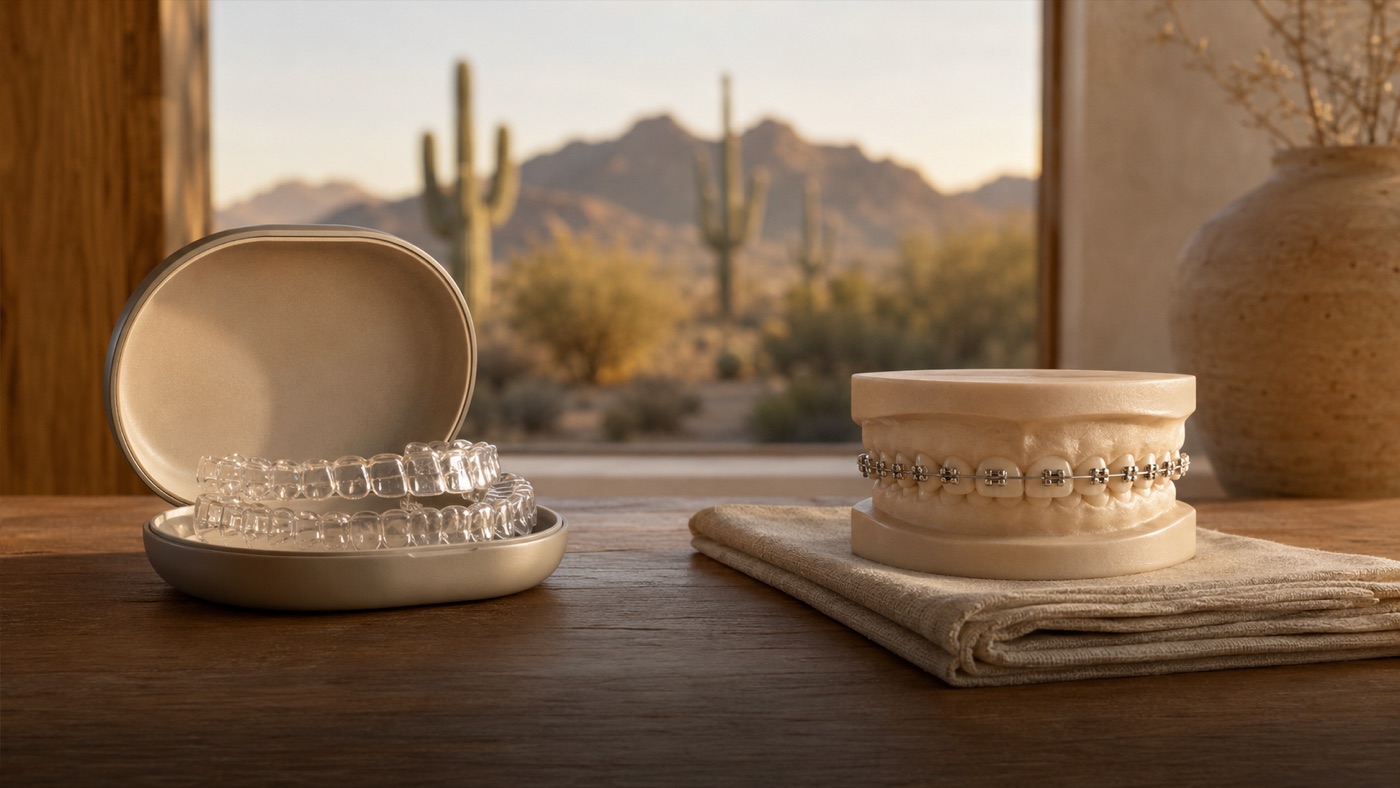
Invisalign vs. Braces in Arizona: Cost, Timeline, and Which Wins
The price gap between clear aligners and braces has narrowed enough that cost is no longer the decision. Which means the marketing has to work harder — and two things it doesn't mention are the ones people actually end up unhappy about.
This guide covers what each really costs in Arizona, the attachments and the refinements nobody warns you about, the orthodontic lifetime maximum that quietly decides your bill, and the honest question about discipline. We list 110 verified Arizona orthodontic practices when you're ready to get quotes for both.
- The gap has closed. Commonly published ranges: braces ~$3,000–$7,500, aligners ~$3,500–$8,500 — heavily overlapping. Your case matters more than the method.
- Two things aligner marketing skips: attachments (tooth-coloured bumps bonded to your teeth — they make trays much less invisible) and refinements (extra rounds of trays; ask if they're in the quote).
- Insurance rarely breaks the tie — both usually draw on the same lifetime orthodontic maximum, commonly $1,000–$3,000. Many plans don't cover ortho at all, and many cap it at age 19.
- Aligners fail one way: in a drawer. They assume 20–22 hours a day, every day.
- ⚠️ Mail-order aligners skip the exam. In an AAO survey, 77% of responding orthodontists had seen patients for retreatment after DTC treatment with no in-person examination.
01 · INSURANCEThe lifetime maximum decides more than the price
Orthodontic insurance works differently from the rest of dental coverage. Regular dental benefits reset each year. Orthodontic benefits usually carry a lifetime maximum — one pool, used once, ever — commonly $1,000–$3,000, and typically paid out as treatment progresses rather than up front.
- Comprehensive treatment, where the plan includes orthodontics at all
- Braces and clear aligners, usually on equal terms
- Payment as treatment progresses
- FSA/HSA dollars, which apply to both
- Anything above the LIFETIME maximum
- Adults, on many plans that cap orthodontic benefits at age 19
- Anything at all, on plans without an orthodontic benefit — which is a great many of them
- Purely cosmetic refinement once treatment is complete
Arizona-specific: on Delta Dental of Arizona's individual plans, orthodontic coverage is offered on the Palo Verde plan only — under a separate $1,500 lifetime maximum, and as an incentive benefit that begins in Year 2, not on day one. The other individual plans in that family don't cover orthodontics at all. If you're buying coverage with braces in mind, that single detail is the whole decision. The wider picture: dental insurance in Arizona, decoded.
Ask the three questions in writing before you enrol in anything: Does this plan include orthodontics? Does it cover adults? What is the lifetime maximum — and when does the benefit start? An orthodontic benefit that begins in Year 2 is not the same product as one that begins immediately, and the brochure will not make that obvious.
02 · COSTWhat each actually costs — and what drives it
| Braces | Clear aligners | |
|---|---|---|
| Commonly published range | $3,000–$7,500 | $3,500–$8,500 |
| Complex cases | Higher, esp. lingual | Higher; more refinement rounds |
| With insurance | Drawn from the same lifetime max | Drawn from the same lifetime max |
| CDT code to look up | D8080 (adolescent) · D8090 (adult) | D8080 · D8090 |
What actually drives each price. For braces: case complexity and duration (more adjustment visits), and bracket type — ceramic runs above metal, and lingual braces (behind the teeth) cost the most. For aligners: complexity translates into the number of trays and refinement rounds — which is where the quote surprise lives.
Four questions turn a vague quote into a real one. Ask all of them, of both providers:
"Are refinements included, or billed separately?"
The biggest cost surprise in aligner treatment. Get the answer in writing, and ask how many rounds are covered.
"How many attachments will my case need, and where?"
This is what decides whether "nearly invisible" is true for you. Ask before they're bonded on, not after.
"What do retainers cost — the first set, and replacements?"
You will need them indefinitely. Almost nobody budgets for them.
"What's the CDT code, and what's the total including everything?"
D8080 for an adolescent, D8090 for an adult. The code is what lets you check the number for your own ZIP at FAIR Health Consumer — and what makes two quotes genuinely comparable.
The plastic isn't the treatment. The diagnosis is the treatment — the trays are just how it gets executed.
"Clear aligners are basically invisible." Not once you have attachments. Attachments are small tooth-coloured bumps bonded to your teeth so the trays have something to grip and push against — and many cases need them, sometimes on most of the teeth in your smile. This is the single most common disappointment people report. It doesn't make aligners a bad choice. It does mean "nearly invisible" deserves a follow-up question: "How many attachments will my case need, and where will they go?" Ask it before you sign, not after they're bonded on.
"The quoted timeline is the timeline." Aligner timelines assume 20–22 hours of wear, every day — so the advertised duration is partly a prediction about you. And then there are refinements: extra rounds of trays issued when teeth don't track to the plan. They're common and not a failure — but they extend treatment, and people in orthodontic communities routinely describe spending a year or more in refinement rounds before finishing. Some give up and switch to braces. Ask whether refinements are included in the quote or billed separately. It is the aligner world's biggest cost surprise.
Get both quotes, itemised, and make each one answer three things: are refinements included, how many attachments, and what do retainers cost — the first set and the replacements. A complete quote covers the years after the smile, not just the months before it.
Braces are a decision you make once. Aligners are a decision you remake twenty times a day.
How we source this
We rebuilt this article's sourcing from scratch, and it's worth telling you why. The previous version cited exactly two sources: Invisalign.com — the manufacturer, quoted for the price of its own product, on a page whose entire job is to compare that product against the alternative — and an anonymous blog. Neither is acceptable on a page people use to spend several thousand dollars. Both are gone.
Here's what we use now, and its limits:
- There is no free, authoritative orthodontic fee benchmark. The ADA discontinued its Survey of Dental Fees in 2023, and federal law now bars the association from publishing fees. So we describe cost ranges as commonly published and tell you how to check your own: look up CDT code D8080 (adolescent) or D8090 (adult) for your ZIP at FAIR Health Consumer.
- Coverage terms come from Delta Dental of Arizona's own plan document — which is where we found that orthodontics is offered on the Palo Verde plan only, at a $1,500 lifetime maximum, starting in Year 2.
- The direct-to-consumer risk comes from the American Association of Orthodontists, including its member survey.
Where a number isn't published, we say so rather than borrow one from a company selling the thing.
03 · FROM THE WEBQuestions people are actually asking
Do you regret choosing Invisalign over braces?
The regret people describe most is rarely about the teeth — it's about **attachments** ("I have attachments on almost every tooth") and about **refinements dragging on.** One recurring story: *"Being in refinements for two years, I finally quit Invisalign and just paid for braces."* None of that means aligners are wrong for you. It means the two questions to ask are how many attachments your case needs, and whether refinements are in the quote.
I went in for an Invisalign consult and was told braces would be better. Should I trust that?
Frequently, yes — and notice the direction of the advice. An orthodontist steering you *away* from the more expensive, more marketed option, toward the tool that suits the correction, is telling you something good about them. Complex bite work and significant rotations are where brackets still win.
Is Invisalign actually worth the extra money?
The gap is smaller than people assume, and the honest answer is that it depends entirely on one thing you can predict better than any orthodontist: **will you wear them 20–22 hours a day, every day?** If the answer is genuinely yes, aligners buy you food freedom and discretion. If you're unsure, braces remove the question — they simply work, visibly.
Are cheap mail-order aligners a good deal?
The **American Association of Orthodontists** is direct about this: treatment should be under the direct, ongoing, **in-person** supervision of a licensed orthodontist. In an AAO member survey, **77% of responding orthodontists said they had seen patients come in for *retreatment*** after mail-order treatment that included no in-person examination. The risk isn't the plastic — it's the exam and the X-rays that don't happen. Moving teeth when there's undiagnosed gum disease can accelerate bone loss.
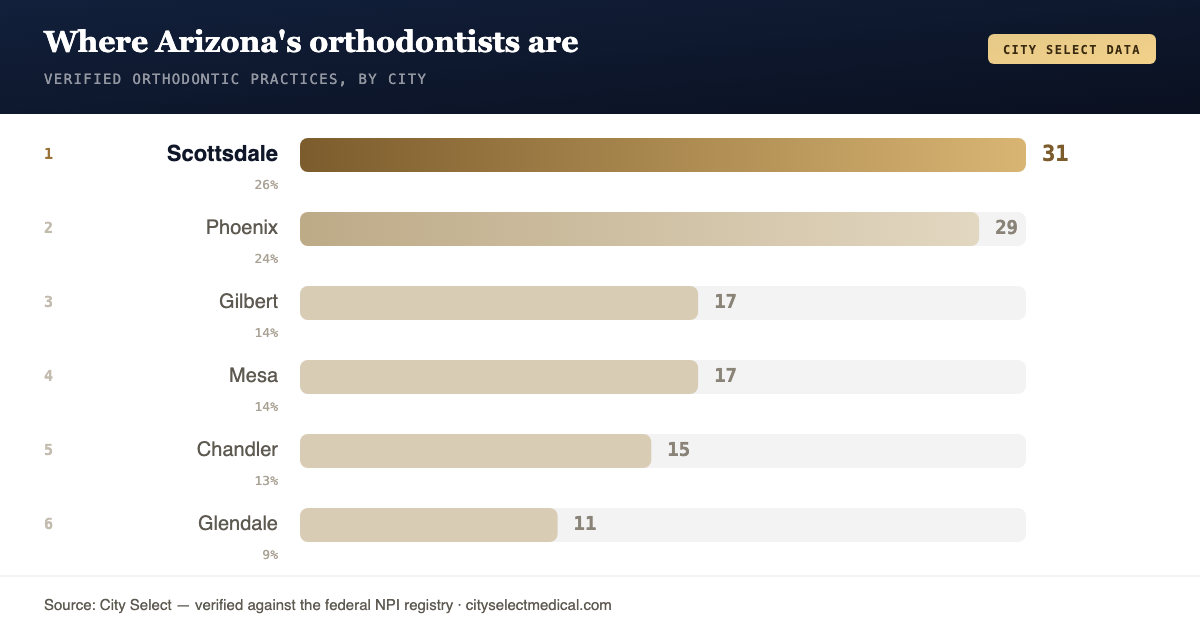
110 NPI-verified orthodontic practices across Arizona. Filter by city — then ask each one for an itemised quote for **both** braces and aligners, and compare like for like.
04 · THE VISITThe honest compliance question
Aligners fail one way: in a drawer.
The technology assumes 20–22 hours of daily wear. Every coffee with the trays out, every "I'll put them back after lunch" extends the timeline — and eventually the bill, through more refinements. This isn't a moral failing; it's a design constraint, and it's the single biggest predictor of whether aligners will go well for you.
Orthodontists see the pattern constantly and will tell you the truth if you ask them directly:
Ask the one question that gets an honest answer: "Given what you know about me — or about my teenager — which of these would you bet on?" It reframes the conversation from selling you a product to advising you on one. And on teenagers specifically: aligners spare the yearbook photos, but braces cannot be left in a lunchroom bin. Some practices offer teen aligners with built-in compliance indicators — ask whether yours does.
The mail-order question, answered plainly
The cheap option is cheap because it removes the doctor. No in-person examination. No X-rays. Limited monitoring.
The AAO's position is that orthodontic treatment should happen under the direct, ongoing, in-person supervision of a licensed orthodontist — and in its member survey, 77% of responding orthodontists reported seeing patients for retreatment after mail-order treatment that skipped the in-person exam. The mechanism of harm is not exotic: moving teeth in the presence of undiagnosed gum disease can accelerate bone loss. An exam and imaging are what catch that first.
"It's the same plastic, so it's the same treatment." The plastic isn't the treatment. The diagnosis is the treatment, and the trays are how it gets executed. If budget is the real constraint — and it often legitimately is — an in-person provider's payment plan is the safer discount than removing the clinician from the process. The AAO also urges patients to report adverse events from aligners to the FDA.
05 · CHOOSINGWhen each one clearly wins
Braces win when the correction is complex
Significant bite work and major rotations are still bracket territory. If two providers independently steer you to braces, listen.
Braces win when compliance is doubtful
They cannot be taken out, forgotten, or lost. For some teenagers — and some adults — that's not a limitation, it's the feature.
Aligners win when appearance during treatment matters
Professionally or personally. Just ask about attachments first, so "discreet" means what you think it means.
Aligners win for contact sports and wind instruments
You can take them out. This is a genuine, underrated advantage.
Either works when the case is simple
Which is exactly when you should get both quotes and let the numbers and your own honesty about discipline decide.
Get an in-person consultation either way. An orthodontist examines roots and bone on imaging before anything moves — and that examination is the safety layer the mail-order route removes.
If two independent orthodontists both tell you braces are the better tool for your case, believe them — especially given that they're steering you toward the cheaper, less-marketed option. That's advice, not a sale.
Verify the orthodontist, not just the brand. "Invisalign provider" is a product certification, not a specialty — general dentists offer aligners too, and many do it well. But orthodontics is one of the twelve recognised dental specialties (a three-year residency), and you can confirm anyone's licence free at the Arizona State Board of Dental Examiners. For a complex bite, that distinction is worth checking. More: dental specialists explained.
The bottom line
Price the two honestly — roughly $3,000–$7,500 for braces and $3,500–$8,500 for aligners, ranges that overlap heavily — and the cost gap usually shrinks below the lifestyle differences. Then ask the questions the marketing doesn't: how many attachments, are refinements included, and what do retainers cost?
Check whether you have an orthodontic benefit at all before assuming coverage — in Arizona, Delta Dental's individual ortho benefit exists on one plan, with a $1,500 lifetime maximum, starting in Year 2. And answer the compliance question about yourself truthfully, because aligners only fail one way: in a drawer. Then get quotes for both, in person: verified Arizona orthodontists.
Frequently asked questions
Is Invisalign more expensive than braces?
Usually somewhat, but the gap has narrowed a great deal. Commonly published ranges put braces around $3,000–$7,500 and clear aligners around $3,500–$8,500, with complex aligner cases running higher. Because the ranges overlap heavily, your specific case matters more than the method — which is why the honest advice is to get quotes for both and decide on fit, not price.
What are Invisalign attachments, and why does nobody mention them?
Attachments are small tooth-coloured bumps bonded to your teeth so the aligners have something to grip and push against. Many cases need them, sometimes on most teeth. They are the single most common disappointment people report: with attachments across your smile, aligners are considerably less invisible than the marketing suggests. Ask at the consultation: 'How many attachments will my case need, and where?'
What are refinements, and will they cost me extra?
Refinements are additional rounds of aligners issued when your teeth don't track to the original plan — which is common, not a failure. The critical question is whether they're included in your quote or billed separately, because that's the aligner world's biggest cost surprise. Refinements can also extend treatment considerably; people in orthodontic forums describe spending a year or more in refinement rounds.
Does insurance cover Invisalign the same as braces?
Where a plan covers orthodontics at all, aligners and braces usually draw from the same pool — so insurance rarely breaks the tie. The bigger question is whether you have ortho coverage in the first place. On Delta Dental of Arizona's individual plans, orthodontic coverage is offered on the Palo Verde plan only, under a separate $1,500 lifetime maximum, and it's an incentive benefit that begins in Year 2. Check three things: does the plan include ortho, does it cover adults, and what's the lifetime maximum.
What is a lifetime orthodontic maximum?
Unlike regular dental coverage, which resets every year, orthodontic benefits usually carry a LIFETIME maximum — one pool, used once, ever. Commonly $1,000–$3,000. That number, not the coverage percentage, is typically your real benefit, and it usually pays out as treatment progresses rather than up front.
Which is faster, Invisalign or braces?
It depends on the case, not the brand. Mild-to-moderate crowding often finishes in a similar window either way; complex bite corrections frequently favour braces. And an aligner timeline assumes 20–22 hours of daily wear — the advertised duration is a compliance-included estimate, which means it's partly a prediction about you.
Are mail-order aligners a safe cheaper alternative?
The American Association of Orthodontists says treatment should be under the direct, ongoing, in-person supervision of a licensed orthodontist. In an AAO member survey, 77% of responding orthodontists reported seeing patients for retreatment after mail-order treatment that included no in-person exam. The core risk is what's skipped: without an examination and imaging, existing gum disease or bone loss can be missed — and moving teeth in the presence of gum disease can accelerate bone loss. If budget is the constraint, an in-person provider's payment plan is the safer discount.
Do adults get braces, or is Invisalign the adult option?
Both work at any age, and adult braces — including less visible ceramic brackets — are common. Adults often lean toward aligners for appearance and food freedom, but complex adult cases still frequently end up in brackets, because that's what the correction requires. Note that the billing code differs by age: D8080 is comprehensive orthodontic treatment for an adolescent, D8090 for an adult.
Do I need retainers forever?
Effectively, yes — teeth drift back without them, and that's true after braces and after aligners alike. Retainers are the part almost nobody budgets for. Ask what the first set costs and what replacements cost, and get both written into the quote. A complete quote covers the years after the smile, not just the months before it.
How do I check whether a quote is reasonable?
Ask for the treatment plan with its CDT code — D8080 for adolescent comprehensive treatment, D8090 for adult — then look the code up for your own ZIP at FAIR Health Consumer. Codes are what make two quotes comparable. Be aware that no free authoritative orthodontic fee benchmark exists any more, so triangulating is the best available approach.
Find a verified orthodontist in Arizona
Every orthodontist on City Select is sourced from the federal NPI registry and organized by city and specialty — no pay-to-rank, no mystery. Filter by your city and insurance:
 Insurance & Costs
Dental Insurance in Arizona, Decoded: What "We Accept Your Plan" Really Means
Dental insurance isn't health insurance — it's closer to a prepaid discount card with a spending cap. Once you see the structure, every confusing EOB starts making sense.
 Choosing Care
How to Choose a Dentist in Arizona: The Checklist That Actually Works
Most people choose the dentist closest to work and hope. Ten focused minutes of checking does better — here's exactly what to check, and the red flags that matter.
 Choosing Care
Dental Specialists Explained: Who Do You Actually Need?
Dentistry has a specialist system just like medicine — and knowing who does what saves you referral loops, repeat exams, and occasionally the wrong surgery.
Written by the City Select editorial team and edited by Alan S., Senior Editor. Drafted with AI assistance and checked against the official sources below. City Select is not a healthcare provider, and this guide is not medical advice. Our editorial & data standards →
- American Association of Orthodontists — health risks of mail-order orthodontics
- American Association of Orthodontists — consumer alert on direct-to-consumer orthodontics
- FAIR Health Consumer — dental cost lookup by ZIP and CDT code
- Delta Dental of Arizona — Individual & Family plan comparison (eff. 1/1/2026)
- American Dental Association — CDT procedure codes
- U.S. Food & Drug Administration — MedWatch adverse event reporting
- Arizona State Board of Dental Examiners — Professional License Search
- NPPES NPI Registry
- How we verify
This guide is for general information and isn't medical, legal, or insurance advice. Coverage, prices, and policies change — verify current details with the relevant provider, plan, or agency, and confirm with the practice before booking. Last updated July 12, 2026.