
Tummy Tuck vs. Liposuction vs. CoolSculpting: Which Fixes What
These three get shopped as though they're rungs on a ladder — cheap, medium, expensive — and they are not. They fix three different problems, and buying the wrong one doesn't buy you a smaller result. It buys you nothing.
So the useful question isn't "which should I get?" It's "what is actually wrong?" Stand in front of a mirror and be honest, because the answer picks the procedure for you — and it's free.
- Loose skin, or separated muscles → only a tummy tuck. Nothing non-invasive competes, because the problem isn't fat.
- Stubborn fat with good skin tone → liposuction, or CoolSculpting for a genuinely small pocket.
- ⚠️ The complication of the "non-surgical" option is treated with surgery. Paradoxical adipose hyperplasia — treated fat grows — does not resolve on its own, and the standard fix is liposuction or excision, usually 6–9 months later.
- ⚠️ And liposuction has its own irreversible failure mode: contour irregularity, a particular risk in thin patients. Neither option is the "safe" one. They fail differently.
- Liposuction is not weight loss. It's contouring. All three assume a stable weight.
01 · THE MIRROR TESTSkin, fat, or muscle?
This costs nothing and it decides everything.
Pinchable fat, and the skin snaps back? That's a fat problem. Liposuction (one decisive event) or CoolSculpting (smaller change, no downtime) are both on the table.
Skin that hangs, folds, or is striped with stretch marks below the navel? That's a skin problem. Only excision removes skin — that's a tummy tuck, and nothing else in this article touches it.
A midline bulge, or "doming" when you sit up — common after pregnancy? That is likely diastasis recti: a muscle problem. Only surgical repair closes it. This is the one that explains why nothing you've tried has worked — because the problem was never fat, and you've been treating fat.
Some of everything? That's the usual post-pregnancy or post-weight-loss reality, and it's combination territory — see the mommy makeover math.
The mirror test is free, and it is the most valuable step in this entire process. Skin problem, fat problem, or muscle problem. Most of the money wasted in body contouring is spent by people treating the wrong one — and the person selling you a treatment is rarely the person who'll tell you that you're treating the wrong one. Do the test before you walk into any consultation, so you can tell whether the advice you get matches what you already know about your own body.
Bring the mirror test to the consult as a question, not a conclusion. Say: "My read is that this is mostly a skin problem — do you agree, and what tells you that?" You'll learn two things at once: whether your self-assessment was right, and whether this provider will disagree with a paying customer. A surgeon who corrects you, with reasons, has just done you a favour worth more than the consult fee.
If significant weight loss is still in progress, wait. All three procedures assume a stable weight, and a result bought mid-journey gets bought twice. This is the single most common piece of money a surgeon will tell you not to spend — and if a provider won't say it to you, notice that.
"Liposuction is for losing weight." It isn't, and it's worth being blunt: liposuction is a contouring procedure, not a weight-loss procedure. It removes localised deposits to change a shape. It is not a treatment for obesity, and it is not a shortcut around one. A surgeon who agrees to use it as one is not doing you a favour.
02 · COSTWhat each actually costs — and the trap in the cheapest one
| Tummy tuck | Liposuction | CoolSculpting | |
|---|---|---|---|
| ASPS 2024 surgeon fee | $8,000–$13,500 | $4,300–$7,500 | ~$1,157 per session (2023 avg.) |
| What that excludes | Anesthesia · facility · garments · follow-ups | Same | Usually priced per area, per session |
| Invasiveness | Major surgery | Surgery | Non-invasive |
| Downtime | Weeks | About a week | Essentially none |
| Fixes skin? | Yes — only this does | No | No |
| Fixes muscle separation? | Yes — only this does | No | No |
The trap is that the cheapest option is priced per session, and the expensive ones are priced per operation. That is not a like-for-like comparison, and the whole marketing logic of non-invasive fat reduction depends on you not noticing.
Ask for the projected total, not the per-session price. Multiple sessions across two areas can climb toward the surgeon's fee for liposuction — for a subtler result.
"Each session removes 20–25% of the fat." You will see this number everywhere. We're not repeating it as a fact, because we couldn't source it to peer-reviewed literature — it's a marketing figure, and it does a lot of work in a sales conversation. Ask instead: "How many sessions do you project for me, what's the total, and what does the result look like if it works — on a patient who started where I'm starting?" Vague answers to a specific question about your own body are the answer.
Buy the procedure that matches the problem, not the one that matches the budget. The wrong one at any price costs more than the right one.
03 · FROM THE WEBQuestions people are actually asking
"CoolSculpting or lipo for me?"
The replies are close to unanimous, and blunt: *"Don't waste your money on CoolSculpting — $3,000 gone."* Another: *"I paid $2.6k for it, it didn't work. So then I had to pay for lipo — which obviously works. But ultimately it drove the price to treat the area up."* **That's the real cost trap: not the price of CoolSculpting, but the price of CoolSculpting *plus* the liposuction you have afterwards.**
"Is CoolSculpting really worth it?"
— and here's the reply that keeps this honest, because it cuts the other way: *"Even a completely minimal improvement from CoolSculpting would've been better than what she ended up with after lipo. **Contour deformities** [are] a fairly big risk of lipo on a thin woman with little fat — and [are] essentially unfixable."* **Both options have an irreversible failure mode. Anyone selling you one as "the safe choice" is selling.**
"Is PAH actually rare?"
One commenter puts it exactly as the researchers do: *"One of the reasons PAH is 'rare' is because so many aren't sure if they have it. If you are dealing with that, you should definitely report it."* **The literature agrees that PAH is under-recognised.** You can report an adverse event to the [FDA through MedWatch](https://www.fda.gov/safety/medwatch-fda-safety-information-and-adverse-event-reporting-program).
"Why hasn't anything worked on my lower belly?"
If there's a midline bulge that domes when you sit up, you may be looking at **diastasis recti** — separated abdominal muscles. **No diet, no workout, and no fat treatment closes it**, because it isn't a fat problem. That realisation is the single most useful thing on this page for a lot of people.
"The internet says CoolSculpting is a scam, so liposuction must be the safe answer." That's the wrong lesson to draw from those threads, and drawing it can hurt you. The patient sentiment is overwhelmingly negative — but the same conversations contain people who were badly served by liposuction, including with contour deformities that are very difficult to correct, especially in thinner patients with little fat to work with. Neither procedure is the safe one. They have different failure modes, and the right question isn't "which is safer" but "which failure mode am I exposed to, and what does this provider do about it?"
04 · THE RISKThe complication nobody mentions at the free consultation
This is the part that reframes the whole comparison, so we're giving it its own section.
Paradoxical adipose hyperplasia (PAH) is the complication where the treated fat enlarges instead of shrinking — appearing weeks to months later as a firm, well-defined mass in exactly the area you were trying to reduce. One patient's summary is hard to improve on: "I got PAH and I look way worse than if I had just left it alone."
Two facts about it deserve far more prominence than the industry gives them:
1. It does not resolve on its own. The literature describes no spontaneous resolution. Waiting is not a treatment.
2. The standard treatment is surgery. Corrective liposuction or direct excision — and in some cases abdominoplasty. Treatment is typically delayed six to nine months until the tissue softens, and some patients require a second procedure.
Read that again in the context of why people choose CoolSculpting. They choose it to avoid surgery. Its principal complication is corrected with surgery — after a six-to-nine-month wait. That doesn't make it a bad option for the right, small problem. It does mean that "non-surgical" describes the procedure, not the risk, and that the consent conversation you're owed is not the one most med spas are having.
How common is it? Nobody can tell you precisely, and be sceptical of anyone who says otherwise. Published estimates vary widely — manufacturer-reported figures are the lowest in the literature, peer-reviewed multicentre and meta-analytic estimates run higher, and researchers specifically note that PAH is under-recognised because patients don't know what they're seeing. We cite the peer-reviewed range and refuse to quote the manufacturer's number on its own.
"Non-surgical" describes the procedure. It does not describe the risk.
Ask the PAH question out loud, in these words, before you pay: "What is your protocol if I develop paradoxical adipose hyperplasia — who diagnoses it, who performs the corrective surgery, and who pays for it?" The answer to "who pays" is the one that matters, and it is very rarely volunteered. A provider who has thought about it will have a clear answer. A provider who hasn't will tell you it's too rare to worry about — which is not a protocol.
Know what you're watching for
PAH shows up weeks to months after treatment — not immediately. A firm, well-defined enlargement in the treated area, often described as unusually solid.
Don't wait it out
The literature describes no spontaneous resolution. Time is not a treatment here.
Expect a delay before it can be corrected
Surgical correction is typically deferred 6–9 months until the tissue softens. That's a long time to live with it, and it belongs in your decision now.
Report it
Adverse events can be reported to the FDA via MedWatch. Under-reporting is precisely why the published rates are uncertain.
When CoolSculpting actually works — because it does, for the right person
It would be lazy and untrue to write off a whole procedure because it's oversold. CoolSculpting works — genuinely, permanently, for the fat cells it treats — when the person is the right candidate. The reason the patient reviews are so polarised is that it's sold far outside the narrow band of people it suits. Here's the band.
You're near your goal weight already
Best candidates are at or close to their target — often cited as within roughly 10–30 lb. It is a contouring tool for a stubborn spot, not a weight-loss tool. Used on someone with a lot of fat to lose, it "doesn't work" — because it was never the tool for that job.
The fat is pinchable
Soft, subcutaneous fat you can grab between two fingers. It cannot treat the firm, deeper fat behind the abdominal wall, so a belly that's firm rather than pinchable won't respond.
Your skin has good elasticity
The skin has to retract over the new contour. Reduce fat under loose skin and you can be left with more looseness, not a better shape — which is the mirror test again: if skin is the problem, no fat tool fixes it.
Your expectations are calibrated to the tool
It's a modest reduction over months, not a single dramatic change. People who expected a liposuction result from a non-surgical treatment report that it "failed"; people who expected a subtle improvement in a small pocket tend to be satisfied.
"It didn't work for me" and "it doesn't work" are different claims — and the gap between them is candidacy. The honest read of the reviews isn't that CoolSculpting is a scam; it's that a treatment with four fairly strict candidacy criteria is routinely sold to people who meet one or two of them. If you're near your goal weight, with a small pinchable pocket and good skin tone, and you want a subtle change without downtime, you are the person it was designed for. If you're not all four of those, the disappointment in those threads is describing you, not the machine. A provider willing to tell you you're not a candidate is worth more than one willing to sell you three sessions.
How we source this
We rewrote this page because it under-stated a real risk and over-stated a marketing number, and both errors flattered the same product.
- The previous version described PAH as "uncommon but real" in an FAQ. That's too gentle. The literature says it does not resolve spontaneously and that the standard treatment is surgery, delayed 6–9 months. A risk that is fixed with an operation is not a footnote on a page about avoiding operations.
- The previous version asserted that each session removes "20–25% of fat." We could not source that to peer-reviewed literature, so we've stopped stating it. It's a marketing figure, and repeating it made us part of the sales pitch.
We also refused to let the correction run away with us. The patient sentiment on CoolSculpting is overwhelmingly negative, and it would be easy — and popular — to write a hit piece. But the same threads contain the counterweight: liposuction's contour deformities can be essentially unfixable, particularly in thin patients. An article that hid that in order to land a cleaner argument would be doing to liposuction exactly what the industry does to CoolSculpting. Both risks are on this page, at the same volume.
On costs: ASPS 2024 ranges, labelled surgeon fee only, because that's what they are. Patient reports that cryolipolysis causes scar tissue complicating later surgery are just that — patient reports. We couldn't verify it, so we're not asserting it.
05 · CHOOSINGMatch the tool to the problem
Do the mirror test first, honestly
Skin, fat, or muscle? It's free, it takes a minute, and it eliminates most of the menu.
Then get a consult with someone credentialed across the whole menu
A provider who only offers one of the three has an incentive gradient. Who's actually qualified to advise.
Ask what happens if it doesn't work
For CoolSculpting: "What's your PAH protocol, and who pays for the correction?" For liposuction: "What's your revision policy for contour irregularity?" Both questions are fair. Both answers are informative.
Price the result, not the session
Get the projected total in writing. A per-session price next to a per-operation price is not a comparison.
If weight loss is ongoing, wait
Every one of these assumes a stable weight.
Arizona-specific: 63% of the state's 48 verified plastic surgery practices are in Scottsdale — the deepest consult bench in Arizona for exactly this comparison, and a market where all three services are sold aggressively side by side. That's an advantage: you can afford to get a second opinion, and you should, particularly if the first provider you saw happens to sell only one of the three things you're choosing between.
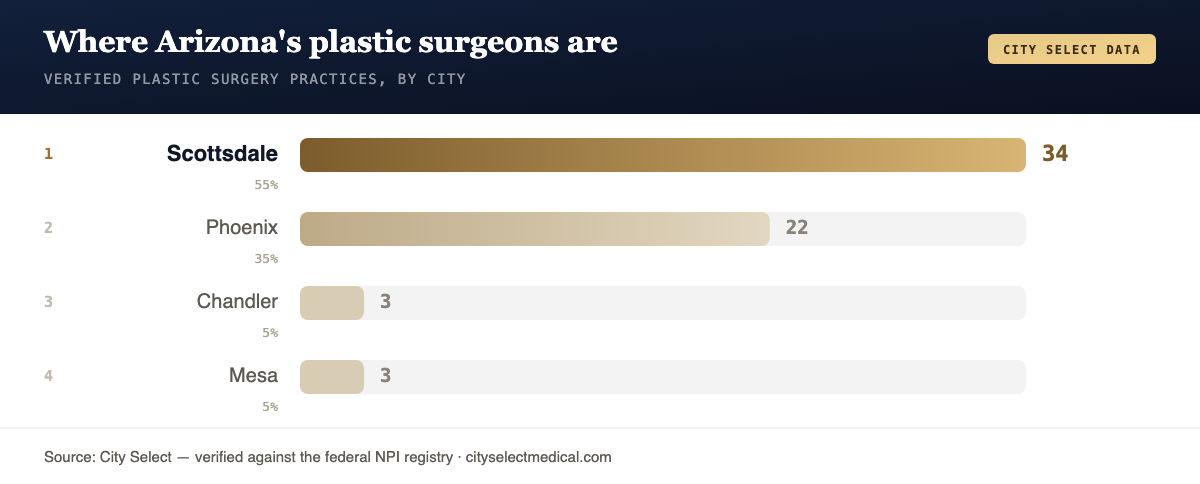
48 NPI-verified Arizona plastic surgery practices — filter by city, then ask a surgeon who offers **all three** what your problem actually is.
The bottom line
Skin and muscle problems need surgery. That's the tummy tuck's territory, and nothing non-invasive competes — because the problem was never fat.
Fat problems give you a real choice, and it's a choice between two different failure modes, not between a risky option and a safe one. CoolSculpting's is PAH — which doesn't resolve on its own and is corrected with surgery, six to nine months later. Liposuction's is contour irregularity — which can be very hard to fix, especially if you're thin. Ask both providers what happens when it goes wrong, and listen carefully to which one has an answer.
Diagnose in the mirror. Confirm with someone whose credentials you've checked. Price the result, not the session. Start here: verified Arizona plastic surgeons.
Frequently asked questions
Can CoolSculpting replace a tummy tuck?
No — they address entirely different problems, and this is the most expensive misunderstanding in body contouring. CoolSculpting targets small pockets of fat. A tummy tuck removes loose skin and repairs separated abdominal muscles. If your issue is skin laxity or post-pregnancy muscle separation, no amount of fat reduction will touch it, because the fat was never the problem.
What is paradoxical adipose hyperplasia, and how is it treated?
PAH is the complication where treated fat enlarges instead of shrinking — a firm, well-defined mass appearing in the treated area weeks to months later. Two things about it deserve more attention than they usually get. First, the literature describes no spontaneous resolution: it does not go away on its own. Second, the standard treatment is surgery — liposuction or excision, and in some cases abdominoplasty — typically delayed six to nine months until the tissue softens, with some patients needing a further procedure. In other words, the main complication of the non-surgical option is treated with surgery.
How common is PAH really?
Published estimates vary a great deal, and the honest answer is that nobody knows precisely. Manufacturer-reported figures are the lowest in the literature; peer-reviewed multicentre and meta-analytic estimates run higher, and researchers specifically note that PAH is under-recognised — patients often don't know what they're looking at, so it goes unreported. Treat any single confident number with suspicion, including a low one. If you think you have it, you can report it to the FDA through MedWatch.
So is CoolSculpting a scam?
No — but it is frequently sold to people it was never going to help, and satisfaction reports from patients are genuinely poor. It has a legitimate place: a small, pinchable pocket of fat in someone with good skin tone who cannot take downtime or does not want surgery. It fails when it's bought as budget liposuction for a job that needed surgery — which is the story patients tell over and over, usually followed by paying for the liposuction anyway.
Does liposuction have its own risks I should weigh?
Yes, and they deserve equal billing. The one worth understanding is contour irregularity — dents, waviness, or asymmetry — which is a particular risk in thinner patients who have relatively little fat to work with, and which can be very difficult to correct. Liposuction is not the automatically safe choice; it's the choice with a different failure mode. This is why surgeon experience with your specific body type matters more than the brochure suggests.
How many CoolSculpting sessions will I need, and what will it really cost?
Ask for the projected total, not the per-session price — that's the whole game. Practices commonly plan multiple sessions per area, and the per-session figure that sounds affordable multiplies quickly. ASPS put the average physician fee for non-invasive fat reduction at roughly $1,157 per session in its most recent single-figure data. Two areas across a few sessions can approach the surgeon's fee for liposuction, for a subtler result.
What is diastasis recti, and which procedure fixes it?
It's the separation of the abdominal muscles that's common after pregnancy — the cause of the lower-belly 'pooch' that survives every workout and every diet. Only surgical repair closes it, typically as part of a tummy tuck. No fat treatment reaches it, because the problem isn't fat. If you have doming down the midline when you sit up, this is likely what you're looking at, and it explains why nothing you've tried has worked.
Is liposuction a weight-loss procedure?
No. It is a contouring procedure, and it should be judged as one. It removes localised deposits of fat to change a shape; it is not a treatment for obesity and it is not a substitute for weight loss. All three procedures on this page assume a stable weight — results bought mid-journey get spent twice.
Can I combine liposuction with a tummy tuck?
Commonly, yes — liposuction contours the flanks while the tuck handles skin and muscle, in a single anesthesia event, which is usually cheaper than two separate operations. Whether combining is safe *for you* is a surgeon's judgement based on operative time and your health profile, and it's a legitimate reason for a surgeon to say no.
Find a verified plastic surgeon in Arizona
Every plastic surgeon on City Select is sourced from the federal NPI registry and organized by city and specialty — no pay-to-rank, no mystery. Filter by your city and insurance:
 Insurance & Costs
Liposuction: What It Costs, What It Can't Do, and the Six-Month Rule
America's most-performed cosmetic surgery is also its most misunderstood purchase. What it really costs, what it can't do, and why you can't judge it for six months.
 Local Guides
Mommy Makeover in Scottsdale: What It Bundles, What It Costs, and When to Stage
It's a marketing term for a bundle you design — which means the cost, the recovery, and even whether it's safe to do at once are all variables. Here's how to set them.
 Choosing Care
Plastic Surgeon vs. Cosmetic Surgeon vs. Med Spa: Who Should Actually Treat You
Three kinds of providers share one vocabulary. The honest test isn't who has the longest training — it's who is qualified to handle the day it goes wrong.
Written by the City Select editorial team and edited by Alan S., Senior Editor. Drafted with AI assistance and checked against the official sources below. City Select is not a healthcare provider, and this guide is not medical advice. Our editorial & data standards →
- ASPS 2024 Procedural Statistics — average surgeon/physician fees
- Incidence of paradoxical adipose hyperplasia after cryolipolysis — systematic review and meta-analysis (Aesthetic Surgery Journal)
- Multicenter evaluation of PAH following cryolipolysis — 8,658 cycles in 2,114 patients (Aesthetic Surgery Journal)
- Treatment of paradoxical adipose hyperplasia following cryolipolysis (PubMed)
- Paradoxical adipose hyperplasia — StatPearls / NCBI
- FDA MedWatch — report an adverse event
- ABMS Certification Matters — verify board certification
- NPPES NPI Registry
- How we verify
This guide is for general information and isn't medical, legal, or insurance advice. Coverage, prices, and policies change — verify current details with the relevant provider, plan, or agency, and confirm with the practice before booking. Last updated July 13, 2026.