
Liposuction: What It Costs, What It Can't Do, and the Six-Month Rule
Liposuction is the most-performed cosmetic surgery in the country, and it may also be the most misunderstood purchase in it. Two ideas cause almost all the disappointment: that it's a way to lose weight, and that you can tell how it went at the six-week mark.
Neither is true. It's a contouring procedure — it changes a shape, not a number on the scale — and you genuinely cannot judge the result for about six months. Get those two straight and most of the regret in the reviews evaporates. This guide covers what it actually costs, the safety limits that matter, and the difference between the lumps that heal and the lumps that don't.
- The advertised figure is the surgeon's fee. ASPS 2024 puts it at $4,300–$7,500 — surgeon fee only, before anesthesia, facility, and garments. ASPS dropped the single "average" after 2023.
- It is not weight loss. It's contouring, for someone near a stable weight with good skin tone.
- ⚠️ You can't judge it for ~6 months. Swelling and lumps at 6–8 weeks are usually normal. Permanent dents and waviness are usually the surgeon — over-suctioning — not bad luck.
- ⚠️ Volume matters. ASPS calls 5 litres "large-volume," with higher complication rates, and says there's no safe absolute maximum. Over 5 L belongs in an accredited facility with overnight monitoring — not an outpatient office.
- The operator matters more than the machine. Laser, ultrasound, VASER — the wand is marketing; the surgeon is the result.
01 · THE EXPECTATIONThe sentence that should precede every quote
Liposuction permanently removes localised fat that diet and exercise haven't shifted — flanks, abdomen, thighs, arms, chin. It sculpts. It does not shrink.
The honest filter is simple. If the goal is losing thirty pounds, liposuction is the wrong aisle. If the goal is the stubborn area that survived losing thirty pounds, it's the right conversation. And if the real problem is loose skin rather than fat — common after pregnancy or major weight loss — no amount of fat removal helps, and removing fat under loose skin can leave you more loose, not less. That's excision territory: which procedure fixes which problem.
Liposuction rewards the person who arrives near the finish line. It punishes the one who uses it to start the race.
Do the pinch-and-snap test in the mirror before you book a consult. Pinch the area that bothers you: if it's soft, grabbable fat and the skin springs back when you let go, you're in liposuction's territory. If the skin is loose and slow to retract, or the fullness is firm and deep rather than pinchable, liposuction may make it look worse, not better — and you want a surgeon who says so. Bring the test to the consult as a question: "Is my issue fat, or skin?"
"I'll lose a dress size and a lot of weight." You may lose the dress size. You will not lose much weight — and chasing weight loss is where liposuction goes wrong. As patients put it repeatedly, the people with bad reviews are usually the ones who needed to lose weight first: "ideal results are achieved if the patient is close to their goal weight." Liposuction rewards people who arrive near the finish line. It punishes people who use it to start the race.
02 · COSTWhat the advertised number leaves out
| Component | Commonly quoted | Notes |
|---|---|---|
| Surgeon's fee | $4,300–$7,500 | ASPS 2024 range — this is the advertised number |
| Anesthesia + facility | $1,500–$3,500 | Confirm who administers anesthesia, by credential |
| Per-area guides | Abdomen ~$3,000–$7,500 · chin ~$2,000–$5,000 · thighs/flanks ~$2,500–$6,000 | Ranges, not a fixed menu |
| Garments & follow-ups | $100–$400 | Rarely mentioned, always billed |
Doing more than one area? The math works in your favour. Anesthesia and facility fees are charged per surgical event, not per area — so adding a second area to one session costs far less than booking a separate surgery later. That's a legitimate saving. It is not, however, a reason to treat a single session as a bulk-buy: the volume-safety limits below still apply.
Ask for the quote per area, itemised
"Abdomen $X, flanks $Y, plus one shared anesthesia and facility fee." A single lump sum can't be compared to another surgeon's.
Confirm garments and follow-ups are included
Both are always billed and often left off the headline number.
Get the revision policy in writing
What qualifies, the window, and what a touch-up would cost you.
Confirm the facility and where large volume goes
If your plan is large-volume, ask whether it moves to an accredited facility with an overnight stay.
Get the quote itemised, and get the revision policy in writing. Two liposuction quotes are only comparable if they cover the same areas, the same facility, and the same number of follow-ups — and the one number people forget to ask about is what a revision costs if the result needs touching up. Ask before you pay, not after. The full consult checklist applies here in full.
03 · FROM THE WEBQuestions people are actually asking
"Did my liposuction fail? I'm bigger than before."
Almost always, no — not yet. *"After surgery I was bigger than I came in. Tons of swelling… after 4 weeks and some lymphatic drainage the swelling melted off and the results were dramatic."* **Immediate swelling routinely makes you look larger.** Ten days, six weeks — that's not the result. The result is months away.
"I'm lumpy and uneven at 7 weeks — is this normal?"
Usually yes — a surgeon's reply in one thread: patients are *"typically still swollen at 7 weeks out even if it doesn't seem like it… wait 6–8 months before deciding if revision is necessary."* Firmness and lumps during healing are common, and lymphatic massage is the standard aid. **The panic point and the judgement point are months apart.**
"Surgeon overdid my lipo — how do I fix it?"
This is the different, harder story, and it's worth telling plainly. **Permanent** contour irregularity is usually a technique problem: *"caused by uneven liposuction and areas where fat was taken too superficially… the problem wasn't that you had lipo, it's that whoever administered it wasn't really great at it."* This is why the surgeon, not the machine, is the decision.
"Does technology like VASER or laser give better results?"
The marketing says yes; the outcomes say the operator. Every technique loosens fat a bit differently, but complication rates and results track the **surgeon's** skill. Choose the person; let them pick the tool.
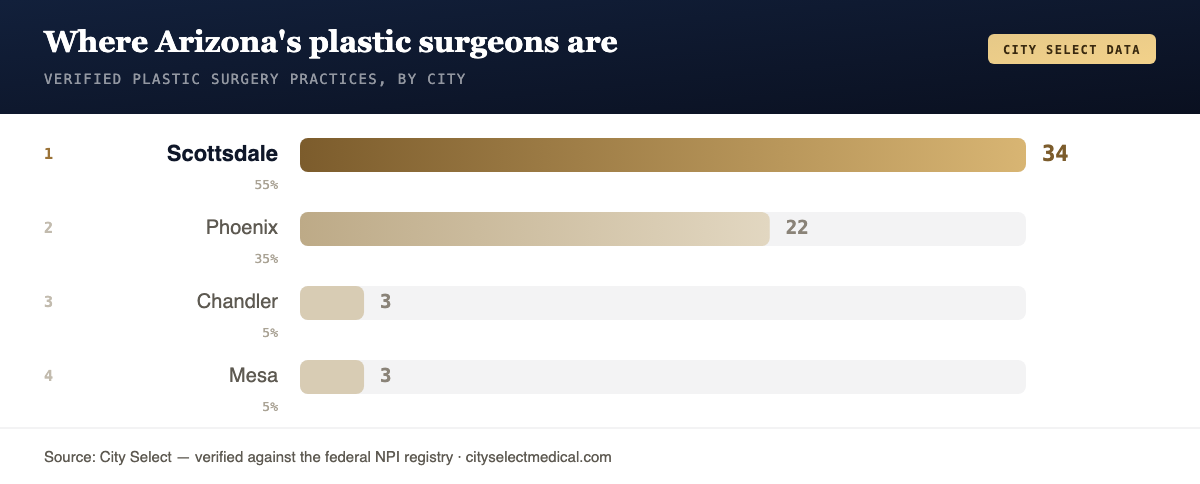
48 NPI-verified Arizona plastic surgery practices. Because liposuction's popularity makes it the procedure most often offered by under-qualified providers, run the credential check *first* — then compare itemised quotes among the ones who pass.
04 · SAFETYThe limit that's real, and the one that's marketing
Two safety facts deserve to be stated plainly, because the sales conversation tends to skip both.
Volume. ASPS defines 5 litres (5,000 mL) of total aspirate as "large-volume" liposuction, and associates it with higher complication rates — above that threshold, the complication rate in one large analysis was 3.7% versus 1.1% below it, mostly from fluid collections (seromas). Crucially, ASPS also states there is no scientific data supporting an absolute safe-volume maximum — risk simply climbs with volume and the number of areas. Large-volume cases should be done in an accredited or hospital facility with overnight monitoring, not an outpatient office.
Beware the phrase "we can get it all in one session." It sounds like value and it's often the opposite — it can mean pushing past the large-volume threshold in an outpatient office that isn't set up to monitor you afterward. The safer answer to "can you do all of this at once?" is sometimes no: a surgeon who proposes staging a big case, or moving it to a facility with an overnight stay, is reading the same safety data you just did. Cheaper-and-more-in-one-go is exactly the combination the volume research warns about.
The rare-but-serious risk. Liposuction is generally very safe in trained hands, but it is real surgery. Historical data from a review of board-certified plastic surgeons put mortality at roughly 19 per 100,000 procedures, with about a quarter attributable to a pulmonary embolism (a blood clot travelling to the lungs). That's context, not a reason for alarm — but it's why the facility, the anesthesia provider, and the surgeon's judgement about how much to do in one sitting are not details to shop past.
The lumps at week seven are usually the swelling. The ones at month seven are usually the surgeon.
"Removing more in one session is a better deal." It's the opposite. A quote that bundles "as much as you want" into a single bargain outpatient session is describing a higher-risk operation in a lower-safety setting — exactly backwards. Volume raises risk; outpatient offices aren't set up for large-volume monitoring. A surgeon who caps the volume, or stages it, or moves a big case to an accredited facility with an overnight stay is protecting you, not upselling you.
Ask the volume question
"How many litres do you expect to remove, and where will you do it if it's large-volume?" A good answer references the 5-litre threshold and the facility.
Ask who gives the anesthesia
An anesthesiologist or CRNA — a dedicated provider, not the operating surgeon, monitoring you throughout.
Ask about clot prevention
Compression, early walking, and risk screening are standard. A surgeon who mentions VTE risk unprompted is paying attention to the thing the mortality data is about.
Ask what a revision costs
Contour touch-ups happen. Know the policy and the price before surgery, not after month six.
05 · CHOOSINGThe surgeon is the result
Because liposuction is the most commonly offered cosmetic procedure, it's also the one most often performed by minimally trained providers — which makes the credential check matter more here, not less. Run the five-minute board-certification check: ABPS, the right Arizona licence board, and an accredited facility. Then, for liposuction specifically, weight the two things the reviews keep proving matter: volume of this procedure, and honesty about your candidacy — a surgeon who tells you to lose weight first, or that you're not a good candidate, is the one whose results you saw and liked.
Ask to see before-and-afters of the specific area you want treated, at six months or later — and on a body like yours. An abdomen photographed the week after surgery tells you nothing; an abdomen at six months tells you whether this surgeon produces smooth results or leaves waviness. If every photo is an early, dramatic "after," or if they can't show your area on a similar starting body, treat that as an answer. The reviews that end badly almost always skipped this step.
The single best predictor of a good result is a surgeon who is picky about candidates and patient about timing. The bad reviews cluster around two things a good surgeon prevents: operating on someone who should have lost weight first, and over-suctioning to deliver a dramatic before/after. A surgeon who under-promises, caps the volume, and tells you to wait six months before judging is describing exactly the process that produces the results you want to copy.
Arizona-specific: 63% of the state's 48 verified plastic surgery practices are in Scottsdale — a concentration no other surgical specialty in our directory matches, and a premium market where quotes sit at the top of every range. Use it: with that many qualified surgeons a short drive apart, you can afford to consult two or three, compare itemised quotes, and walk away from anyone who promises to remove more in one session than the safety data supports.
How we source this
We rebuilt this page's cost and safety numbers, and both changes point the same way: toward what's actually documented.
- The old version led with a single ASPS "average" fee. ASPS stopped publishing that single figure after 2023, moving to a range because one number misrepresented real-world variation. We now cite the 2024 range, labelled surgeon-fee-only, and refuse to print a City Select "all-in average" that no credible source supports. (We're not reprinting the old number; a stale price outlives its correction.)
- The old version stated a hard "11-pound" removal cap. That's imprecise — aspirate includes fluid, not pure fat — and, more importantly, ASPS explicitly says there is no scientific absolute safe-volume cutoff. We now give the real guidance: 5 litres is the "large-volume" threshold, risk rises with volume, and large cases belong in an accredited facility.
The recovery and contour material comes from patients and the surgical literature, not marketing: the six-month rule, and the crucial distinction between the swelling-lumps that heal and the over-suction irregularities that don't. The mortality figure is historical context from a board-certified-surgeon review, cited to explain why facility and volume matter — not as a current per-patient risk.
The bottom line
Start from the ASPS surgeon-fee range — $4,300–$7,500 — and know it's a fee, not a bill. Add anesthesia, the facility, garments and follow-ups, get the total in writing, itemised, and ask what a revision costs.
Then hold the two lines that prevent almost all the regret: it's contouring, not weight loss — arrive near a stable weight — and you can't judge it for six months. The lumps at week seven are usually swelling. The permanent ones are usually the surgeon, which is why you choose the operator, not the machine, and why you don't let anyone talk you into removing more in one session than the safety data supports.
Verify first, consult two or three, compare itemised quotes: verified Arizona plastic surgeons.
Frequently asked questions
Why is the advertised liposuction price so much lower than what people pay?
Because the advertised number is usually the surgeon's fee — one line item. ASPS reports surgeon/physician fees and states plainly that they exclude anesthesia, the operating facility, and related costs. For 2024 that surgeon fee runs roughly $4,300 to $7,500 for liposuction, and ASPS stopped publishing a single national average after 2023. Add anesthesia, the facility, garments, and follow-ups, and get an itemised written total — the ad is answering a narrower question than the one you're asking.
How much fat can liposuction safely remove?
ASPS calls 5 liters (5,000 mL) of total aspirate 'large-volume' liposuction and associates it with higher complication rates — but it also states clearly that there is no scientific data supporting an absolute safe-volume cutoff. Risk simply rises with the volume removed and the number of areas treated. Large-volume cases should be done in an accredited or hospital facility with overnight monitoring, not in an outpatient office. A quote that promises to remove 'as much as you want' in one bargain outpatient session is a red flag, not a deal.
Is liposuction a weight-loss procedure?
No, and this is the single most important thing to understand before you pay. Liposuction is a contouring procedure — it removes localised fat to change a shape, not to lower the number on the scale. The ideal candidate is already near a stable weight with good skin elasticity. If your goal is to lose thirty pounds, liposuction is the wrong tool; if your goal is the stubborn area that survived losing thirty pounds, it's the right conversation.
My results look lumpy and I'm more swollen than before — did it fail?
Almost certainly not, if you're in the first couple of months. Immediate post-op swelling routinely makes people look bigger than they came in, and lumps and firmness during healing are common. Surgeons and patients consistently say the same thing: you cannot judge liposuction before about six months, and revision decisions shouldn't be made before then. That said, lumps that persist well past six months can reflect the surgery itself — see the next answer.
What causes permanent lumps or dents after liposuction?
Persistent contour irregularity — dents, waviness, asymmetry that outlast the healing period — is most often the result of the technique, not bad luck: aggressive over-suctioning, or fat removed too close to the skin. As one blunt community summary put it, 'it's not that you had lipo, it's that whoever administered it wasn't great at it.' It's a particular risk in thinner patients who have less fat to work with, and it can be very difficult to correct. This is exactly why surgeon experience with your body type matters more than the device they use.
Does the technology matter — laser, ultrasound, VASER, power-assisted?
Far less than the marketing implies. These differ in how the fat is loosened before it's removed, and every version is heavily advertised — but complication rates and result quality track the surgeon, not the wand. Choose the operator and let them recommend the technique for your tissue, rather than choosing a brand of machine and finding an operator to run it.
Will the fat come back?
The fat cells that are removed don't grow back. But the fat cells that remain — everywhere on your body — can still enlarge if you gain weight, and the change in distribution can look different than before. In practice, results last in proportion to how stable your weight stays, which is why surgeons want you at a maintained, stable weight before surgery rather than mid-diet.
Does insurance ever cover it?
Cosmetic liposuction, essentially never. The genuine exception is lipedema — a chronic medical condition involving abnormal fat accumulation, usually in the legs — where liposuction can be part of medically necessary treatment and may be covered with proper documentation. If you have a lipedema diagnosis, pursue the medical-billing conversation before paying cash. What no one should do is try to have cosmetic liposuction billed as a medical treatment, which is insurance fraud.
Find a verified plastic surgeon in Arizona
Every plastic surgeon on City Select is sourced from the federal NPI registry and organized by city and specialty — no pay-to-rank, no mystery. Filter by your city and insurance:
 Choosing Care
Tummy Tuck vs. Liposuction vs. CoolSculpting: Which Fixes What
These get shopped as if they're interchangeable. They aren't. Each fixes exactly one kind of problem — and each has a failure mode you should know before you pay.
 Choosing Care
How to Verify a Plastic Surgeon Is Actually Board-Certified (the 5-Minute Check)
"Board-certified" is the most misused phrase in cosmetic medicine. Here's the free five-minute check — plus the Arizona law that makes a vague claim more than just a red flag.
 Choosing Care
15 Questions to Ask at a Plastic Surgery Consultation
A consultation is a two-way interview, and you're the one hiring. Fifteen questions, grouped so you can work through them in order — including the four that patients say they wish they'd asked.
Written by the City Select editorial team and edited by Alan S., Senior Editor. Drafted with AI assistance and checked against the official sources below. City Select is not a healthcare provider, and this guide is not medical advice. Our editorial & data standards →
- ASPS 2024 Procedural Statistics — average surgeon/physician fees
- ASPS — how much liposuction is 'safe'? (varies by body weight)
- ASPS — Practice Advisory on Liposuction (executive summary)
- Advances in liposuction — patient safety principles (NCBI/PMC)
- FDA MedWatch — report an adverse event
- ABMS Certification Matters — verify board certification
- NPPES NPI Registry
- How we verify
This guide is for general information and isn't medical, legal, or insurance advice. Coverage, prices, and policies change — verify current details with the relevant provider, plan, or agency, and confirm with the practice before booking. Last updated July 13, 2026.