
Plastic Surgeon vs. Cosmetic Surgeon vs. Med Spa: Who Should Actually Treat You
Most guides to this question tell you that more training is always better, and that you should go as far up the ladder as you can afford. That advice is confidently wrong, and anyone who has actually had Botox knows it.
Ask around and you'll hear the same thing repeatedly: the nurse practitioner who does nothing but injectables all day, every day, is often better with a needle than a surgeon who injects between operations. That's true, and it's not a scandal — it's what repetition does. So here's the honest frame, which is different from the one you'll read elsewhere: the credential ladder doesn't predict who is better at the procedure. It predicts who can rescue you when the procedure goes wrong. Those are different questions, and conflating them is how people get hurt.
- "Plastic surgeon" — implies an accredited plastic surgery residency, verifiable through ABPS, the only ABMS member board for plastic surgery.
- "Cosmetic surgeon" — a marketing title, not a protected credential. The physician may be superbly trained or trained in something else entirely. It is a prompt to ask which board.
- Med spa — the right venue for injectables and lasers. In Arizona, a nurse-practitioner-owned med spa needs no physician medical director — Arizona grants NPs full practice authority. That's legal, and common.
- The needle skill question and the safety question are different questions. A high-volume injector may beat a surgeon on technique. Nobody beats an equipped clinician on the day it goes wrong.
- ⚠️ The one question that matters: "If I have a vascular occlusion, do you have hyaluronidase on site, who's trained to use it, and what's the written protocol?"
01 · THE LADDERWhat each title actually requires
| Title | What it actually requires | What it can mean | Where it belongs |
|---|---|---|---|
| Plastic surgeon (ABPS) | Accredited plastic surgery residency; ABPS is an ABMS member board | The full surgical menu | Any cosmetic surgery |
| Dermatologist (ABMS) | Dermatology residency | Skin expertise; often very high injectable volume | Injectables, lasers, skin surgery |
| "Cosmetic surgeon" | A medical licence. The title itself is not a protected credential. | Anything from ABPS-equivalent to a different specialty entirely | Depends entirely on the actual board |
| Nurse practitioner (NP) | APRN licence. In Arizona: full practice authority — independent, no physician required | Frequently the highest-volume injector in the building | Injectables, lasers — independently, in AZ |
| Registered nurse (RN) | RN licence, injecting under delegation of a physician or NP | Skilled injector to newly trained | Injectables under supervision |
| Aesthetician | Aesthetics/cosmetology licence | Skincare professional | Facials, superficial peels — not medical injection |
This is a ladder of verified training floors — not a ranking of talent. The floors matter because they tell you what someone had to prove. They do not tell you how many times that person has picked up a syringe this month, which for injectables is arguably the more predictive number.
"Cosmetic surgeon" is the one title on this list that verifies nothing by itself — so it's the one to interrogate, not to fear. The physician behind it may be excellent. Ask the only question that resolves it: "Which board certified you, and is it an ABMS member board?" Then check the answer yourself at certificationmatters.org — free, and it takes about a minute.
ABPS is an ABMS member board
The American Board of Plastic Surgery is the ABMS board for plastic surgery. That's a structural fact you can verify at the source.
The American Board of Cosmetic Surgery is not an ABMS member board
Its diplomates are licensed physicians. Their training pathway is simply a different one, and it isn't the plastic surgery residency pathway.
We're deliberately not going further than that
The loudest voices in this argument — ASPS, The Aesthetic Society — are interested parties. We report what ABMS lists and let you decide what it's worth.
The fact tells you what was verified, not who is good
A credential is evidence about training. It is not evidence about a particular surgeon's hands, judgement, or results.
"Go as far up the ladder as you can afford." This is the advice everyone gives, and for injectables it's simply not supported. A dedicated injector performing the same procedure dozens of times a week accumulates repetitions a surgeon splitting time with the operating room does not. Patients say this constantly, and they're describing something real. The ladder is not a quality ranking for routine injectables. It is a rescue-capacity ranking — which is why it becomes decisive the moment a procedure involves cutting, sedation, or an implant.
Titles are marketing. Boards are credentials. Volume is skill. Only one of the three helps you on the day it goes wrong.
02 · ARIZONAThe rule almost every article gets wrong
Nearly every "how to choose a med spa" guide tells you to ask "who is your medical director?" and to walk out if there isn't a physician on site.
In Arizona, that advice will send you out of perfectly good clinics.
Arizona has been a full practice authority state since 2001 — one of the earliest in the country. Under the Arizona Nurse Practice Act, nurse practitioners may evaluate, diagnose, order and interpret tests, prescribe, and manage treatment independently — with no physician collaborative agreement and no supervision requirement. They may also own a med spa outright. Their oversight body is the Arizona State Board of Nursing, not the Medical Board.
So: an NP-owned med spa with no physician medical director is entirely lawful in Arizona. "Who's your medical director?" is not the disqualifying test. Registered nurses are different — an RN injects under the delegation and supervision of a physician or an NP, so for an RN injector, the supervision question is a fair and relevant one.
Arizona licenses these providers in three separate places, and people constantly search the wrong one. MDs → Arizona Medical Board · DOs → Arizona Board of Osteopathic Examiners · RNs and NPs → Arizona State Board of Nursing If you look up your injector on the Medical Board site and get no result, that does not mean they're unlicensed — it may mean they're a nurse practitioner, and you're in the wrong database. All three lookups are free. Step-by-step: how to verify a surgeon in five minutes.
03 · FROM THE WEBQuestions people are actually asking
Would you rather go to a med spa or a plastic surgeon's office for Botox?
The overwhelming lean is toward the dedicated injector, and the reasoning is sound: *"All she does ALL DAY is Botox and filler."* Volume is a real proxy for injectable skill. We won't pretend otherwise. Just don't carry that logic across to surgery, where the thing you're buying is not repetitions — it's the ability to manage a surgical complication.
Should I go to my friend who's a new plastic surgeon, or an experienced nurse injector?
People answer this almost unanimously in favour of the experienced injector — for *injectables*. It's a good instinct. The credential is a floor, not a ceiling, and a brand-new surgeon has cleared a high floor without yet accumulating the reps.
Med spa, dermatologist, or plastic surgeon — where do I actually go?
The useful sorting rule isn't the building, it's the procedure. **Does it cut, sedate, or implant?** If no: injectables and lasers, and the venue matters less than the injector and the emergency protocol. If yes: you want a surgeon whose *surgical* residency an ABMS board verified, operating in an accredited facility.
What actually happens if something goes wrong at a med spa?
This is the question that should be asked far more than it is — and the answer separates good clinics from risky ones faster than any credential on the wall. See below.
"Board certification means a good result." It does not, and no honest page will tell you otherwise. No credential predicts an outcome — not ABPS, not a decade of experience, not a wall of certificates. What board certification tells you is that an independent body verified a defined training standard. That's a floor worth insisting on for surgery. It is not a promise, and any provider who offers you one is telling you something important about themselves.
04 · THE COMPLICATIONThe question almost nobody asks
Here is the thing the credential ladder is actually for.
Hyaluronic-acid filler can enter or compress a blood vessel. It's called a vascular occlusion, and it is the emergency that matters in aesthetics. Blood supply to the tissue is cut off. Untreated, the published emergency-management literature describes progression to skin necrosis and scarring — and in rare cases involving the danger zones of the central face, filler reaching the retinal artery, with the risk of irreversible vision loss.
It is also treatable — if the person in the room is ready. The antidote is hyaluronidase, an enzyme that dissolves HA filler. Published guidance treats occlusion as a time-critical emergency with immediate high-dose hyaluronidase and a clear escalation pathway. Meaning: the drug has to be in the building, the injector has to recognise it, and there has to be a written protocol — not a phone call to someone who'll get back to you.
Ask this, in these words, before anyone injects filler into your face: "If I have a vascular occlusion — do you keep hyaluronidase on site, who here is trained to use it, and what is your written protocol?" You are not being difficult. You are asking the single most clinically relevant question in the entire aesthetics industry, and a good injector will be pleased you asked. A specific, confident answer is a very good sign. Hesitation is your answer.
Notice what that question does. It doesn't ask about credentials, titles, or years of training. It asks about readiness — which is the thing all of those were ever proxies for. A nurse practitioner with hyaluronidase in the drawer and a protocol on the wall is safer than a surgeon without either.
The certificate on the wall is a proxy for readiness. The hyaluronidase in the drawer is readiness.
Two more worth asking, while you're being "difficult." "How often do you perform this exact treatment?" — for injectables, recent volume is the most honest proxy for skill anyone can give you. And "What happens if I'm unhappy with the result — what's the correction policy, and what does a correction cost?" Filler can be dissolved; a surgical result cannot be undone as easily. Getting the correction policy in writing before you pay is the cheapest insurance in aesthetics.
Ask who is injecting you — and what licence they hold
MD, DO, NP, PA, or RN. Then look them up on the right board of the three. Free, two minutes.
If it's an RN, ask who delegates and supervises
RNs inject under the delegation of a physician or NP. That's the legitimate structure — it should have a name attached to it.
Ask about the occlusion protocol
Hyaluronidase on site, someone trained, a written plan. This is the question.
Ask how often they perform this specific treatment
For injectables, recent volume is the best available proxy for skill. "A few times a month" and "twenty times a week" are different products.
For anything surgical, change the test entirely
Now you want ABPS certification, an accredited facility (AAAASF, AAAHC, or Joint Commission), and a named anesthesia provider. Volume no longer substitutes for rescue capacity.
05 · MATCHINGDoes it cut, sedate, or implant?
That single question sorts almost every decision in this market.
If no — Botox, filler, lasers, superficial peels — a med spa or dermatology practice is an appropriate venue, and the injector and the emergency protocol matter more than the sign on the door.
If yes — anything involving general anesthesia, an implant, excision, or significant fat removal — you want a surgeon whose surgical residency an ABMS board verified, operating in an accredited facility. Here the ladder stops being advisory and starts being the whole point, because a surgical complication cannot be managed by volume or good aesthetic judgement. It's managed by training, equipment, and a hospital.
For anything surgical, add one more check the injectable world doesn't need: the room. Ask whether the operating facility is accredited — by AAAASF, AAAHC, or the Joint Commission — or is a licensed ambulatory surgical centre. Then ask who administers the anesthesia, by name and credential. An office procedure room is not the same thing as an accredited OR, and the difference only ever shows up on the worst day.
The in-between cases — deep peels, thread lifts, large-volume injectables — deserve the most scrutiny, precisely because that's where scope creep lives. When a procedure is marketed as "a facelift without surgery," ask what it actually does, and compare it against what surgery actually does: tummy tuck vs. lipo vs. CoolSculpting works through exactly that trap.
How we source this
We rewrote this article because the version we had published was wrong in two ways, and both are worth naming.
- It implied that a higher credential means a better injector. Consumers know this isn't true, and they're right. We now say so, and locate the ladder where it actually earns its keep: rescue capacity.
- It told Arizona readers to demand a physician medical director and walk out if there wasn't one. Arizona is a full practice authority state — nurse practitioners here practise independently and may own med spas. That advice would have steered people away from lawful, competent clinics. It's gone.
On the ABPS/ABCS question, we deliberately did not rely on ASPS or The Aesthetic Society, which are interested parties in that dispute. We went to ABMS — which lists its member boards directly — and report only the structural fact: ABPS is a member board; the American Board of Cosmetic Surgery is not. We draw no conclusion about any individual physician's competence, because that isn't a conclusion the fact supports.
We publish no cost figures here — this is a credentials page, and mixing the two is how readers get nudged toward the cheap answer to a safety question.
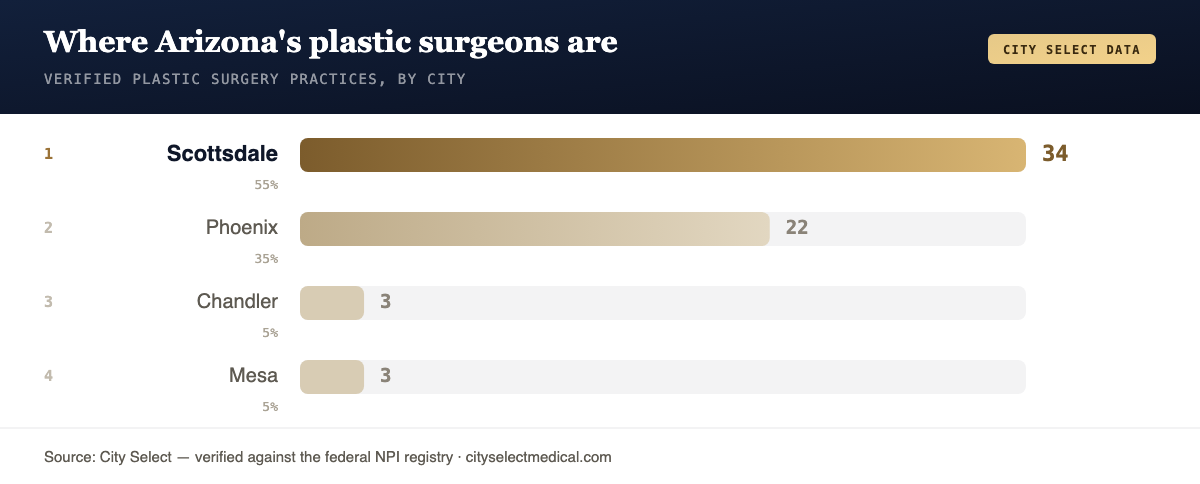
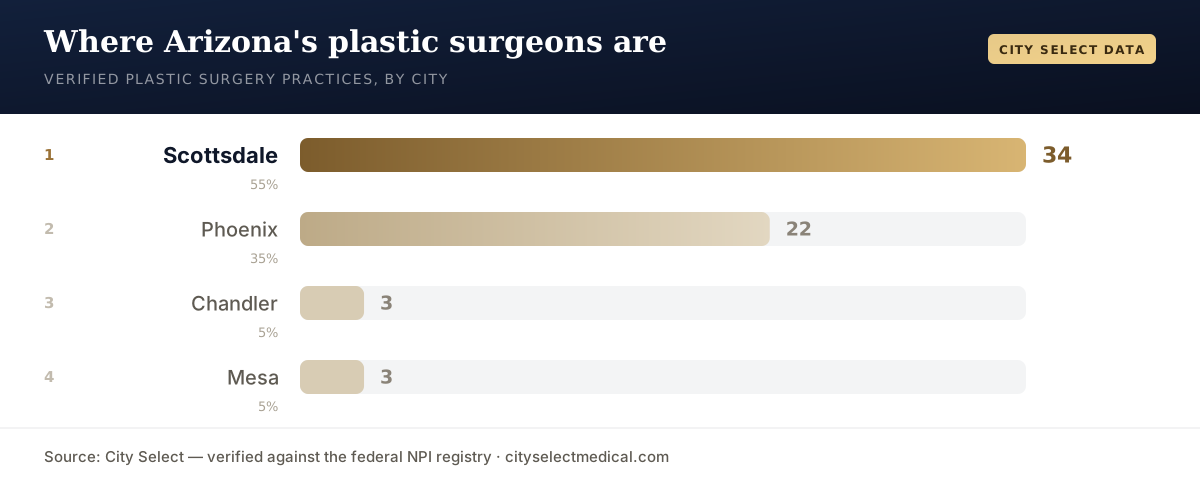
48 NPI-verified plastic surgery practices and 99 dermatology practices across Arizona — with the federally registered specialty visible on every profile, so you know what someone is *actually* registered as before the consultation starts.
The bottom line
Three tiers, one honest rule. Titles are marketing, boards are verification, and volume is skill — and the mistake nearly everyone makes is treating those as the same axis. For injectables, a high-volume nurse injector may well be the best hands in the building, and in Arizona that injector can lawfully run the place. For surgery, none of that substitutes for a surgeon whose residency an ABMS board audited, operating somewhere accredited.
And whichever tier you're in, ask the occlusion question. Hyaluronidase on site, someone trained to use it, a written protocol. It's free to ask, it takes ten seconds, and it tells you more about a clinic than every certificate on its wall.
Start here: verify any surgeon in five minutes · browse verified Arizona practices.
Frequently asked questions
Is a cosmetic surgeon a real surgeon?
They're a licensed physician, but the title itself tells you nothing about surgical training — "cosmetic surgeon" is a marketing term, not a protected credential. The physician behind it may be an ABPS-certified plastic surgeon, or a doctor whose residency was in an unrelated field. The distinction that matters: the American Board of Plastic Surgery (ABPS) is the only ABMS member board for plastic surgery. The American Board of Cosmetic Surgery is not an ABMS member board. Neither fact tells you a given doctor is good or bad — it tells you what was verified, and by whom.
Who can legally inject Botox and filler in Arizona?
Physicians (MD/DO), physician assistants, nurse practitioners, and registered nurses under delegation. Arizona is notable here: it has been a full practice authority state since 2001, so nurse practitioners may evaluate, diagnose, prescribe and practise independently — no collaborating physician required — and may own a med spa outright. An RN injector, by contrast, works under the delegation and supervision of a physician or NP.
Does a med spa in Arizona need a physician medical director?
Not necessarily, and this is where a lot of consumer advice is wrong. Because Arizona grants nurse practitioners full practice authority, an NP-owned med spa can operate lawfully without a physician medical director. So "who is your medical director?" is not the disqualifying test many articles claim. The better questions are who is injecting you, what licence they hold, and what happens if there's a complication.
Is a nurse injector as good as a plastic surgeon for Botox?
For routine injectables, often yes — and possibly better. A high-volume nurse injector who does nothing but Botox and filler all day may have far more recent repetitions than a surgeon who injects between operations. Skill with a needle tracks volume and recency more than it tracks the length of a residency. Where the credential ladder genuinely matters is not the injection — it's the complication.
What is the single best question to ask a med spa?
"If I have a vascular occlusion, do you keep hyaluronidase on site, who is trained to use it, and what is your written protocol?" A vascular occlusion — filler entering or compressing a blood vessel — is the emergency that can cause tissue death and, in rare cases involving facial danger zones, blindness. Hyaluronidase is the enzyme that dissolves hyaluronic-acid filler, and published emergency-management guidance treats it as time-critical. A confident, specific answer is a very good sign. A blank look is your exit.
Are med spas safe?
The category isn't the risk — scope is. A med spa with skilled licensed injectors and a real emergency protocol is an appropriate place for Botox, filler, and laser treatments. The failure mode is scope creep: surgical or surgery-adjacent procedures offered in a setting that isn't equipped for surgical complications.
Can a dermatologist do cosmetic procedures?
Yes. Board-certified dermatologists hold an ABMS-recognised specialty and legitimately perform injectables, lasers, and skin surgery within their scope. The test is scope-match, not job title.
How do I check an Arizona provider's licence?
Arizona uses three separate boards, and this trips people up constantly. MDs are licensed by the Arizona Medical Board (azmd.gov), DOs by the Arizona Board of Osteopathic Examiners (azdo.gov), and nurses and nurse practitioners by the Arizona State Board of Nursing (azbn.gov). If you search only the medical board and find nothing, you may be looking at a perfectly licensed nurse practitioner in the wrong database.
Find a verified plastic surgeon in Arizona
Every plastic surgeon on City Select is sourced from the federal NPI registry and organized by city and specialty — no pay-to-rank, no mystery. Filter by your city and insurance:
 Choosing Care
How to Verify a Plastic Surgeon Is Actually Board-Certified (the 5-Minute Check)
"Board-certified" is the most misused phrase in cosmetic medicine. Here's the free five-minute check — plus the Arizona law that makes a vague claim more than just a red flag.
 Choosing Care
Tummy Tuck vs. Liposuction vs. CoolSculpting: Which Fixes What
These get shopped as if they're interchangeable. They aren't. Each fixes exactly one kind of problem — and each has a failure mode you should know before you pay.
 Choosing Care
15 Questions to Ask at a Plastic Surgery Consultation
A consultation is a two-way interview, and you're the one hiring. Fifteen questions, grouped so you can work through them in order — including the four that patients say they wish they'd asked.
Written by the City Select editorial team and edited by Alan S., Senior Editor. Drafted with AI assistance and checked against the official sources below. City Select is not a healthcare provider, and this guide is not medical advice. Our editorial & data standards →
- ABMS — Certification Matters (verify any ABMS board certification)
- American Board of Plastic Surgery — an ABMS member board
- Arizona Medical Board (MDs)
- Arizona Board of Osteopathic Examiners (DOs)
- Arizona State Board of Nursing (RNs and NPs)
- American Association of Nurse Practitioners — Arizona (full practice authority)
- Vascular occlusion following dermal filler injections — systematic review of emergency management
- Hyaluronidase for dermal filler complications — applications and dosage (JMIR Dermatology)
- NPPES NPI Registry
- How we verify
This guide is for general information and isn't medical, legal, or insurance advice. Coverage, prices, and policies change — verify current details with the relevant provider, plan, or agency, and confirm with the practice before booking. Last updated July 13, 2026.