
Mommy Makeover in Scottsdale: What It Bundles, What It Costs, and When to Stage
"Mommy makeover" is not a procedure. It's a marketing term for a bundle you design — which is the single most useful thing to understand before you price one, because it means almost everything about it is a variable: what's included, what it costs, how long you're under anesthesia, and even whether doing it all at once is safe for you.
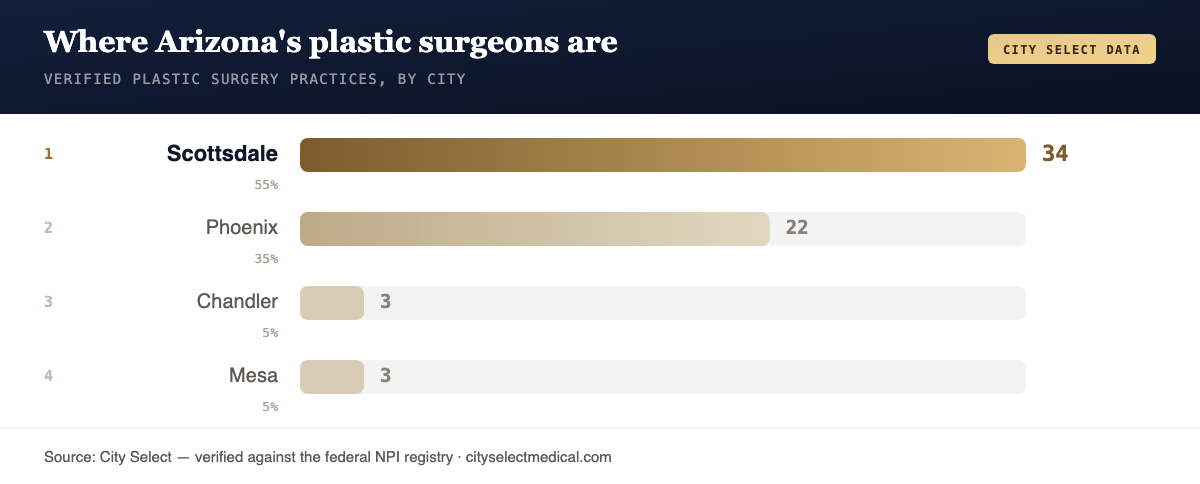
Scottsdale is the right place to be having this conversation — it holds more of Arizona's plastic surgeons than the rest of the state combined — and also the place you're most likely to be quoted at the top of every range. This guide builds the cost from its parts, walks the combine-or-stage decision with the actual data, and plans the recovery nobody plans honestly: the one with a toddler who doesn't know about your lifting limit.
- It's a custom bundle, usually a tummy tuck + a breast procedure (lift, augmentation, or both), often with liposuction. There is no standard definition and no standard price.
- Build the cost from parts. ASPS 2024 surgeon fees: abdominoplasty $8,000–$13,500, breast augmentation $4,575–$8,000 — surgeon fees only, before anesthesia, facility, and implants. Patients self-report all-ins around $15,000–$30,000+.
- ⚠️ Combining saves money but lengthens the surgery — and each extra operating hour raises complication odds by roughly 21% (peer-reviewed). ASPS targets ≤6 hours.
- The staging decision is a safety decision, not a billing one — in either direction.
- The recovery rule that matters: no lifting over ~10 lb for 4–6 weeks. That means not lifting your toddler. Solve childcare before you book.
01 · THE BUNDLEWhat's in it, and what the parts cost
There is no standard mommy makeover, so start with the only question that matters: what specifically bothers you? Loose skin, separated muscles, deflated volume, and stubborn fat are four different problems with four different fixes — and a good consult starts there, not with a package name.
| Component | What it fixes | ASPS 2024 surgeon fee |
|---|---|---|
| Tummy tuck (abdominoplasty) | Loose skin + separated muscles | $8,000–$13,500 |
| Breast augmentation | Lost volume | $4,575–$8,000 |
| Breast lift (mastopexy) | Sagging / deflation after nursing | $6,500–$11,000 |
| Liposuction (flanks, hips) | Localised stubborn fat | $4,300–$7,500 |
Only the tummy tuck fixes muscle separation, and that's worth dwelling on, because it's why so many post-pregnancy bellies don't respond to anything else. The "pooch" that survives every workout is often diastasis recti — separated abdominal muscles — and no fat treatment reaches it. One patient's surgeon put the honest version well: from the outside it "felt like a 1–2 finger gap," but he warned it's "often worse when he got in there, because palpating the muscle from the outside is imprecise."
Ask for the quote broken into its parts, not as one number. A "$22,000 mommy makeover" tells you nothing you can compare; "tummy tuck $X, breast lift $Y, lipo of the flanks $Z, plus one shared anesthesia and facility fee" tells you everything. Itemisation is what lets you take a second surgeon's quote and lay it beside the first — and it's the fastest way to see whether a lower total is a better deal or just a smaller operation.
Start from the four problems, not the package. Loose skin needs excision; separated muscle needs surgical repair; lost volume needs a lift or implant; stubborn fat needs liposuction. If only one or two of those describe you, you may not need a "makeover" at all — you may need a single procedure, at a fraction of the cost and recovery. The bundle is right for the mother who genuinely has all four. It's oversold to the one who has one.
02 · COMBINE OR STAGEThe most important decision, with the actual data
Combining is cheaper. Staging is sometimes safer. And the internet will pull you in both directions, so here's the evidence instead of the opinions.
Why combining costs less: anesthesia and facility fees are charged per surgical event, not per procedure. One combined operation pays them once instead of twice — typically a meaningful saving. That part is real.
Save money where it's safe to. Don't buy a longer surgery to save a facility fee.
Why combining can cost you more than money: a combined operation is a longer operation, and complication risk climbs with time under anesthesia. Peer-reviewed data associate each additional operating hour with roughly a 21% increase in the odds of a complication, with the odds rising steeply beyond about 4.5 hours. ASPS targets aesthetic surgery at six hours or less. Concurrent procedures also raise the 30-day risk of a blood clot (VTE). So a tummy tuck + breast surgery + extensive liposuction squeezed into one marathon isn't automatically a bargain — it's a risk decision that should be made out loud.
"A surgeon who won't do it all at once is either unskilled or just wants two anesthesia fees." You will read exactly this online, stated confidently. Sometimes it's even true. But it is just as often backwards. The surgeon who declines to combine everything is frequently the one watching your operative time and your health profile — which is precisely what the data says protects you. The real red flag is the opposite: a surgeon who never mentions an operative-time limit and books the marathon without a conversation. Judgement that occasionally costs the surgeon the bigger single case is judgement worth paying for.
Ask for the projected operative time
"How many hours will my combined plan take?" If it's pushing past six, ask directly whether staging is safer. This is the number the safety data is about.
Give an honest health history
BMI, anemia, clotting history, nicotine — every one of these pushes toward staging or postponing, and hiding them doesn't make you safer.
Ask what happens if it runs long on the day
A good plan has a line: if the case exceeds a set time, the surgeon stops and stages the rest. Ask whether yours does.
Ask about overnight monitoring
Longer combined cases sometimes warrant an overnight stay. One patient who had hers in an outpatient office said the ride home was so bad she'd recommend a surgeon who uses a hospital with an overnight stay. Ask where you recover, and who watches you.
BMI, in plain terms: many surgeons prefer a BMI under about 30 for combined procedures, and some set stricter limits nearer 28, because infection, wound-healing problems, and clot risk all rise with it. Guardrails around 30–32 are commonly cited for combined cases. Above that, expect a surgeon to stage the procedures, trim the scope, or ask you to stabilise your weight first — and to treat a surgeon who skips that conversation entirely as someone optimising for the booking rather than your result. None of this is a hard legal cutoff; it's a safety gradient, and a good surgeon will explain where you sit on it.
03 · FROM THE WEBWhat mothers actually say
"How bad is the recovery with kids?"
A recovery-room nurse answered plainly: restrictions usually mean **"no lifting over 10 lbs for 4–6 weeks, no domestic chores, nothing strenuous"** — *"doable with older kids or a truly amazing support system."* Another mother was blunter: *"I would NOT recommend this with toddlers. Lifting, bending and just walking was almost out of the question for almost 4 weeks."* **This is the part to plan around, not the price.**
"What actually went wrong for people?"
The most cited recovery failure isn't medical — it's logistical: a mother who *"was popping open stitches because she couldn't catch a break from her active kids while trying to keep up the house."* **Under-planned childcare is how a good surgery becomes a bad result.**
"Will a surgeon do it all at once?"
Opinions run hot — one commenter insisted a surgeon who won't combine is *"not skilled enough"* or wants to *"charge double."* **Weigh that against the operative-time data above.** The surgeon's willingness to combine tells you less than their willingness to talk about *why*, and where your limit is.
"How much was yours?"
Self-reported totals vary enormously and depend entirely on what's included — one patient noted **$28k "is pretty high"** while she paid **$15k** for a different combination (no implants, an auto-augmentation instead). **Two mommy makeovers at wildly different prices can both be fair — because they're different operations.**
48 NPI-verified Arizona plastic surgery practices, most of them in Scottsdale. Get the same itemised, combined, written quote from two or three — and ask each the operative-time question.
04 · RECOVERYThe ten-pound rule and the toddler who can't read it
The tummy tuck sets the recovery clock, and its first rule collides head-on with parenting: no lifting over about ten pounds for four to six weeks. A ten-pound limit means not lifting your toddler — not into the crib, not into the car seat, not off the floor at 2 a.m. Planning around that single constraint is the difference between a smooth recovery and a compromised result.
The ten-pound limit is the whole recovery plan when your twenty-five-pound two-year-old has never heard of it.
"I'll just take it easy for a week and manage the kids myself." This is the plan that fails most often, and it fails the same way every time. The lifting restriction isn't a suggestion you can push through on a good day — pushing through it is how patients describe "popping open stitches" and compromising the repair they paid for. A week of feeling better is not a week of being healed. The abdominal repair is still setting for weeks, and a single lift of a struggling toddler can undo it. Plan for the restriction you'll actually have, not the one you hope for.
The honest timeline:
Days 1–7: you need another adult on duty
Walking hunched to protect the repair, possibly managing drains, on real pain medication. You cannot solo-parent this week. Line up 7–10 days of help minimum — partner leave, family, or hired.
Weeks 2–3: upright and presentable
Off strong meds, desk work possible for many, presentable in clothes. Still no lifting; someone else does car-seat buckles and backpacks.
Weeks 4–6: restrictions ease on the surgeon's schedule, not the calendar's
Lifting limits lift when your surgeon says so. Light exercise returns.
Weeks 6–12 and beyond: the slow part
Progressive return to normal; swelling keeps resolving; final abdominal result is closer to 6–12 months. Judge before-and-after photos accordingly, and ask when each photo was taken.
Solve childcare before you choose a surgery date — and if you genuinely can't secure more than a few days of help, tell your surgeon, because that is a legitimate medical reason to stage the procedures rather than combine them. A shorter single recovery you can actually protect beats a full combined recovery you'll be forced to violate. The mothers who regret their recovery almost never regret the surgery — they regret that nobody made them plan the ten-pound rule against a two-year-old who kicks during diaper changes.
Concrete prep that actually works: pre-teach toddlers to climb into the car seat and onto the couch themselves (start weeks ahead — it takes practice); move daily-use items to counter height so you're not bending or reaching; batch and freeze meals; and set up a recovery station on the main floor so you're not doing stairs for essentials. None of this is glamorous, and all of it protects the result you're paying five figures for.
05 · CHOOSINGWorking Scottsdale's market properly
Same rules as any plastic surgery, applied to the deepest market in the state. Run the five-minute board-certification check — ABPS, the right Arizona licence board, and an accredited facility. Consult at two or three practices using the fifteen consultation questions. Then compare combined, itemised, written quotes — and for a makeover specifically, add two questions: "How many combined cases like mine did you do last year?" and "What's your cap on operative time, and will you stage if my plan exceeds it?"
Book your consultations close together, and take the same written questions to each. Scottsdale's density is a genuine advantage here — three qualified opinions are a short drive apart — but only if you compare them like for like. Bring the identical list, ask each surgeon the operative-time and staging questions in the same words, and notice who volunteers the trade-offs before you ask. The surgeon who tells you what won't change, and where your plan gets riskier, is giving you the consult the other two charged for.
How we source this
We rebuilt this page's costs from scratch, because the old ones were confident numbers with nothing under them.
"Mommy makeover" has no ASPS fee line, for the simple reason that it isn't a procedure — it's a combination. So a single "average mommy makeover cost" is a number nobody can actually source, and the previous version printed one anyway. We now build the cost from its ASPS 2024 component parts, labelled surgeon-fee-only, and present patient-reported all-ins as exactly that: self-reported, unverified, useful only as a reality check.
The staging section is where the real work is. The safe-vs-cheap tension is genuine, and patients are told contradictory things — so we didn't pick a side. We used peer-reviewed operative-time and VTE data to explain why the decision is a safety decision in both directions: a surgeon who reflexively combines everything and a surgeon who reflexively refuses are both substituting a rule for your specific operative time and health.
On insurance, we describe the genuine billable exceptions as documentation pathways and draw a hard line at relabelling cosmetic surgery as medical, which is fraud. The recovery section is built from what mothers and recovery-room staff actually said, because the ten-pound rule is the part the brochures skip.
The bottom line
A mommy makeover is a custom bundle, so treat every part as a decision. Build the cost from its parts — ASPS puts the abdominoplasty around $8,000–$13,500 and breast augmentation around $4,575–$8,000, surgeon fees only — and get the combined total in writing, itemised.
Make the combine-or-stage call on operative time and your health, not on price and not on a stranger's opinion: each extra hour under anesthesia raises complication odds by roughly a fifth, and a surgeon who talks that through with you is worth more than one who simply says yes.
Wait until you're 6+ months postpartum and 3–6 months past nursing, decide the future-pregnancy question with open eyes, and — above everything — solve the ten-pound-lifting problem before you book a date. Then work Scottsdale's deep bench properly: verify credentials, three consults, written quotes. Start here: plastic surgeons in Scottsdale.
Frequently asked questions
Is a mommy makeover one surgery or several?
Both are normal — it's a marketing term for combining procedures, not a fixed operation. It's commonly done as a single surgery to share one anesthesia and facility event, but staging it into two sessions is medically preferable in plenty of cases. The right answer depends on your total operative time and your health profile, not on a package name — and, importantly, not on the surgeon's billing preference.
What's actually included in a mommy makeover?
Whatever you and your surgeon design. The common core is a tummy tuck (which removes loose skin and repairs separated abdominal muscles) plus a breast procedure — a lift, an augmentation, or both — and often some liposuction. Less common add-ons include arm lifts, fat transfer, and labiaplasty. Because there's no standard definition, two '$18,000 mommy makeovers' can be entirely different operations, which is why an itemised quote matters more here than almost anywhere.
What does it really cost?
There's no single answer, and be wary of anyone who gives you one — 'mommy makeover' has no standard price because it has no standard content. Build it from the parts: ASPS 2024 surgeon fees put abdominoplasty around $8,000-$13,500 and breast augmentation around $4,575-$8,000, and those are surgeon fees only — they exclude anesthesia, the facility, and implants. Patients commonly self-report all-in totals from roughly $15,000 to $30,000 or more depending on the combination and market. Treat that as a reality check, not a quote, and get an itemised written total.
Does combining procedures really save money?
Usually some, because anesthesia and facility fees are charged per surgical event rather than per procedure — so one combined surgery pays them once instead of twice. The saving is real but it is not the whole picture, and it should never be the deciding factor, because combining also lengthens the single operation, and longer operations carry more risk. Save money where it's safe to; don't buy a longer, riskier single surgery to save a facility fee.
Is it safe to do everything at once?
Sometimes, and sometimes not — and this is the most important question on the page. The relevant fact is that complication risk rises with time under anesthesia: peer-reviewed data associate each additional operating hour with roughly a 21% increase in the odds of a complication, and ASPS targets aesthetic surgery at six hours or less. So a plan that crams a tummy tuck, breast surgery, and extensive liposuction into one marathon operation isn't a bargain — it's a risk decision. A good surgeon sets the plan around your operative time and health, and will stage it if the single event runs too long.
Should I be suspicious of a surgeon who won't do it all at once?
Not necessarily — and you'll hear the opposite online, where some patients claim a surgeon who won't combine is 'not skilled enough' or just wants to charge two anesthesia fees. Sometimes that's true. But the surgeon who declines to combine everything is often the one paying attention to operative time and your health profile, which is exactly what the safety data says matters. The red flag isn't a surgeon who stages; it's a surgeon who never even discusses operative-time limits and books the marathon without a conversation.
What BMI do I need?
There's no single legal cutoff, but many surgeons prefer a BMI under about 30 for combined procedures, and some set stricter limits nearer 28 — because infection, healing problems, and blood-clot risk all track with higher BMI. Guardrails around 30-32 are commonly cited for combined cases; above that, surgeons often stage the procedures, reduce the scope, or ask you to stabilise your weight first. A surgeon who skips that conversation entirely is optimising for booking, not for your outcome.
Does insurance cover any of it?
The cosmetic components, essentially never. There are genuine exceptions, but they run through documented medical necessity, not relabelling: a breast reduction with documented symptoms may be covered, a hernia repair performed at the same time as a tummy tuck is often billable to insurance, and a panniculectomy (removal of overhanging skin, a different operation from a cosmetic tummy tuck) is sometimes covered. If part of your case is genuinely medical, a surgeon's office that handles those claims will know how to document it. What no one should do is dress a cosmetic procedure up as a medical one — that's insurance fraud, not a strategy.
How long is recovery with kids at home?
The tummy tuck sets the clock, and its central rule collides directly with parenting: no lifting over about ten pounds for four to six weeks. That means not lifting a toddler — not into the crib, the car seat, or off the floor. Many people are presentable in clothes at two to three weeks, with swelling resolving over months and final abdominal results closer to six to twelve months. Recovery-room staff and patients say the same thing: it is manageable with a genuine support system and very hard without one. Solve childcare before you book a date.
Can I get one if I might have another child?
You can, but a pregnancy after a tummy tuck typically undoes the abdominal result, so plan on a likely revision. Most surgeons advise waiting until your family is complete, and many patients do the breast work now and defer the abdomen until they're done having children. The point is to decide with that trade-off on the table, not to discover it afterward.
Find a verified plastic surgeon in Arizona
Every plastic surgeon on City Select is sourced from the federal NPI registry and organized by city and specialty — no pay-to-rank, no mystery. Filter by your city and insurance:
 Choosing Care
How to Verify a Plastic Surgeon Is Actually Board-Certified (the 5-Minute Check)
"Board-certified" is the most misused phrase in cosmetic medicine. Here's the free five-minute check — plus the Arizona law that makes a vague claim more than just a red flag.
 Insurance & Costs
Breast Augmentation Cost: The Real Total, Not the Quoted Fee
The advertised number is one of five line items. Here's the whole bill — plus the FDA boxed warning most cost guides never mention, and the reoperation rate nobody prices in.
 Choosing Care
15 Questions to Ask at a Plastic Surgery Consultation
A consultation is a two-way interview, and you're the one hiring. Fifteen questions, grouped so you can work through them in order — including the four that patients say they wish they'd asked.
Written by the City Select editorial team and edited by Alan S., Senior Editor. Drafted with AI assistance and checked against the official sources below. City Select is not a healthcare provider, and this guide is not medical advice. Our editorial & data standards →
- ASPS 2024 Procedural Statistics — average surgeon/physician fees
- Impact of operative time on complications after plastic surgery — multivariate analysis, 1,753 cases (Aesthetic Surgery Journal)
- Venous thromboembolism in aesthetic surgery — risk optimization (Aesthetic Surgery Journal)
- Risk of complications in combined plastic surgery procedures — TOPS database (PubMed)
- CMS — Women's Health and Cancer Rights Act (WHCRA)
- ABMS Certification Matters — verify board certification
- Arizona Medical Board (MDs)
- NPPES NPI Registry
- How we verify
This guide is for general information and isn't medical, legal, or insurance advice. Coverage, prices, and policies change — verify current details with the relevant provider, plan, or agency, and confirm with the practice before booking. Last updated July 13, 2026.