
Breast Augmentation Cost: The Real Total, Not the Quoted Fee
The number you've seen advertised is the surgeon's fee. It is one line on an invoice that has five or six.
That isn't a conspiracy — it's a definitional gap that the whole industry has quietly built its advertising on. ASPS, the body that publishes the fee data everyone quotes, says plainly that its figures exclude anesthesia, operating-room and facility costs. For breast augmentation, the implants are frequently quoted separately too. So the gap between the ad and the invoice isn't a markup. It's the rest of the bill.
This guide gives you every line item, the two FDA facts most cost guides never mention, and the one situation where federal law obliges an insurer to pay.
- The advertised figure is the surgeon's fee only. ASPS 2024 puts it at a range of about $4,575–$8,000 — and ASPS abandoned the single-average number after 2023, because one figure misrepresented reality.
- Then add: anesthesia · facility/OR · the implants themselves · pre-op labs · garments · follow-ups.
- We don't publish an "average total," because nobody credibly can. We show you how to build yours — and demand it in writing.
- ⚠️ FDA boxed warning: implants are NOT lifetime devices. Reoperation runs about 11.7% within 7 years (FDA post-approval data). Removal alone: $3,650–$6,500 surgeon fee.
- The one insurance exception is federal law. Where a plan covers mastectomy, WHCRA obliges it to cover reconstruction — including surgery on the other breast for symmetry.
01 · INSURANCEThe exception that federal law protects
Cosmetic augmentation is not covered. Reconstruction is a different world, and the law is unusually clear about it.
- **Reconstruction after mastectomy — all stages** (WHCRA)
- **Surgery on the OTHER breast to produce a symmetrical appearance**
- **Breast prostheses**
- **Treatment of physical complications of the mastectomy, including lymphedema**
- Breast **reduction**, on some plans, where symptoms are documented
- Cosmetic breast augmentation, essentially always
- Implant exchange or removal done for cosmetic preference
- Revisions for size or shape changes
- Anything a plan classifies as cosmetic, absent documentation
Read the symmetry clause again, because it is the most under-known benefit in this entire field: if a plan covers your mastectomy, WHCRA requires it to cover surgery on the unaffected breast to produce a symmetrical appearance. Many people never learn this and pay out of pocket for an operation the law obliges their plan to cover.
If a plan covers the mastectomy, federal law reaches the other breast too. The clause exists whether or not anyone mentions it to you.
If your situation is reconstructive — post-mastectomy, congenital deformity, significant asymmetry — do not start with a cash-pay cosmetic consultation. You are in a different lane with different rights. Ask a prospective surgeon's office directly: "Do you handle WHCRA reconstruction claims, and will you submit for pre-authorisation?" Practices that do this routinely are a different animal from practices that don't, and the difference will show up in your bill.
02 · COSTEvery line item, and why the ad only shows one
| Line item | Commonly quoted | Notes |
|---|---|---|
| Surgeon's fee | $4,575–$8,000 | ASPS 2024 range — this is the advertised number |
| Implants (the pair) | $1,000–$2,500 | Often quoted separately. Silicone/cohesive above saline |
| Anesthesia | $600–$1,500 | Ask who administers it, by credential |
| Facility / OR fee | $800–$2,000 | Only accept an accredited facility |
| Pre-op labs & imaging | $100–$400 | Sometimes bundled, often not |
| Garments & supplies | $100–$300 | Rarely mentioned. Always billed |
| Follow-up visits | $0–$400 | Ask how many are included |
"The quote I was given is the price I'll pay." Not necessarily — and this is where people get hurt financially rather than medically. Patients regularly describe being handed a number, then billed materially more, and told afterwards that "the quote is just an estimate." One reported a final bill roughly 30% above what they'd been assured. Ask two questions and get the answers on paper: "Is this binding, or an estimate?" and "What could change it, and by how much?" A practice that won't commit in writing has told you what its number is worth.
The gap between the advertisement and the invoice isn't a markup. It's the rest of the bill.
Ask for the quote as a document, not a conversation. The sentence that does the work: "Please send me a written, itemised, all-in total — surgeon's fee, anesthesia, facility, implants, labs, garments, and every scheduled follow-up — and tell me whether it's binding." A practice that can produce that in an email has earned a deposit. One that can't, hasn't. And you now have a document you can put beside another surgeon's document.
Two quotes are only comparable if they cover the same things. Before you compare a $9,000 quote to a $13,000 one, check four boxes on each: does it include the implants? the anesthesia? the facility? and how many follow-ups? A large share of "that surgeon is so much cheaper" turns out to be a difference in what got counted, not a difference in price.
03 · FROM THE WEBQuestions people are actually asking
"$15,000 for a breast augmentation??"
The sticker-shock thread is a genre of its own, and the community's top answer says our thesis better than we could: **"Quotes like $5,500 are almost certainly just the doctor's fee."** They're right. When you see a low number and a high number for the same operation, the usual explanation isn't that one surgeon is gouging you — it's that **the two numbers are answering different questions.**
"How do I know if a breast augmentation price is fair?"
— from someone quoted **"anything from $13,000 to $20,000."** The only way to answer it is to compare **itemised, like-for-like** quotes. A phone estimate and a written all-in total are not comparable documents, and a spread that wide usually means you're holding one of each.
"How much was your breast augmentation?"
Self-reported totals cluster far above the advertised fee — commonly **$8,000 to $18,000**, higher when a lift is added and in premium markets. **Treat that as anecdote, not data** — it's unverified and self-selected. But as a reality check against a $4,000 banner ad, it's more honest than most of what's published.
"Are implants permanent?"
No, and the FDA requires manufacturers to say so in a **boxed warning.** This is the single biggest omission in cosmetic-surgery cost content, and it belongs in a *cost* article precisely because it's a **cost** — see below.
48 NPI-verified practices. Build a shortlist, then ask every one of them for the same itemised, written, all-in quote — so you're comparing documents that actually compare.
04 · THE VISITThe FDA facts that belong in a cost guide
Implants are not lifetime devices. That is not our opinion — it's the FDA's boxed warning, the strongest warning the agency applies to a medical device.
The warning tells patients three things: that implants are not lifetime devices and may need to be replaced; that textured implants have been associated with BIA-ALCL, a rare cancer of the immune system; and that implants have been associated with a range of systemic symptoms some patients report, often called breast implant illness.
None of that is a reason to rule out augmentation. Millions of people have implants and are happy with them. It is a reason to go in informed — and to understand that the decision has a maintenance cost attached to it.
Bring the boxed warning up yourself, and watch what happens. Say: "Talk me through the FDA boxed warning — the lifetime-device point, BIA-ALCL, and the systemic-symptom reports." A good surgeon will answer this calmly and in detail; it's a conversation they have every week. Defensiveness, dismissal, or a quick pivot back to sizing is the actual finding here — not because the warning should scare you off, but because how someone handles an uncomfortable question predicts how they'll handle an uncomfortable complication.
Ask which implant, and why yours
Brand, fill, texture, and size — and the reasoning, not just the recommendation.
Ask specifically about textured implants
The FDA associates textured implants with BIA-ALCL. If a textured implant is being proposed, ask why, and what the alternative would cost you.
Ask what the imaging schedule will be
For silicone, the FDA recommends ultrasound or MRI at 5–6 years, then every 2–3. Ask who orders it, and what it costs.
Ask what happens if you want them out
Not hypothetically — as a price. Removal is an operation with its own fee, and you're likelier to want it than most consultations imply.
| Saline | Silicone gel | Highly cohesive ("gummy bear") | |
|---|---|---|---|
| FDA minimum age (cosmetic) | 18 | 22 | 22 |
| Relative cost | Lowest | Higher | Highest |
| Feel | Firmer | More natural | Most form-stable |
| If it ruptures | Obvious — the implant deflates visibly | Silent — you may not know | Silent; the gel holds its shape |
| FDA-recommended imaging | Not recommended in the same way | Ultrasound or MRI at 5–6 years, then every 2–3 years | Same as silicone |
| Short-term capsular contracture (FDA) | ~2.8% | ~5.0% | — |
The 20-year cost of augmentation includes a maintenance line, and almost no consultation mentions it. FDA post-approval data put the reoperation rate at roughly 11.7% within seven years for primary augmentation. Silicone implants carry a recommended imaging schedule for life — starting at 5–6 years, then every 2–3 years, and those scans cost money. And ASPS puts the surgeon's fee for removal alone at $3,650–$6,500, at future prices. Ask what a revision costs at this practice, and get the policy in writing, before you pay a deposit.
05 · CHOOSINGSequence it right: verify, consult, then compare
Price-shopping before you verify credentials optimises the wrong variable. A revision costs far more than the difference between any two legitimate quotes — so the cheap surgeon is only cheap until something needs fixing.
First: verify, before you book anything
Run the five-minute board-certification check. ABPS certification, the right Arizona licence board, and — non-negotiable for surgery — an accredited facility.
Second: consult with two or three who passed
Use the consultation questions. Ask about the FDA boxed warning and watch how they handle it. Ask the revision policy. Ask who gives the anesthesia, by name.
Third: only now, compare written all-in quotes
Same line items, same implants, same facility, in writing. Anything else is comparing an apple to a photograph of an apple.
Fourth: treat deferred-interest financing as a calendar obligation
Medical credit cards typically offer 0% for a promotional window — but if any balance remains when it closes, interest is commonly charged retroactively on the original amount, often at rates in the high twenties or low thirties. Divide the total by the promo months and autopay that figure, or use a fixed-rate personal loan instead.
"This price is only good if you book today." Surgery prices do not expire, whatever the script says. If the monthly payment only works on the practice's in-house financing at the consultation table, the timing isn't right yet — and a practice applying deadline pressure to a permanent, irreversible medical decision has told you something more important than its price.
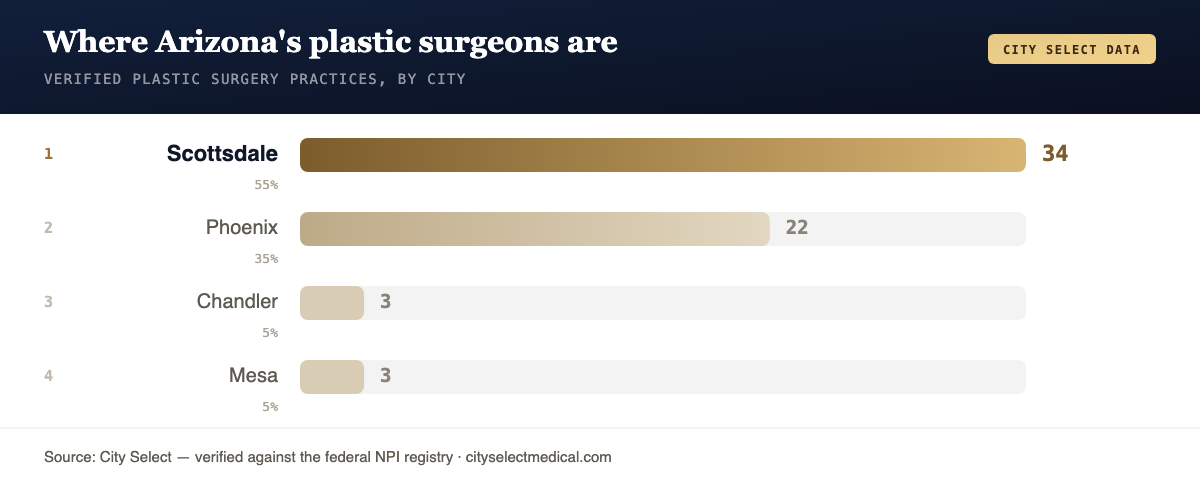
Arizona-specific: more than half of the state's plastic surgery practices — 63% of all 48 — are in Scottsdale, a concentration no other surgical specialty in our directory comes close to. That cuts both ways. You have more surgeons to choose from than almost anywhere in the country, and you are shopping in a premium market where quotes at the upper end of every range are normal. Get quotes outside Scottsdale too — Phoenix has 11 verified practices — and compare like for like. This is precisely the geographic variation that made ASPS give up on a single national number.
How we source this
This page previously carried a cost figure that was wrong, and it's worth saying so. It quoted a single, stale national "average" — split by implant type — and attributed it to current ASPS data. That figure was out of date, and that split doesn't exist in the current data at all. (We're not reprinting the number here; a wrong price has a way of outliving its correction.)
Here's what's actually true, and it's a better story: ASPS stopped publishing a single national average after 2023. Its 2024 report says the switch to a range "provides a more accurate representation of real-world conditions, recognizing the diverse geographic locations and practice settings" of its surgeons. The publisher of the industry's most-cited statistic decided that one number was misleading — and yet nearly every competing page still prints one.
So: we cite the 2024 range, we label it surgeon fee only, and we refuse to publish a City Select "average total." No credible source produces one. Inventing a number to fill that hole is the exact behaviour this article exists to warn you about.
We also fixed a claim about our own data. The previous version said most Arizona plastic surgery practices "list no insurance participation because their business is cash-pay." We can't know that. What we can measure is that most don't publish insurance information at all — which is not the same fact, and we won't dress up a gap in our data as a finding.
FDA material — the boxed warning, the imaging schedule, the reoperation and capsular-contracture figures, the age minimums — comes from the FDA directly, not from surgeons' marketing pages.
The bottom line
Start from the ASPS surgeon-fee range — about $4,575–$8,000 — and understand that it is a fee, not a bill. Add anesthesia, the facility, the implants, labs, garments and follow-ups, then make the practice commit to the total in writing, and ask whether that total is binding or merely an estimate.
Price in the part nobody advertises: the FDA's boxed warning says implants are not lifetime devices; FDA post-approval study data put reoperation at roughly 11.7% within seven years for primary augmentation; silicone carries an FDA-recommended imaging schedule from year 5–6 onward; and ASPS puts the surgeon's fee for removal alone at $3,650–$6,500.
And if your situation is reconstructive, read the WHCRA section again — including the symmetry clause. Then sequence it properly: verify credentials → consult → then compare quotes, among surgeons who all passed the check. Start from a verified list: Arizona plastic surgeons.
Frequently asked questions
Why is the advertised price so much lower than what people actually pay?
Because the advertised number is usually the surgeon's fee — one line item of several. ASPS publishes surgeon/physician fees and states plainly that they exclude anesthesia, operating-room and facility costs. For breast augmentation the implants themselves are often quoted separately too. A banner ad saying "augmentation from $4,995" isn't necessarily lying; it's answering a narrower question than the one you're asking.
What does ASPS actually report for breast augmentation?
For 2024, ASPS reports a surgeon-fee range of roughly $4,575–$8,000 for breast augmentation with implants. Note the word range: ASPS stopped publishing a single national average after 2023, saying a range better reflects real-world variation across markets and practice settings. Any page still quoting one national average number is using a presentation its own source retired.
So what's the realistic all-in total?
We won't invent a number, because no credible source publishes a verified national all-in average — and inventing one is the exact problem this guide is about. What we can tell you: start from the ASPS surgeon-fee range, then add anesthesia, the facility fee, the implants, pre-op labs, garments, and follow-ups. In public forums, patients commonly self-report all-in totals from roughly $8,000 to $18,000, higher where a lift is added and in premium markets. That's self-reported and unverified, but it's a useful reality check against a $4,000 advertisement.
Do breast implants last forever?
No — and the FDA requires manufacturers to say so. The FDA's boxed warning states that breast implants are not lifetime devices, that the chance of complications increases the longer you have them, and that many people will need additional surgery. FDA post-approval study data put the reoperation rate at about 11.7% within seven years for primary augmentation. Budget for the possibility of a second operation; ASPS puts the surgeon fee for implant removal alone at roughly $3,650–$6,500.
What is the FDA boxed warning on breast implants?
A boxed warning is the FDA's strongest device warning. For breast implants it states that they are not lifetime devices; that textured implants have been associated with BIA-ALCL, a rare cancer of the immune system; and that implants have been associated with a range of systemic symptoms some patients report (often called breast implant illness). It is not a reason to rule out augmentation — it is information you're entitled to have before you decide, and a surgeon who won't discuss it is telling you something.
Do I need scans after getting silicone implants?
The FDA recommends imaging — ultrasound or MRI — to screen for silent rupture of silicone gel implants, beginning at 5–6 years after surgery and then every 2–3 years. Saline ruptures are usually obvious because the implant visibly deflates, so routine screening imaging isn't recommended in the same way. Ask what that monitoring will cost you over twenty years; it's a real line item nobody mentions at the consult.
Saline or silicone — is one safer?
Both are FDA-approved for cosmetic augmentation. The differences that matter are feel, how a rupture behaves, monitoring, and age eligibility: the FDA approves saline from age 18 and silicone from age 22 for cosmetic augmentation. On complications, FDA-reported short-term capsular contracture rates run somewhat higher for silicone (about 5.0%) than saline (about 2.8%). This is a trade-off conversation, not a safety ranking.
Does insurance ever cover breast surgery?
Cosmetic augmentation, essentially never. But reconstruction is different, and this is the most valuable thing on this page for the right reader. Under the federal Women's Health and Cancer Rights Act, where a plan covers a mastectomy it must also cover all stages of reconstruction, surgery on the other breast to produce symmetry, prostheses, and treatment of physical complications including lymphedema — with deductibles and coinsurance consistent with other benefits under that plan. Breast reduction is also sometimes covered where symptoms are documented.
Is the quote I was given binding?
Ask, explicitly, in writing. Patients regularly report being handed an "estimate" that grows before surgery — one described a final bill roughly 30% above what they'd been told, and being informed afterwards that the quote was only an estimate. Ask two questions: "Is this a binding quote or an estimate?" and "What could change it, and by how much?" Get the answer on paper before you pay a deposit.
Find a verified plastic surgeon in Arizona
Every plastic surgeon on City Select is sourced from the federal NPI registry and organized by city and specialty — no pay-to-rank, no mystery. Filter by your city and insurance:
 Choosing Care
How to Verify a Plastic Surgeon Is Actually Board-Certified (the 5-Minute Check)
"Board-certified" is the most misused phrase in cosmetic medicine. Here's the free five-minute check — plus the Arizona law that makes a vague claim more than just a red flag.
 Choosing Care
15 Questions to Ask at a Plastic Surgery Consultation
A consultation is a two-way interview, and you're the one hiring. Fifteen questions, grouped so you can work through them in order — including the four that patients say they wish they'd asked.
 Choosing Care
Plastic Surgeon vs. Cosmetic Surgeon vs. Med Spa: Who Should Actually Treat You
Three kinds of providers share one vocabulary. The honest test isn't who has the longest training — it's who is qualified to handle the day it goes wrong.
Written by the City Select editorial team and edited by Alan S., Senior Editor. Drafted with AI assistance and checked against the official sources below. City Select is not a healthcare provider, and this guide is not medical advice. Our editorial & data standards →
- ASPS 2024 Procedural Statistics — average surgeon/physician fees (ranges)
- FDA — Risks and complications of breast implants (incl. boxed warning)
- FDA — Types of breast implants (age indications)
- FDA — Breast implants: what to know
- CMS — Women's Health and Cancer Rights Act (WHCRA) fact sheet
- U.S. Department of Labor — WHCRA fact sheet
- ABMS Certification Matters — verify board certification
- NPPES NPI Registry
- How we verify
This guide is for general information and isn't medical, legal, or insurance advice. Coverage, prices, and policies change — verify current details with the relevant provider, plan, or agency, and confirm with the practice before booking. Last updated July 13, 2026.