
Dermatology in Arizona: Costs, Insurance & How to Choose a Dermatologist
Arizona runs one of the highest melanoma rates in the country — by the University of Arizona Cancer Center's read, roughly 40% above the national average — and it isn't a mystery why. High elevation, a southern latitude, and a Phoenix UV index that sits between "high" and "extreme" for about half the year add up to more lifetime sun on Arizona skin than almost anywhere else in the U.S. That's the real reason a dermatologist matters more here than in most states: this is skin-cancer country.
That said, few people book a dermatologist over incidence statistics. They book over a price they can't predict, a plan they don't understand, and a quiet worry about whether the person reading their skin is actually board certified. This guide covers both — the Arizona sun reality and the three things that trip everyone up: what it costs, what your plan covers, and how to choose well — then points you to 99 verified dermatologists across the state when you're ready to book.
- Cost: a self-pay visit runs about $150–$300 first / $100–$200 follow-up, with procedures billed separately — ask for a Good Faith Estimate and a cash discount.
- Coverage: medically necessary care (acne, eczema, moles, skin cancer) is usually covered by insurance and AHCCCS; cosmetic treatments are not.
- Choosing: look for FAAD after the name, verify the certification and Arizona license, and match the derm's focus to your need.
01 · SUN & SKINWhy a dermatologist matters more in Arizona
If you've lived in Arizona for any stretch, your skin has a sun history — and dermatologists here spend a large share of their time on the consequences. Arizona's melanoma incidence runs well above the national rate (the University of Arizona Cancer Center puts it around 40% higher), and the driver is plain geography: high elevation and a southern latitude mean thinner atmospheric shielding, and Phoenix's UV index sits between "high" and "extreme" for roughly six months of the year. More UV, over more years, on more exposed skin.
Arizona isn't an average sun state — its melanoma rate runs about 40% above the U.S. average, which is exactly why knowing your own skin matters more here.
Here's where honest guidance matters more than a scary headline. Experts don't fully agree on routine full-body screening for people with no symptoms and no risk factors: in 2023 the U.S. Preventive Services Task Force again concluded there's insufficient evidence to weigh the benefits and harms of clinician skin-cancer screening in asymptomatic adults — a "we can't tell yet" verdict, explicitly not a recommendation against it, and not a comment on the value of seeing a dermatologist. The American Academy of Dermatology, meanwhile, urges people to know their own skin and get anything suspicious looked at. Both positions can hold at once. The practical read for a high-UV state: if you carry risk factors — fair skin, blistering sunburns in your past, a prior skin cancer, or simply decades of Arizona sun — that's worth a conversation with a dermatologist about how often you should be seen. There's no single cadence that fits everyone.
Learn your own skin. The AAD suggests a monthly self-check in good light, front and back — including the scalp, between the toes, and the soles of your feet. You're not diagnosing; you're building a memory so a new or changing spot stands out later.
"Darker skin doesn't get skin cancer." It does. Melanoma is less common in people with darker skin, but it's more often caught late — and five-year survival is measurably lower as a result. It also tends to appear in easy-to-miss places: the palms, the soles, and under the nails (the type that killed Bob Marley). The spots that are easiest to forget are worth checking regardless of skin tone.
The dermatologist's shorthand for a mole worth showing someone: ABCDE. Asymmetry · Border that's irregular or blurred · Color that varies within the spot · Diameter bigger than a pencil eraser (~6 mm) · Evolving — changing in size, shape, or color, or starting to itch or bleed. One rule of thumb on top: the "ugly duckling," the spot that simply doesn't look like your others, deserves a look.
02 · INSURANCEWhat insurance (and AHCCCS) covers
Before cost, many people want to know one thing: will my plan pay for this? Here's the line that clears up most of the confusion: insurance follows medical necessity. If a dermatologist is treating a condition — acne, eczema, psoriasis, a changing mole, skin cancer — that's medical care, and it's generally covered. If they're doing something cosmetic — Botox, fillers, cosmetic mole removal — that's on you.
- Acne (medical treatment)
- Eczema & psoriasis
- Suspicious or changing moles
- Skin-cancer screening & treatment
- Warts, rashes & skin infections
- Medically necessary biopsies
- Botox & dermal fillers
- Cosmetic laser & resurfacing
- Cosmetic mole / skin-tag removal
- Aesthetic chemical peels
- Acne-scar cosmetic treatments
- Most anti-aging procedures
AHCCCS, Arizona's Medicaid program, works the same way: it covers medically necessary dermatology through its managed-care health plans. You pick a plan that covers your ZIP code and a primary care doctor, and depending on the plan you may need a referral before a dermatologist visit is covered. Cosmetic care isn't included.
Common trap — referral rules. Many PPO plans let you self-refer to a dermatologist; HMO and AHCCCS plans often don't. A five-minute check with your plan before booking is the difference between a covered visit and a surprise bill.
03 · COSTWhat a dermatologist actually costs in Arizona
Once you know what's covered, the next question is what you'll actually pay. Most searches for "dermatologist cost" are really two questions: what will the visit run, and what will the stuff they do to me run? Those are separate lines on the bill.
For the visit itself, self-pay pricing in Arizona clusters in a predictable band. National price guides put a first visit around $150–$300 and follow-ups around $100–$200, and that tracks with what Arizona practices publish. Hospital-affiliated groups like Banner post Arizona direct-pay prices you can check before you go.
Procedures are separate. A full-body skin exam, a biopsy, a mole removal, or an acne plan each carry their own cost, and that's where totals move. Here's what the common ones typically run:
| Service | AZ self-pay | With insurance | U.S. average |
|---|---|---|---|
| Office visit (new patient) | $150–$300 | $30–$75 copay | $150–$300 |
| Full-body skin exam | $100–$300 | Often covered* | $100–$300 |
| Skin biopsy | $150–$350 | $30–$100 | $200–$350 |
| Mole removal (medical) | $150–$500 | Covered* | $150–$530 |
| Mohs surgery | $1,800–$2,500 | Covered* | $1,864–$2,400 |
How we price this
Dermatology prices vary more than almost any specialty, because "a dermatology visit" can mean a five-minute acne check or a Mohs surgery. The ranges above are statewide self-pay estimates cross-referenced across published cash prices (Banner and other Arizona direct-pay listings), procedural-cost studies (CareCredit / Synchrony), and consumer price aggregators (GoodRx, Sidecar Health) — then sanity-checked against what Arizona practices actually post. They are a planning tool, not a quote. The one number that binds is the Good Faith Estimate the practice gives you for your specific plan and procedure — ask for it in writing.
Two habits save real money in Arizona:
Ask for a Good Faith Estimate. Arizona practices will give you one for self-pay care; some post them online.
Ask about a cash discount. It's common and rarely advertised.
A biopsy usually means two bills, not one. Your dermatologist bills for taking the sample; a separate pathology lab bills for reading it under a microscope. The second bill is the one that catches people off guard — ask up front whether the lab your derm uses is in your network.
Patients routinely report 20%-off cash pricing on a dermatology visit — just for asking.
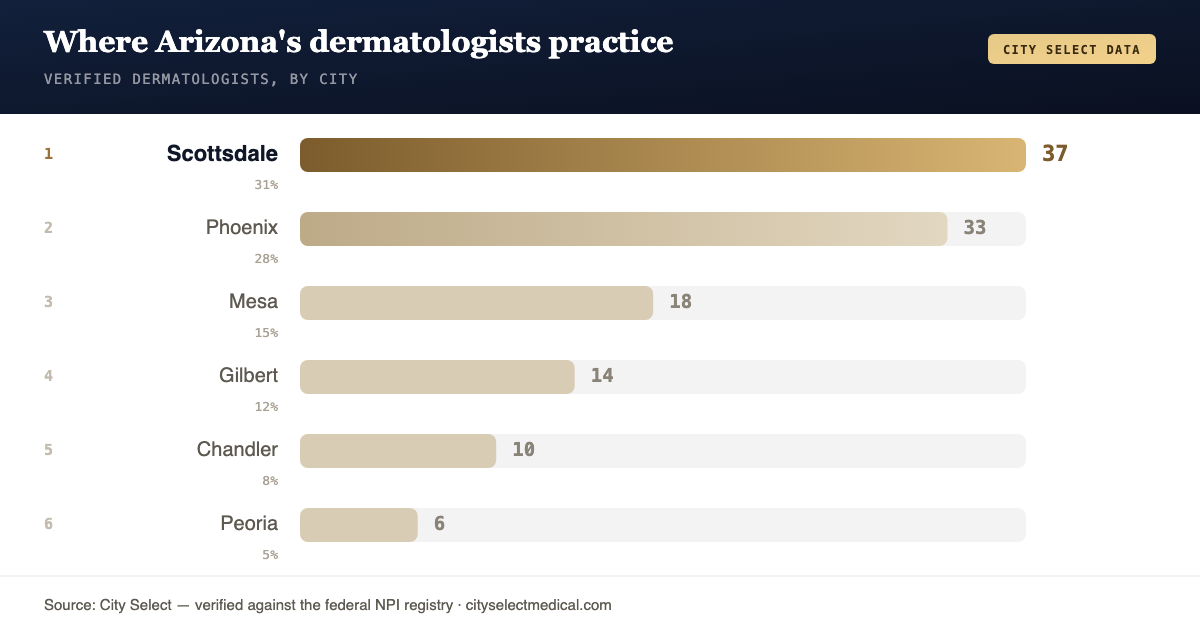
Arizona-specific: Scottsdale has the deepest bench of dermatologists in the state — 22 of our 99 verified AZ derms — which means more direct-pay and cosmetic options, and more price competition, than most metros.
04 · FROM THE WEBQuestions people are actually asking
Do dermatologists give cash discounts?
Often, yes — many Arizona practices offer a discount for paying cash at the time of service (patients report around 20%). It's rarely posted, so ask when you book.
Can I get a tretinoin (Retin-A) prescription without a dermatologist?
Sometimes — a primary care doctor, urgent care, or online derm service may prescribe it. A dermatologist is the right call for anything beyond a simple refill or a skin concern that needs an exam.
How much is a full-body skin exam?
Self-pay, it commonly falls in the $100–$300 range for the exam itself; it's typically covered when there's a medical reason, such as a history of skin cancer or a suspicious spot. Confirm the code with your plan.
Is seeing a dermatologist worth it vs. drugstore products?
For persistent acne, changing moles, or anything you'd want a trained eye on, yes — a prescription plan and a skin check do things a shelf product can't.
99 NPI-verified dermatologists across 33 Arizona cities — including 22 in Scottsdale. Filter by city and the insurance they publish, then check FAAD and the Arizona license yourself before you book.
05 · THE VISITWhat to expect at a skin check
A first dermatology visit is usually quick and low-drama. You'll talk through your history and concern, the dermatologist will examine your skin, and you'll leave with a plan. Patients often describe the hardest part as simply getting in the chair — the exam itself tends to be faster and easier than expected. Here's the shape of it, so nothing catches you off guard.
Before you go
Jot down your concerns and any spot you've noticed changing. If you've had skin cancer or a lot of sun, say so — it changes how thoroughly you'll be checked. Remove nail polish if you want your nails looked at.
The exam
A full-body skin check runs about 10–15 minutes. You'll undress to your comfort level in a gown, and the dermatologist works head to toe — often with a handheld dermatoscope for a closer look at specific spots.
The plan
You leave with something concrete: a prescription, a biopsy or removal to schedule, or a monitoring timeline. Ask what would make you call back sooner rather than waiting for the next visit.
Flag the spot you're worried about out loud. A full-body scan is systematic, but you know your own skin — pointing to the mole that's been nagging you makes sure it gets the closest look. Your dermatologist tailors any timeline to your skin, so treat the ranges here as orientation, not a promise.
06 · CHOOSINGHow to choose — and verify — a dermatologist
Arizona has hundreds of dermatologists; the hard part isn't options, it's knowing who's genuinely qualified for what you need. Three checks do most of the work.
Confirm board certification
Look for FAAD after the name — Fellow of the American Academy of Dermatology. Verify it yourself through the American Board of Dermatology or the ABMS Certification Matters tool, and confirm an active license with the Arizona Medical Board.
Match the derm to the need
Dermatology splits into medical (conditions, skin cancer), surgical (Mohs, excisions), and cosmetic (laser, injectables). A great cosmetic injector isn't automatically who you want reading a suspicious mole.
Ask who you'll actually see
Many practices staff physician assistants and nurse practitioners alongside dermatologists — completely normal for routine visits. But if seeing the physician matters for your concern, ask when you book.
One credential does most of the work: FAAD. It signals the dermatologist completed an accredited residency and passed the American Board of Dermatology exam. A skilled cosmetic injector without it may be perfect for a filler appointment — but for a suspicious mole or a stubborn rash, board-certified dermatology is the training that reads skin for a living.
The bottom line
Arizona is a high-UV, high-melanoma state, so the first move is the free one: know your own skin, watch new or changing spots with the ABCDE rule, and get anything suspicious looked at — how often you're seen beyond that is a conversation to have with a dermatologist based on your risk.
On the practical side, budget for roughly $150–$300 on a first self-pay visit, expect procedures billed on top, and ask about a Good Faith Estimate and a cash discount before you book. Check coverage the simple way — insurance and AHCCCS follow medical necessity, so a condition is usually covered and anything cosmetic isn't, and a quick call about referral rules heads off a surprise bill. Then choose deliberately: look for FAAD, verify the certification and Arizona license yourself, and match the dermatologist's focus — medical, surgical, or cosmetic — to what you actually need.
Frequently asked questions
How much does a dermatologist cost in Arizona without insurance?
For a straightforward self-pay office visit, most Arizona practices land roughly in the $150–$300 range for a first visit and $100–$200 for follow-ups, with procedures (biopsies, mole removal, a full-body skin exam) priced separately. Some Arizona derms publish direct-pay prices, and many offer a cash discount if you ask. Always request a Good Faith Estimate up front.
How often should I get a skin check in Arizona?
There's no single number that fits everyone, and experts don't fully agree: in 2023 the USPSTF concluded there's insufficient evidence to weigh the benefits and harms of routine clinician skin-cancer screening in adults with no symptoms, while the AAD encourages knowing your own skin and getting suspicious spots looked at. The practical read for Arizona — a very high-UV state — is that if you have risk factors (fair skin, past sunburns or skin cancer, years of sun exposure), it's worth asking a dermatologist how often you personally should be seen. Anything new, changing, or that won't heal is worth getting checked regardless.
Does AHCCCS cover a dermatologist?
AHCCCS (Arizona's Medicaid program) generally covers medically necessary dermatology — acne, eczema, psoriasis, suspicious moles, and skin-cancer care — through its managed-care health plans. You choose a plan for your ZIP and a primary care doctor, and a referral may be required. Cosmetic treatments are not covered. Confirm specifics with your plan.
Will a dermatologist see me without insurance?
Many will, on a self-pay basis, and a growing number of Arizona practices are direct-pay with published prices. A few offices don't take new self-pay patients, so it's worth calling ahead and asking about cash pricing and discounts before you book.
Will I see the dermatologist or a nurse practitioner?
Both are common. Many practices use board-certified dermatologists alongside physician assistants and nurse practitioners for routine visits. It's a fair question to ask when booking — and if seeing the physician matters to you for a specific concern, say so.
How do I know if a dermatologist is board certified?
Look for FAAD after their name — Fellow of the American Academy of Dermatology — which signals board certification. You can verify independently through the American Board of Dermatology or the ABMS 'Certification Matters' tool, and confirm an active Arizona license with the Arizona Medical Board. Every City Select listing is sourced from the federal NPI registry.
Do I need a referral to see a dermatologist in Arizona?
It depends on your plan. Many PPOs let you self-refer; HMOs and AHCCCS plans often require a referral from your primary care doctor. Check your plan before booking so a covered visit doesn't turn into a surprise bill.
Find a verified dermatologist in Arizona
Every dermatologist on City Select is sourced from the federal NPI registry and organized by city and specialty — no pay-to-rank, no mystery. Filter by your city and insurance:
 Choosing Care
How to Choose a Dermatologist in Arizona (and Verify Board Certification)
Choosing a dermatologist in Arizona isn't about a lack of options — it's knowing who's genuinely qualified for what you need. How to verify board certification yourself, match the right kind of derm to your concern, spot the red flags, and check who'll actually be in the room.
 Insurance & Costs
How Much Does a Dermatologist Cost in Arizona? (2026)
What a dermatologist really costs in Arizona: the office visit, the procedures billed on top, why 'I have insurance' doesn't always mean a small copay, and the moves — cash price, Good Faith Estimate, financing — that lower the bill.
 Insurance & Costs
Does Insurance (and AHCCCS) Cover a Dermatologist in Arizona?
Whether insurance, AHCCCS, or Medicare pays for a dermatologist in Arizona comes down to one rule — medical is covered, cosmetic isn't. Here's how that plays out, the referral and prior-auth catches, and the surprise bills to head off before you book.
Written by the City Select editorial team and edited by Alan S., Senior Editor. Drafted with AI assistance and checked against the official sources below. City Select is not a healthcare provider, and this guide is not medical advice. Our editorial & data standards →
- University of Arizona Cancer Center — Skin cancer in Arizona
- USPSTF — Skin Cancer Screening (2023 recommendation)
- American Academy of Dermatology — ABCDEs of melanoma
- American Academy of Dermatology — How to select a dermatologist
- American Board of Dermatology — verify certification
- AHCCCS — Covered Medical Services
- CareCredit / Synchrony ASQ360° Procedural Cost Study 2023–2025
- GoodRx — procedure cost data
- Banner Health — Arizona direct-pay price transparency
- Arizona Medical Board — license verification
- How we verify
This guide is for general information and isn't medical, legal, or insurance advice. Coverage, prices, and policies change — verify current details with the relevant provider, plan, or agency, and confirm with the practice before booking. Last updated July 15, 2026.