
Does Dental Insurance Cover Implants? Arizona Coverage, Decoded
Ask an insurer whether they cover dental implants and you'll usually get a yes. That yes is doing an enormous amount of work. "Covered" and "paid for" are different words, and between them sit four contract clauses that most people meet for the first time on a denial letter.
This guide walks each one — the waiting period, the missing-tooth clause, the LEAT downgrade, and the cap — tells you which Arizona plans actually pay, and shows you what to do when the answer comes back no. When you're ready to compare offices, we have 580 verified Arizona practices that list implants.
- Many PPO plans "cover" implants — as a major service, commonly paying 40–60% after a waiting period. Coverage varies significantly by plan, by component, and by eligibility rules.
- Then up to four limits apply: a 6–12 month waiting period, a missing-tooth provision, an alternate-benefit (LEAT) rule, and the annual maximum. Not every contract contains all four.
- Once an implant is eligible, the annual maximum usually caps what the plan can contribute. With a $1,000–$2,000 max, realistic help on a $4,500 implant is $1,000–$2,000 — not half. An outright exclusion can end the claim before the cap ever matters.
- AHCCCS generally does not cover routine adult implants — its adult benefit is primarily emergency-only. Original Medicare generally doesn't either, though limited medically-related dental exceptions exist. Medicare Advantage dental riders vary; check the Evidence of Coverage.
- A denial is not necessarily final. Read the stated reason, compare it against the contract, and use the plan's appeal process.
01 · INSURANCEThe four clauses that decide what you actually get
Dental plans commonly use some combination of four recurring limits: waiting periods, missing-tooth provisions, alternate-benefit rules, and annual maximums. Not every contract contains all four — but learn them once and you can read any plan in ten minutes.
- The crown — often 40–60% coinsurance
- The abutment, on many plans
- The extraction of the failing tooth
- Imaging, on some plans
- Bone graft, sometimes, with documentation
- Anything above your annual maximum
- A tooth missing *before* your policy started, where a missing-tooth provision applies
- The difference, where an alternate-benefit (LEAT) rule applies
- Anything at all during the waiting period
- Routine implants under AHCCCS's adult benefit
- Routine implants under Original Medicare
1. The waiting period
Major services usually sit behind a waiting period of six to twelve months. Buy a plan in January because you need an implant in February and you will discover this the hard way.
On Delta Dental of Arizona's individual plans, implants are a Type 3B major service with a nine-month waiting period — and they're limited to one per 60 months.
The waiting period is often waivable, and almost nobody asks. Delta Dental of Arizona's plan document states that waiting periods may be waived for members with qualifying prior PPO/Indemnity or DHMO coverage and no more than a 63-day gap — and that granting the waiver is at Delta Dental of Arizona's sole discretion. If you're switching plans, request a certificate of prior coverage from your old insurer before you enroll, and ask the new insurer in writing whether it will apply. That one document can be worth nine months.
2. The missing-tooth clause
This is the one that ends claims. A missing-tooth clause excludes replacement of any tooth that was already gone before your policy started. Lost the tooth two years ago, bought the plan last month? The implant can be denied outright — even though you never claimed a cent for the extraction.
It generally applies only to the first replacement of that tooth. Replacing an implant, bridge, or partial that was placed years ago is usually treated as a replacement, not a first placement, and is typically allowed.
"I never claimed for that tooth, so the plan can't hold it against me." It isn't about claims — it's about timing. The clause looks at whether the gap existed on the day your coverage started. You can have a spotless claims history and still be denied.
Continuous coverage is worth asking about — but it is not a guaranteed override. If you moved between plans without a gap, request a certificate of prior coverage from your old insurer (free, one phone call), then ask the new insurer a precise question: "Does this contract recognise prior coverage for the waiting period, or for the missing-tooth provision — or only for the waiting period?" Those are two different provisions, and a plan may honour one and not the other. The effect depends entirely on the specific policy language, so get the answer in writing before you rely on it.
3. The LEAT / alternate-benefit downgrade
The clause almost nobody explains. LEAT — Least Expensive Alternative Treatment — lets the plan pay for the cheapest option that would have worked, not the one you chose.
You want an implant. A bridge would also have closed the gap. The plan may calculate its benefit using the allowed amount for the less expensive covered alternative — and you remain responsible for the difference between that benefit and the implant charges. You still get the implant; the plan simply pays as though you'd had the bridge. In some contracts it goes further: if a partial denture would have worked, the plan can base its benefit on that instead.
"My plan covers implants at 50%, so I'll pay half." Not if the contract contains an alternate-benefit provision. Fifty percent of the bridge's allowed amount is not fifty percent of the implant — and the difference is yours. Ask your insurer one question: "Does this plan contain an alternate-benefit or LEAT provision for tooth replacement?" If the answer is yes, ask your dentist to document why an implant is appropriate for your anatomy and function. That narrative may strengthen the submission, particularly where the plan allows clinical review or appeal — but it cannot necessarily override an explicit alternate-benefit provision.
You get the implant. The plan pays as though you'd had the bridge. The difference is yours.
4. The annual maximum — the one that really decides it
Every clause above is survivable. The cap is arithmetic. With a $1,000–$2,000 annual maximum, the plan cannot pay you more than that in a year — no matter what percentage the brochure advertises. On a $4,500 implant, that's the whole story.
Forget the coinsurance percentage. The annual maximum is the number that decides what you get — and on most Arizona plans it's between $1,000 and $2,000. Everything else is detail.
The cap resets each benefit year — and an implant is a months-long sequence anyway. Because the stages are billed separately, services completed in different benefit years may draw from separate annual maximums. But benefit dates can hinge on when a component is prepared, placed, or delivered — so ask the dentist and the insurer how each stage is dated for benefit purposes, and get it in writing before you rely on it. And never delay clinically necessary care purely to chase a benefit year.
02 · COSTWhat Arizona plans actually pay — plan by plan
Here's where it gets concrete. Delta Dental of Arizona publishes its individual-plan grid, and it repays a careful read.
| Plan | Annual maximum | You pay on implants | Monthly, age 3–54 |
|---|---|---|---|
| Palo Verde | $2,000 | 40% | $59.72 |
| Mesquite | $2,000 | 50% | $47.78 |
| Saguaro | $1,500 | 60% | $28.14 |
| Agave | $1,000 | 70% | $20.60 |
| Cholla | Unlimited | Not covered | $19.32 |
Read the bottom row again.
"Unlimited annual maximum" is the best deal on the page. The Cholla plan is marketed "great for seniors." It's the cheapest at $19.32 a month, and it carries an unlimited annual maximum — which sounds extraordinary. It does not cover implants. It doesn't cover major services at all. The unlimited cap applies only to the services it does cover. An unlimited maximum on a plan that excludes major work isn't generosity. It's a ceiling you will never reach.
That's the trap in this entire category: the plan aimed squarely at the people most likely to need an implant is the plan that won't pay for one. And you'd never catch it from the headline number.
Read the coverage grid, not the maximum. The maximum is marketing. The grid is the contract.
Two Delta Dental plans — Copper and Turquoise — carry no waiting periods at all, and your coinsurance improves each year for three years. If you know an implant is coming but it isn't urgent, that structure is worth modelling against the nine-month wait.
Three numbers decide whether a plan is worth buying for an implant: the annual maximum, the waiting period, and whether major services are covered at all. In that order. The monthly premium is the least informative number on the page.
How we source these numbers
Each plan figure above comes straight from Delta Dental of Arizona's own Individual & Family plan comparison document (DDAZ-0229-rev0625, rates effective 1/1/2026) — not from a summary, not from a dental practice's blog, and not from an insurance-affiliate site. We read the grid and the footnotes, because the footnotes are where the waiting-period waiver and the frequency limits live.
For everything else:
- Coverage rules — AHCCCS Medical Policy Manual 310-D1 for Arizona Medicaid; Medicare.gov for the federal position. Both are primary sources; neither is ambiguous.
- What an implant costs, so you can size the gap the plan leaves — Delta Dental of Arizona's published Phoenix-metro median fees, cross-checked against FAIR Health Consumer's ZIP-and-CDT-code lookup, which you can run yourself.
- Clause mechanics (missing-tooth, LEAT, appeals) — dental-billing and payer sources, cross-checked across several. Where they disagreed on detail, we describe the range rather than pick a winner.
We do not anchor a single figure to a vendor page, a manufacturer, or a financing company. Where a number isn't published anywhere public, we say so rather than estimate one.
Where you shop still matters, because in-network is where the arithmetic works. Here's how many Arizona dentists in our directory publish that they take each major plan:
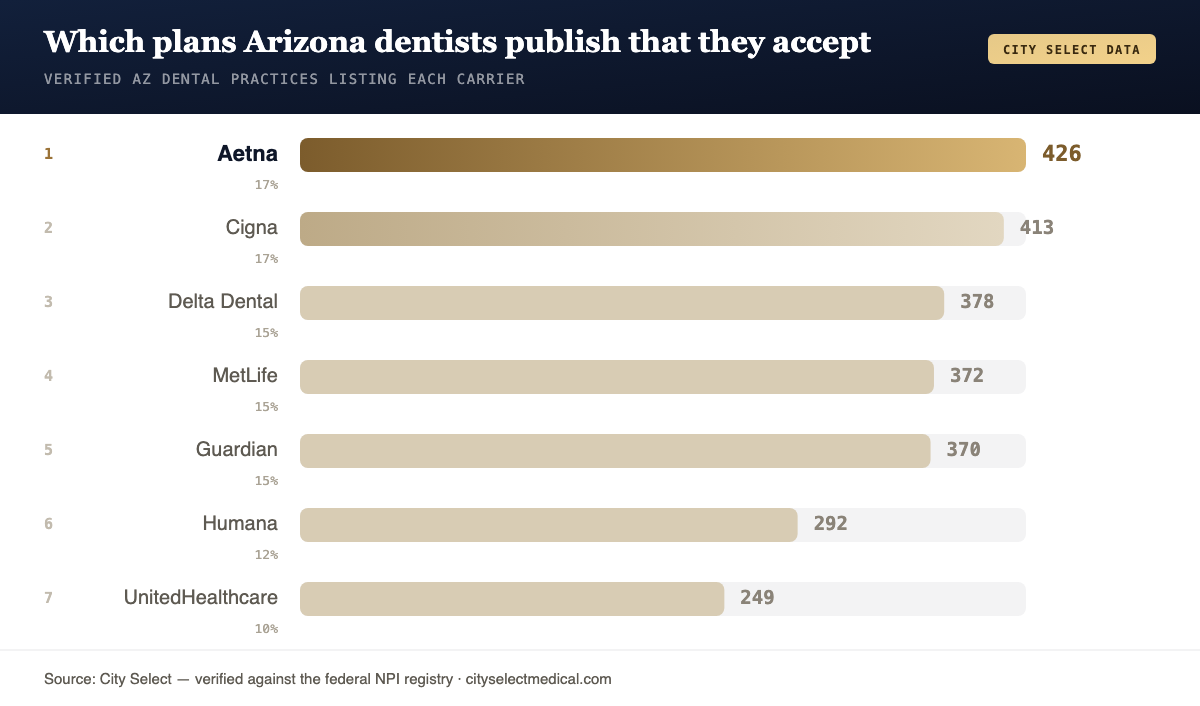
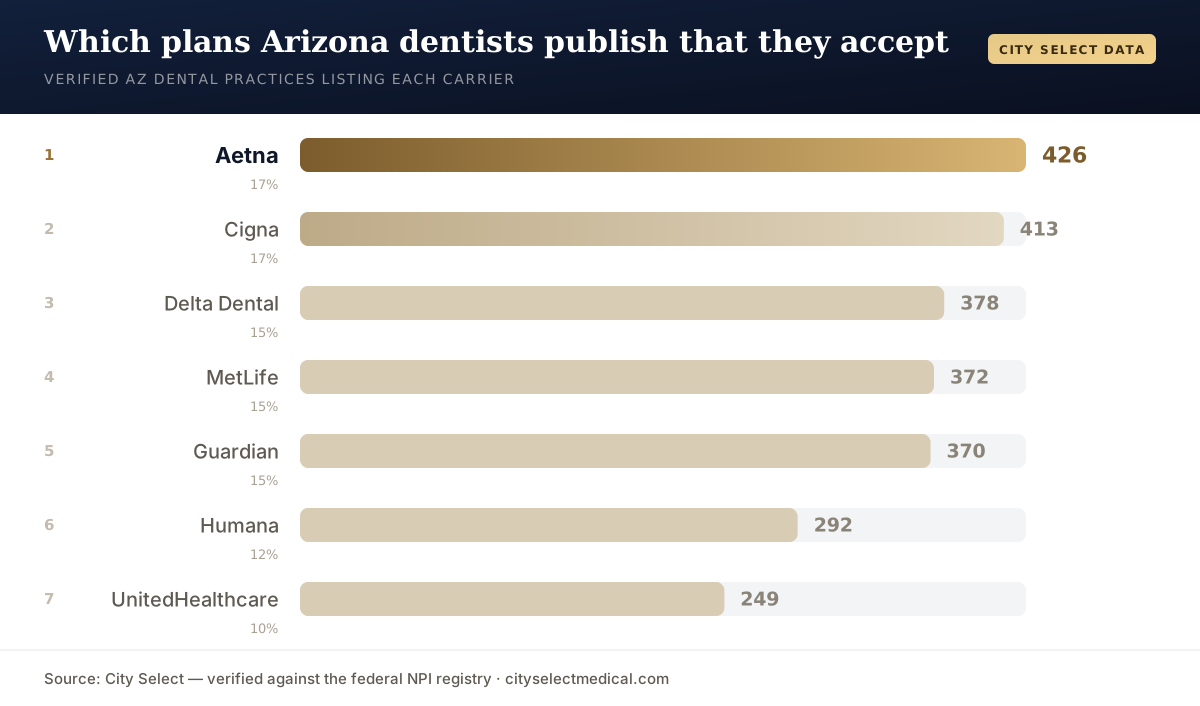
Arizona-specific: 59% of Arizona dental practices publish no findable insurance information whatsoever. That single fact is why "do you take my plan?" still requires a phone call in 2026 — and it's why you must confirm in-network status with both the office and your insurer. "We accept your insurance" and "we are in your network" are different sentences with different prices.
03 · FROM THE WEBQuestions people are actually asking
My implant was denied under a "missing tooth clause" — the tooth came out before I had this plan. Any way around it?
Possibly, but there's no universal fix. If you had continuous coverage with no gap, request a **certificate of prior coverage** and ask the insurer whether its contract recognises prior coverage for that specific provision — some do, many don't, and it turns entirely on the policy language. If there was a genuine gap, the provision usually holds, and the honest answer is to plan for self-pay.
Why did my insurance pay for a bridge when I got an implant?
That's an alternate-benefit (LEAT) rule. The plan calculates its benefit using the allowed amount for the cheaper covered alternative, and you're responsible for the difference. A clinical narrative from your dentist may help the insurer evaluate why an implant is appropriate — but it cannot necessarily override an explicit alternate-benefit provision.
Should I buy dental insurance before getting an implant?
Do the arithmetic first. Premiums + deductible + a 6–12 month wait + a $1,000–$2,000 cap often means the plan pays back little more than it costs in year one. It works best when the implant isn't urgent and the plan has no missing-tooth provision.
Does insurance cover the implant post or just the crown?
Plans may treat the implant body, the abutment, and the implant-supported crown as **separate services with different coverage** — so "are implants covered?" is the wrong question. Ask about the specific CDT codes, including the implant-body code (**D6010**), and get the answer for each component.
580 Arizona practices in our directory list dental implants. Filter by your city and your carrier — then confirm in-network status with both the office and your insurer before you book.
04 · THE VISITWhat to do before you schedule anything
Coverage is decided long before the drill. Three documents settle it, and you can have all three in a week.
Pull your Evidence of Coverage — the booklet, not the brochure
The summary grid won't name the missing-tooth clause or the LEAT provision. The full plan booklet will. Search it for "missing tooth," "alternate benefit," "least expensive," and "waiting period." Ten minutes with a PDF search box saves months.
Ask your dentist for a pre-treatment estimate
Also called a predetermination. The office submits the proposed treatment with CDT codes and the insurer replies, in writing, with what they'll pay — before the work happens. On a $4,500 procedure this is not optional. Any office that resists is telling you something.
Get a certificate of prior coverage if you've switched plans
It's free and it takes one phone call to your old insurer. It may support a waiting-period waiver — Delta Dental of Arizona allows one at its discretion for qualifying prior coverage with a gap of 63 days or less. Ask the new insurer, in writing, whether the contract also recognises prior coverage for its missing-tooth provision; that's a separate question with a separate answer.
A pre-treatment estimate turns "we think you're covered" into a number, in writing, from the people who have to pay it.
Ask the office to submit the predetermination with a clinical narrative, not just codes. A bare code submission invites a LEAT downgrade — the plan sees "tooth replacement" and prices the cheapest one. A narrative explaining why an implant is right for your bone and bite is what makes them price the implant.
If the claim is denied
"Denied means denied." Not necessarily. A denial notice should explain the basis for the decision and tell you about your appeal rights — which means it also tells you exactly what to address. Arizona requires regulated dental and health plans to provide an appeal process for adverse determinations.
Read the stated reason, compare it against your plan's actual contract language, and use the plan's appeal process if documentation is missing or the terms appear to have been applied incorrectly.
Send the dated extraction record, the X-rays, and a short narrative from your dentist explaining why an implant is appropriate for your case rather than a bridge or a partial. If the denial cites the missing-tooth provision and you had continuous coverage, attach the certificate of prior coverage and ask the insurer, specifically, whether the contract recognises prior coverage for that provision. If the denial is upheld, ask about a second-level appeal or peer review.
The three documents that win appeals: the dated extraction record, the X-rays, and a clinical narrative in your dentist's own words. Ask for all three by name.
The denial notice tells you why. That sentence isn't bad news — it's the instruction manual for the appeal.
Arizona-specific: if you believe a regulated insurer isn't following its own policy or the required appeal process, the Arizona Department of Insurance and Financial Institutions (DIFI) accepts consumer complaints. Arizona law requires regulated dental, vision, and health plans to provide an appeal process for adverse determinations.
05 · CHOOSINGHow to choose a practice when insurance is the constraint
"We accept your insurance" and "we are in your network" are different sentences with different prices. Accepting means they'll bill your plan. In-network means they've agreed to contracted rates. Out-of-network, the office can bill you the balance above what the plan allows — on an implant, that gap can run four figures.
"They said they take my insurance, so I'm covered." Taking your insurance means they'll send the claim. In-network means they've agreed a contracted price. An out-of-network office can bill you the balance above what your plan allows — and on a $4,500 procedure, that balance is not a rounding error.
Ask it in these exact words: "Are you in-network with my plan — not just accepting it?" Then verify with the insurer, because office front desks and insurer directories are both wrong often enough to cost you thousands.
Confirm in-network with BOTH sides
Insurer directories go stale and office front desks make mistakes. Ask the office "are you in-network with [plan], not just accepting it?" — then verify with your insurer. Both, every time.
Ask whether they file pre-treatment estimates
An office that routinely submits predeterminations on major work is an office that has done this before and doesn't want a surprise either.
Ask who handles the appeal if it's denied
Some practices have a dedicated billing person who fights denials. Some hand you the letter. That difference is worth real money on a $4,500 claim.
Ask about the self-pay price anyway
Sometimes, after the waiting period, the deductible, the LEAT downgrade, and the cap, the cash price is simply better than the insured price. Run both numbers. It is not a rhetorical exercise.
Run the cash number even if you're insured. Add up the premiums, the deductible, the months you'll wait, and what the cap actually pays — then compare that to the practice's self-pay price and its in-house membership plan. More often than people expect, the cash route wins. It costs you ten minutes to find out.
The bottom line
Many dental plans provide some implant coverage — and then the waiting period, the missing-tooth provision, the alternate-benefit rule, and the annual maximum decide what that's actually worth. On a $4,500 implant with a $1,000–$2,000 cap, plan on $1,000–$2,000 of real help if the implant is eligible at all, and read the booklet rather than the brochure. AHCCCS generally won't contribute to a routine implant; Original Medicare generally won't either.
Before you schedule anything: pull the Evidence of Coverage and search it for "missing tooth," "alternate benefit," and "waiting period"; get a pre-treatment estimate in writing, with CDT codes; and if you've switched plans recently, get a certificate of prior coverage and ask the insurer exactly which provisions it applies to. Then price the insured route against the cash route honestly — because more often than people expect, the cash route wins.
Frequently asked questions
Does dental insurance cover dental implants?
Many PPO dental plans cover at least some implant-related services as a major service, but coverage varies significantly by plan, by component, and by eligibility rules. Four recurring limits decide what you actually receive: the waiting period (often 6–12 months), a missing-tooth provision, an alternate-benefit (LEAT) rule, and the annual maximum. On a $4,500 implant with a $2,000 cap, realistic help is $1,000–$2,000 — and an outright exclusion can end the claim before the cap matters.
What is the missing tooth clause?
It excludes replacement of any tooth that was already missing before your policy started. If you lost the tooth two years ago and bought the plan last month, the implant can be denied outright — even though you never made a claim for the extraction. It generally applies only to the first replacement of that tooth.
What is a LEAT or alternate benefit clause?
Least Expensive Alternative Treatment. If a cheaper option could replace the tooth — a bridge, or even a partial denture — the plan may pay only what that cheaper option would have cost and leave you the difference. You still get the implant; the plan just pays as if you got the bridge.
How long is the waiting period for implant coverage?
Commonly 6 to 12 months for major services. On Delta Dental of Arizona's individual plans, implants sit in Type 3B with a 9-month waiting period. That waiting period may be waived for qualifying prior PPO/Indemnity or DHMO coverage with no more than a 63-day gap — the plan document states the waiver is granted at Delta Dental of Arizona's sole discretion. Request a certificate of prior coverage and ask the insurer in writing before you assume either way.
Does Medicare cover dental implants?
Original Medicare generally does not cover routine dental care, including implants — though limited dental services may be covered when closely connected to certain covered medical treatment. Some Medicare Advantage plans offer dental benefits, but implant coverage, limits, and exclusions vary by plan. Check the plan's Evidence of Coverage, or contact the plan directly.
Does AHCCCS cover dental implants?
AHCCCS generally does not cover routine adult dental implants. Its standard adult dental benefit is primarily limited to qualifying emergency services, generally capped at $1,000 per contract year, with specific medically-related exceptions. An extraction may qualify in an acute situation; routine implant placement is not among the covered adult emergency services.
My implant claim was denied. Can I appeal?
Yes. Arizona requires regulated dental and health plans to provide an appeal process for adverse determinations. Read the stated reason on the denial notice, compare it against your plan's contract language, and follow the plan's appeal instructions. Send the dated extraction record, X-rays, and a short narrative from your dentist explaining why an implant is appropriate for your case. If the denial cites a missing-tooth provision and you had continuous prior coverage, request a certificate of prior coverage and ask whether the contract recognises it for that specific provision — that varies by policy.
How often will insurance pay for an implant?
Frequency limits are real. Delta Dental of Arizona's individual plans cover implants once per 60 months — five years. If an implant fails inside that window, the replacement is on you.
Can a dental implant be billed to medical insurance?
Sometimes, in part. If the tooth was lost to an accident or a disease process rather than ordinary decay, portions — imaging, bone grafting, anesthesia — occasionally route through medical insurance, where there's no dental annual cap. Offices that place implants daily know how to check. It is rarely offered; ask.
Is it worth buying dental insurance just to get an implant?
Run the arithmetic before you buy. Premiums plus deductible plus a 9-month wait plus the annual cap often means the plan pays out little more than it costs in year one. Where it does make sense: if you can wait, sequence the work across two plan years, and your plan has no missing-tooth clause. Compare that total against the practice's own membership plan and the cash price.
Find a verified dentist in Arizona
Every dentist on City Select is sourced from the federal NPI registry and organized by city and specialty — no pay-to-rank, no mystery. Filter by your city and insurance:
 Insurance & Costs
Dental Implant Costs in Arizona: Single Tooth to Full Arch
The quote you get by phone is rarely the number you'll pay. Here's how implant pricing actually breaks down — component by component — and where the real savings are.
 Insurance & Costs
Dental Insurance in Arizona, Decoded: What "We Accept Your Plan" Really Means
Dental insurance isn't health insurance — it's closer to a prepaid discount card with a spending cap. Once you see the structure, every confusing EOB starts making sense.
 Insurance & Costs
Does AHCCCS Cover Dental for Adults? Arizona's $1,000 Rule, Explained
If you're on AHCCCS and your tooth hurts, the answer is "yes, but" — and there are five exceptions written into the policy that don't touch your $1,000 at all.
Written and maintained by the City Select editorial team. Every figure is checked against the official sources below, and every practice in our directory is verified against the federal NPI registry — no pay-to-rank and no purchased placement in the verified results. See our editorial & data standards →
- Delta Dental of Arizona — Individual & Family plan comparison (rates effective 1/1/2026)
- Delta Dental of Arizona — usual & customary fees (median dentist fees, ZIP prefix 850)
- AHCCCS Medical Policy Manual 310-D1 — adult dental benefit
- Medicare.gov — dental services coverage
- FAIR Health Consumer — dental cost lookup by ZIP and CDT code
- American Academy of Periodontology — dental implant procedures
- Arizona Department of Insurance and Financial Institutions — consumer appeals
- How we verify
This guide is for general information and isn't medical, legal, or insurance advice. Coverage, prices, and policies change — verify current details with the relevant provider, plan, or agency, and confirm with the practice before booking. Last updated July 11, 2026.