
How to Choose a Dermatologist in Arizona (and Verify Board Certification)
Arizona doesn't have a dermatologist shortage so much as a sorting problem. There are hundreds of them, plus med spas and wellness clinics that offer skin services too — and from the outside, a polished website tells you almost nothing about who's genuinely qualified to read a suspicious mole versus who's qualified to sell you a filler. In a state with one of the highest skin-cancer rates in the country, that difference is worth getting right.
The good news: the checks that actually matter are quick, and you can do most of them yourself in a few minutes. This guide walks through the three that do most of the work — verify the credential, match the derm to your need, and know the red flags — then points you to 142 verified dermatologists across Arizona when you're ready to compare.
- Verify the credential yourself: look for FAAD, then confirm it at the American Board of Dermatology or ABMS — a license alone isn't board certification.
- Match the type to your need: dermatology splits into medical, surgical, and cosmetic — a great injector isn't automatically who you want for a skin check.
- Know the red flags: a physician who only lends their name, on-the-spot upselling, or "perfect results" promises are all reasons to walk.
01 · CREDENTIALSVerify board certification — yourself
A medical license and board certification are not the same thing. A license means the state cleared the doctor to practice and met a minimum bar. Board certification means they went further — an accredited dermatology residency and the American Board of Dermatology exam. For anything where skill and training drive the outcome — reading a mole, treating a stubborn condition, injecting a face — that extra layer is the one you want, and it's the one you can check in minutes.
Look for FAAD
Fellow of the American Academy of Dermatology after the name is the shorthand for board-certified in dermatology. It's a signal, not proof on its own — so verify it.
Confirm it at the source
Check the name in the American Board of Dermatology's directory or the ABMS Certification Matters tool. Both are free and take a minute.
Check the Arizona license
Confirm an active, unrestricted license — MDs at the Arizona Medical Board (azmd.gov), DOs at the Arizona Board of Osteopathic Examiners (azdo.gov).
"They're a licensed doctor, so they're a board-certified dermatologist." Not necessarily. Any licensed physician can legally offer some skin services, and "cosmetic" or "aesthetic" titles aren't protected the way board certification is. The FAAD credential — and the verification steps above — are what separate a board-certified dermatologist from a doctor who simply offers skin treatments.
How we verify — and how you can
Every dermatologist in the City Select directory is matched to the federal NPI registry — the government's provider database — so the name, specialty, and location you see trace to an official record, not a self-reported profile. We don't rank providers by "quality" and listings are never for sale. What we can't do is certify anyone for you, which is why we point you to the primary sources: the American Board of Dermatology for certification, and the Arizona boards for licensure. The check takes two minutes and it's the single most valuable thing you can do before booking.
Do the check before the first appointment, not after. Two minutes on the ABD or ABMS site up front beats discovering a credential gap once you're already in the chair — or worse, after a procedure.
02 · MATCHMatch the type of dermatologist to your need
"Dermatologist" is one word for three fairly different jobs, and the best choice depends entirely on why you're going. Sorting this out first saves you from booking the wrong kind of expert.
Dermatology splits into three lanes — match yours before you book. Medical treats conditions: acne, eczema, psoriasis, skin cancer. Surgical handles excisions and Mohs surgery for skin cancer. Cosmetic covers Botox, fillers, and laser. Plenty of derms work across lanes, but the emphasis on their profile tells you where their day-to-day skill actually lives.
"A top cosmetic dermatologist is the best choice for my skin check." Different skill, different focus. A brilliant injector spends their days on aesthetics; a medical dermatologist spends theirs reading skin and catching cancers. For a full-body exam or a changing mole, you want the one who does that all day — and in a high-UV state, that's not a detail to hand-wave.
03 · RED FLAGSThe questions to ask — and the red flags to heed
A good practice welcomes questions; a place that dodges them is telling you something. Ask these when you book or at the consult, and pay attention to how the answers feel — a real consultation is calm and thorough, not a sales pitch.
"Will a board-certified dermatologist provide my care?"
And if part of it is delegated, to whom — a PA or NP? Both are normal; you just deserve to know before you're in the room.
"For a cosmetic procedure, can I see your own before-and-afters?"
Real, patient-specific results — not stock photos or manufacturer images — and a realistic answer about what to expect.
"Is this in-network, and do I need a referral?"
For medical care, confirm the network and any HMO/AHCCCS referral rule up front so a covered visit doesn't become a surprise bill.
A calm, thorough consult is itself a good sign. The AAD's own guidance: before anyone injects, peels, or lasers, a real provider reviews your history, goals, risks, and budget. If that step gets skipped, that's the red flag — not the price list.
If the physician only lends their name to the business and is never actually there, walk away. That one rule filters out a surprising amount of trouble.
Arizona-specific — who's actually overseeing your injectable or laser? At a med spa, a treatment may be delivered by a nurse or aesthetician under a physician's oversight. Under Arizona's 2025 Board of Nursing guidance, higher-risk procedures (injectables, energy-device/laser, medical microneedling) require a written provider order for you specifically — a standing "the medical director signs off on everything" arrangement isn't enough. It's fair to ask who the supervising physician is and whether they're on site.
04 · FROM THE WEBQuestions people are actually asking
Is a "cosmetic dermatologist" the same as a board-certified dermatologist?
Not automatically. Board certification (FAAD, verified at the ABD) is the credential; "cosmetic" describes a focus, and the title isn't protected. Verify the certification regardless of the label on the door.
Should I see a dermatologist or a med spa for Botox?
Either can be appropriate, but the accountability differs. A dermatology practice is physician-led by definition; at a med spa, ask who the supervising physician is and whether they're on site — especially in Arizona (see above).
How do I find a dermatologist who's good with darker skin?
Ask directly whether they routinely treat skin of color and check the palms, soles, and nails on exams — melanoma in darker skin is often found late in exactly those spots. A yes, with specifics, is what you're listening for.
Does it matter which dermatologist I pick for a skin check?
Yes — prioritize a board-certified medical dermatologist who does full-body exams routinely, over a practice focused mainly on cosmetics.
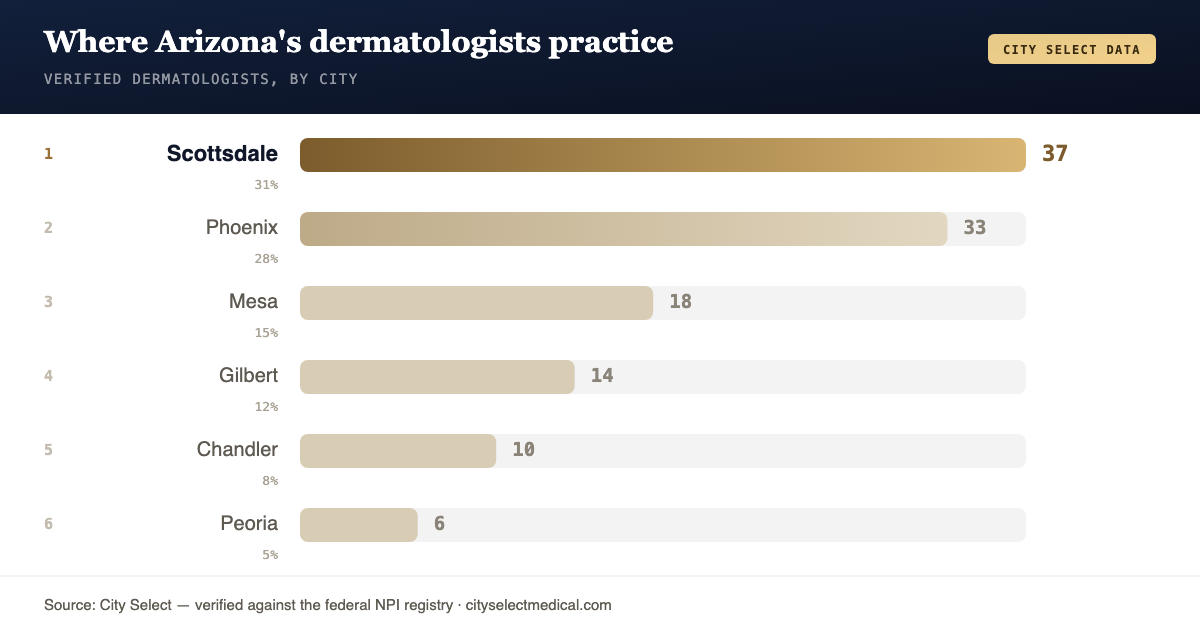
142 NPI-verified dermatologists across 32 Arizona cities — including 37 in Scottsdale. Filter by city and the insurance they publish, then verify FAAD and the Arizona license yourself before you book.
05 · FITThe practical fit — location, insurance, and who you'll see
Once the credential checks out and the type matches, the rest is logistics — but logistics that quietly shape your experience. Where the practice is, whether it takes your plan, and who actually walks into the room all matter more than the polish of the website.
Ask who you'll actually see — and say so if it matters. Practices routinely staff PAs and nurse practitioners alongside dermatologists, which is normal and keeps wait times down. But if your concern is one you'd want the physician's eyes on, say that when you book; a good practice will accommodate it.
Insurance fit is a medical-care question, not a cosmetic one. For a condition or a skin check, in-network status and any referral rule are what keep a covered visit from becoming a surprise bill. For cosmetic work, everything's self-pay, so the questions shift to results and provider accountability instead.
The best dermatologist for you is the one who's genuinely qualified for your concern, takes your plan if it's medical, and answers your questions without a sales pitch.
The bottom line
Choosing a dermatologist in Arizona comes down to three moves you can make before you ever book. Verify the credential yourself — look for FAAD and confirm it at the American Board of Dermatology or ABMS, plus an active Arizona license. Match the type to your need — medical, surgical, or cosmetic — because a great injector and a great mole-reader aren't automatically the same person.
Then mind the red flags and the fit: a physician who's never present, on-the-spot upselling, or "perfect results" promises are all reasons to keep looking, while in-network status and referral rules protect you on the medical side. Get those right and you're not guessing — you're choosing from a shortlist of people you've actually checked.
Frequently asked questions
How do I know if a dermatologist is board certified?
Look for FAAD after their name — Fellow of the American Academy of Dermatology, which signals board certification. Verify it independently through the American Board of Dermatology (abderm.org) or the ABMS 'Certification Matters' tool, and confirm an active Arizona license with the Arizona Medical Board (MDs at azmd.gov, DOs at azdo.gov). Every City Select listing is sourced from the federal NPI registry.
What's the difference between a medical, surgical, and cosmetic dermatologist?
Medical dermatology treats conditions — acne, eczema, psoriasis, skin cancer. Surgical dermatology handles excisions and Mohs surgery for skin cancer. Cosmetic dermatology covers Botox, fillers, and laser. Many derms do more than one, but the emphasis matters: a great cosmetic injector isn't automatically who you want reading a suspicious mole, and vice versa. Match the derm's focus to your actual concern.
Will I see the dermatologist or a PA/nurse practitioner?
Both are common. Many practices use board-certified dermatologists alongside physician assistants and nurse practitioners for routine visits — completely normal. But if seeing the physician matters for your specific concern, it's a fair question to ask when you book, and you're entitled to a clear answer.
What are the red flags when choosing a dermatologist or cosmetic provider?
Walk away if the physician only lends their name and is never actually present, if you're pushed to add multiple cosmetic procedures on the spot, or if someone promises 'perfect' results. Suspiciously cheap injectables can mean diluted product or inexperience. A real consultation feels calm and thorough — history, goals, risks, and cost reviewed before anyone injects, peels, or lasers.
Does it matter if my dermatologist takes my insurance?
For medical care, yes — in-network keeps costs down and avoids surprise bills, and some HMO and AHCCCS plans require a referral from your primary care doctor first. Cosmetic work is self-pay regardless. Confirm both the network and any referral rule before you book so a covered visit doesn't turn into an out-of-network charge.
How do I choose a dermatologist for a mole or skin check?
For a skin check, prioritize a board-certified medical dermatologist who does full-body exams routinely. If you have darker skin, ask whether they regularly check the palms, soles, and nails — melanoma in skin of color is often caught late in exactly those spots. In Arizona, a high-UV state, matching a medical (not purely cosmetic) derm to a skin check matters.
Find a verified dermatologist in Arizona
Every dermatologist on City Select is sourced from the federal NPI registry and organized by city and specialty — no pay-to-rank, no mystery. Filter by your city and insurance:
 Choosing Care
Dermatology in Arizona: Costs, Insurance & How to Choose a Dermatologist
Arizona runs one of the highest melanoma rates in the U.S. — so a good dermatologist matters more here. A plain-English guide to what visits and procedures cost, what your plan (and AHCCCS) covers, how skin checks actually work, and how to pick — and verify — the right board-certified derm.
 Insurance & Costs
How Much Does a Dermatologist Cost in Arizona? (2026)
What a dermatologist really costs in Arizona: the office visit, the procedures billed on top, why 'I have insurance' doesn't always mean a small copay, and the moves — cash price, Good Faith Estimate, financing — that lower the bill.
 Insurance & Costs
Does Insurance (and AHCCCS) Cover a Dermatologist in Arizona?
Whether insurance, AHCCCS, or Medicare pays for a dermatologist in Arizona comes down to one rule — medical is covered, cosmetic isn't. Here's how that plays out, the referral and prior-auth catches, and the surprise bills to head off before you book.
Written and maintained by the City Select editorial team. Every figure is checked against the official sources below, and every practice in our directory is verified against the federal NPI registry — no pay-to-rank and no purchased placement in the verified results. See our editorial & data standards →
- American Academy of Dermatology — How to select a dermatologist
- American Academy of Dermatology — Questions to ask before a cosmetic treatment
- American Board of Dermatology — verify certification
- ABMS — Certification Matters
- American Med Spa Association — Arizona legal summary
- Arizona Medical Board — license verification
- How we verify
This guide is for general information and isn't medical, legal, or insurance advice. Coverage, prices, and policies change — verify current details with the relevant provider, plan, or agency, and confirm with the practice before booking. Last updated July 15, 2026.