
How Much Does a Dermatologist Cost in Arizona? (2026)
Plenty of people searching "dermatologist cost" are really asking two questions at once: what does the visit run, and what does the stuff they do to me run? Those are separate lines on the bill, and the second one — the biopsy, the mole removal, the full-body exam — is where the total actually moves. In Arizona, where skin cancer is common enough that biopsies and skin checks are routine, that second line matters more than it might elsewhere.
There's also a twist that catches people off guard: having insurance doesn't automatically mean a small copay. This guide lays out both halves — the visit and the procedures — plus the deductible mechanic nobody explains and the handful of moves that genuinely lower the bill, then points you to 142 verified dermatologists across Arizona to compare.
- The visit: about $150–$300 self-pay for a first visit ($100–$200 follow-up), or a $30–$75 copay if you've met your deductible.
- Procedures are separate: biopsy, mole removal, and a full-body exam each carry their own cost — and a biopsy often means two bills (derm + pathology lab).
- Lower the bill: ask for the cash price (it can beat the insured rate early in the year), a Good Faith Estimate, and a cash discount.
01 · THE VISITWhat a dermatology visit actually costs
Start with the visit itself, because it's the part with a predictable band. Self-pay in Arizona clusters around $150–$300 for a new-patient visit and $100–$200 for a follow-up, and hospital-affiliated groups like Banner publish direct-pay prices you can check ahead of time. With insurance, a medically necessary visit is usually a specialist copay of $30–$75 — if you've met your deductible.
"I have insurance, so I'll just owe a copay." Not necessarily. If you haven't hit your annual deductible yet, the copay doesn't kick in — you pay the full negotiated rate, often $200–$350 for the visit, until you reach the threshold. Early in the plan year, on a high-deductible plan, an insured visit can cost more than a cash visit. That's not a billing error; it's how deductibles work.
The visit fee
The practice's charge for the appointment — self-pay list price, or the plan's negotiated rate if you're insured.
Your plan's math
Met your deductible? You owe the copay ($30–$75). Haven't? You owe the negotiated rate until you do.
Anything done to you
Procedures (biopsy, removal, exam) are billed on top of the visit — a separate line, sometimes a separate bill entirely.
Ask for the cash price even if you're insured. Many Arizona clinics will quote a cash rate that matches or beats the insured rate — especially useful before you've met your deductible. It's a two-minute question that can save real money.
How we price this
Dermatology prices vary more than almost any specialty, because "a visit" can mean a five-minute wart check or a multi-stage surgery. The ranges here are statewide self-pay estimates cross-referenced across published cash prices (Banner and other Arizona direct-pay listings), procedural-cost studies (CareCredit/Synchrony), and consumer price aggregators (GoodRx, Sidecar Health) — then sanity-checked against what Arizona practices actually post. They're a planning tool, not a quote. The one binding number is the Good Faith Estimate the practice gives you for your specific plan and procedure — ask for it in writing.
02 · PROCEDURESThe procedures billed on top
This is where totals move. A full-body skin exam, a biopsy, a mole removal, or an acne plan each carry their own cost. Here's what the common ones typically run in Arizona:
| Service | AZ self-pay | With insurance | U.S. average |
|---|---|---|---|
| Office visit (new patient) | $150–$300 | $30–$75 copay* | $150–$300 |
| Full-body skin exam | $100–$300 | Often covered* | $100–$300 |
| Skin biopsy | $150–$500 | $30–$100* | $200–$350 |
| Mole removal (medical) | $150–$500 | Covered* | $150–$530 |
| Mohs surgery | $1,800–$2,500+ | Covered* | $1,864–$2,400 |
| Isotretinoin — monthly (generic) | $200–$400 cash | $20–$50 copay | ongoing across course |
A biopsy usually means two bills, not one. Your dermatologist bills for taking the sample; a separate pathology lab bills for reading it under a microscope. The second bill is the one that surprises people — ask up front whether the lab your derm uses is in your network.
Patients routinely report 20%-off cash pricing on a dermatology visit — just for asking. It's rarely posted.
03 · DRIVERSWhat actually drives the price
Two dermatology bills for the "same" thing can differ a lot, and it's usually not random. A handful of factors explain most of the spread.
The biggest price driver is medical vs. cosmetic. A medically necessary procedure is billed to insurance (subject to your deductible and copay); the identical-looking cosmetic version — removing a mole because you don't like it, a cosmetic laser — is self-pay in full. The reason for the procedure, not just the procedure itself, sets what you'll owe. Complexity (a simple shave vs. a multi-stage Mohs), the pathology lab, and the metro you're in do the rest.
"Insurance covers dermatology, so anything my derm does is covered." Only the medical part. Cosmetic treatments — Botox, fillers, cosmetic mole/skin-tag removal, aesthetic lasers and peels — are self-pay even at a medical dermatology practice, and average cosmetic out-of-pocket runs higher than medical. If coverage matters, ask whether the specific procedure will be coded as medical before it's done.
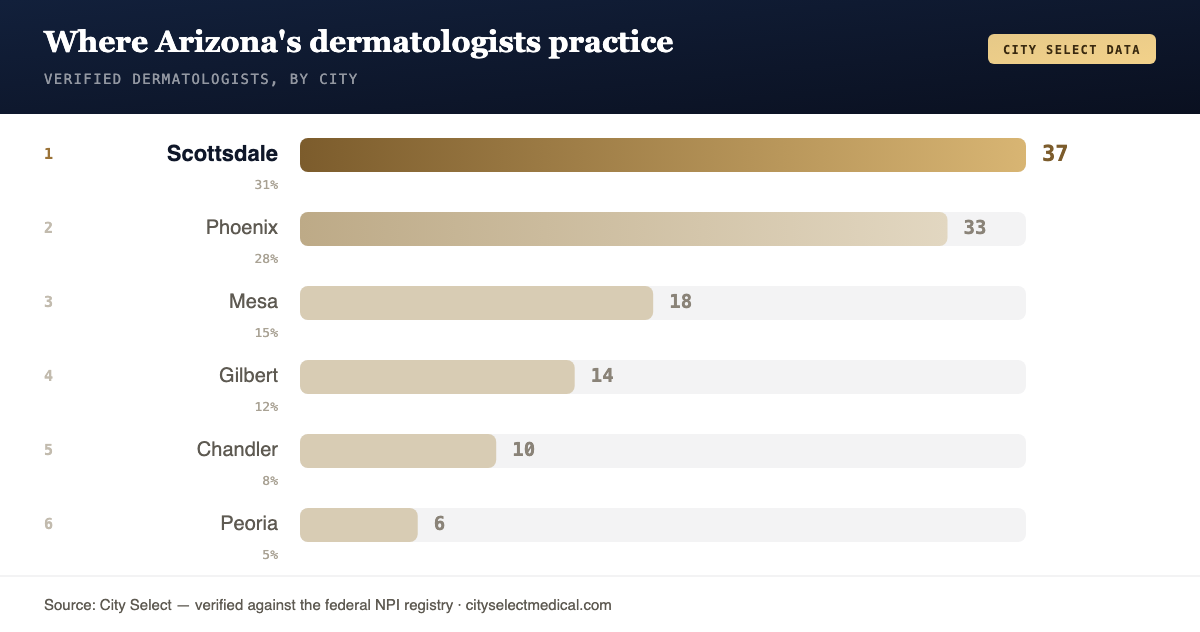
Arizona-specific: Scottsdale has the deepest bench of dermatologists in the state — 37 of our 142 verified AZ derms. That concentration cuts two ways: more cosmetic and direct-pay options, but also the metro where cosmetic prices trend highest. More competition on the medical side, premium positioning on the cosmetic side.
04 · FROM THE WEBQuestions people are actually asking
Do dermatologists give cash discounts?
Often, yes — many Arizona practices discount for paying cash at the time of service (patients report around 20%). It's rarely posted, so ask when you book.
Why was my dermatologist visit so expensive with insurance?
Most likely your deductible. Until you meet it, you pay the negotiated rate, not the copay — so an early-year visit can feel surprisingly steep.
Is it cheaper to pay cash than use insurance at a dermatologist?
Sometimes, especially before you've met your deductible. Ask the office for the cash price and compare it to what your plan would apply.
Does a mole check cost extra if they remove one?
Yes — the removal and the pathology are billed on top of the exam, and a cosmetic removal is self-pay. Ask whether it's medical before it's done.
142 NPI-verified dermatologists across 32 Arizona cities — including 37 in Scottsdale. Filter by city and the insurance they publish, then ask each for a cash price and a Good Faith Estimate before you book.
05 · LOWER THE BILLHow to pay less — without cutting corners
You have more leverage on a dermatology bill than you might think. None of these require haggling or skipping care — they're just the questions the office is used to answering.
Ask for a Good Faith Estimate
Arizona practices will give you one for self-pay care; some post them online. It's the number that actually binds.
Get the cash price and compare
Even insured — especially before your deductible — the cash rate can win. Ask for both and pick the lower.
Ask about a cash discount and financing
A ~20% cash discount is common and unadvertised; CareCredit or in-house plans (sometimes 0%) spread out a larger procedure. Read deferred-interest terms carefully.
Confirm network and coding
For medical care, check the practice and the pathology lab are in-network, and ask whether the procedure is coded medical — that's what protects you from a surprise bill.
Handle financing terms with your eyes open. Promotional 0% and deferred-interest plans are useful, but deferred-interest can charge back-interest from day one if the balance isn't cleared inside the window. Know which kind you're signing up for.
Some dermatology costs are ongoing, not one-time — plan for the whole course. An acne treatment like isotretinoin isn't a single price: the FDA's iPLEDGE program requires monthly visits (and monthly pregnancy testing for patients who can become pregnant), so the real budget is a monthly cost across several months. Ask your dermatologist what the full course looks like before you start.
The cheapest surprise is the one you head off with a question: cash price, Good Faith Estimate, in-network lab. Ask all three before you book.
The bottom line
A dermatologist in Arizona is really two costs: the visit (about $150–$300 self-pay, or a $30–$75 copay once you've met your deductible) and the procedures billed on top, where a biopsy can even arrive as two bills. Insurance helps on the medical side, but before you've hit your deductible it may not lower the visit at all — which is exactly why asking for the cash price is worth doing every time.
So budget for the visit plus whatever gets done, expect cosmetic work to be fully self-pay, and use the leverage you have: a Good Faith Estimate, the cash price, a cash discount, and a quick network check on both the practice and its pathology lab. Get those in hand and the bill stops being a surprise.
Frequently asked questions
How much does a dermatologist cost in Arizona without insurance?
For a straightforward self-pay office visit, most Arizona practices land roughly $150–$300 for a first visit and $100–$200 for follow-ups, with procedures (biopsy, mole removal, full-body exam) priced separately. Some Arizona derms publish direct-pay prices and many offer a cash discount (patients report around 20%) if you ask. Always request a Good Faith Estimate up front.
Is a dermatologist cheaper with insurance?
Not always, and this surprises people. If you've met your deductible, you'll usually pay a specialist copay of about $30–$75. But if you haven't hit your deductible yet, the copay doesn't apply — you pay the full negotiated rate, often $200–$350 for the visit, until you reach the threshold. On a high-deductible plan early in the year, the cash price can actually beat the insured rate, so it's worth asking for both.
How much is a full-body skin exam in Arizona?
Self-pay, a full-body skin exam commonly runs $100–$300 for the exam itself. It's typically covered when there's a medical reason — a history of skin cancer or a suspicious spot — though a biopsy taken during the visit is billed separately. Confirm the code and your coverage with your plan.
Why did I get a separate bill after my skin biopsy?
Because a biopsy usually generates two bills, not one. Your dermatologist bills for taking the sample; a separate pathology lab bills for examining it under a microscope. The second bill is the one that catches people off guard — ask up front whether the lab your derm uses is in your network.
Can I finance dermatology treatment?
Often, yes. Many Arizona practices accept CareCredit or similar medical credit cards with promotional (sometimes 0%) financing, and some offer in-house payment plans for larger procedures like Mohs surgery. Read the promotional terms carefully — deferred-interest plans can charge back-interest if the balance isn't cleared in the window.
How much does Accutane (isotretinoin) cost in Arizona?
Generic isotretinoin runs roughly $20–$50 a month with insurance, or a few hundred a month cash (discount programs like GoodRx bring it down). But the medication is only part of it: the FDA's iPLEDGE program requires monthly prescriber visits and, for patients who can become pregnant, monthly pregnancy testing — so budget for an ongoing monthly cost across the full course, not a one-time price. This is a decision to make with your dermatologist.
Find a verified dermatologist in Arizona
Every dermatologist on City Select is sourced from the federal NPI registry and organized by city and specialty — no pay-to-rank, no mystery. Filter by your city and insurance:
 Choosing Care
Dermatology in Arizona: Costs, Insurance & How to Choose a Dermatologist
Arizona runs one of the highest melanoma rates in the U.S. — so a good dermatologist matters more here. A plain-English guide to what visits and procedures cost, what your plan (and AHCCCS) covers, how skin checks actually work, and how to pick — and verify — the right board-certified derm.
 Choosing Care
How to Choose a Dermatologist in Arizona (and Verify Board Certification)
Choosing a dermatologist in Arizona isn't about a lack of options — it's knowing who's genuinely qualified for what you need. How to verify board certification yourself, match the right kind of derm to your concern, spot the red flags, and check who'll actually be in the room.
 Insurance & Costs
Does Insurance (and AHCCCS) Cover a Dermatologist in Arizona?
Whether insurance, AHCCCS, or Medicare pays for a dermatologist in Arizona comes down to one rule — medical is covered, cosmetic isn't. Here's how that plays out, the referral and prior-auth catches, and the surprise bills to head off before you book.
Written and maintained by the City Select editorial team. Every figure is checked against the official sources below, and every practice in our directory is verified against the federal NPI registry — no pay-to-rank and no purchased placement in the verified results. See our editorial & data standards →
This guide is for general information and isn't medical, legal, or insurance advice. Coverage, prices, and policies change — verify current details with the relevant provider, plan, or agency, and confirm with the practice before booking. Last updated July 15, 2026.