South Gilbert.
45,449 households.
Newer luxury developments — Cooper Commons, Higley, Power Ranch, Seville. Highest-income segment. 45,449 households at a median of $125,000. One practice per specialty — when your category locks, no competitor in that category appears on the card for the duration of your campaign.
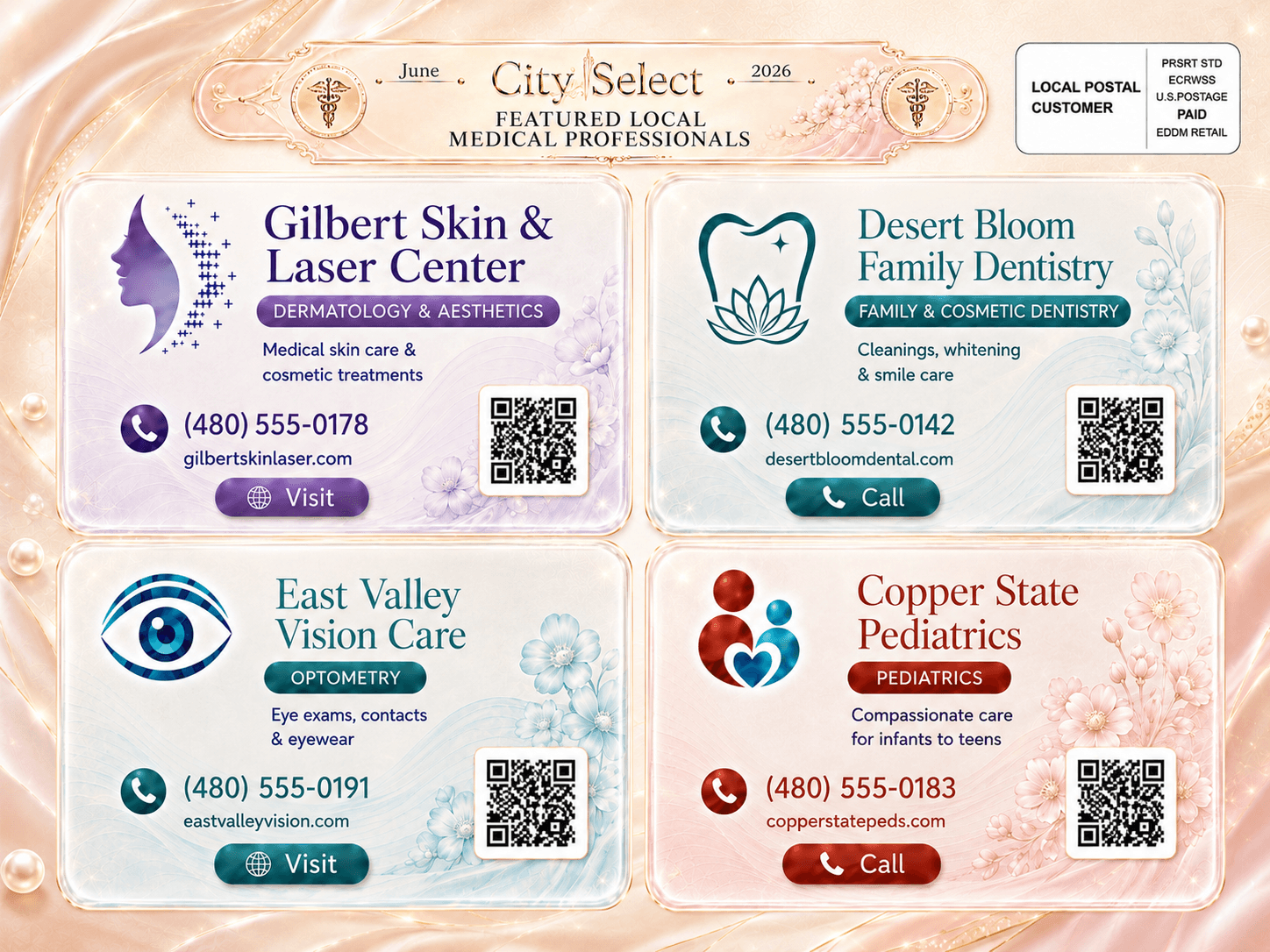
South Gilbert coverage. By the route, by the zip.
Your card lands in every active residential mailbox in 85295 and 85297 and 85298 — 45,449 households at $125,000 median income, by USPS EDDM.
What being featured actually does.
Direct mail is not just a lead-gen channel — and the leads it does drive are only part of the return. It is also a recognition channel that makes every other channel you run work harder. Four ways being featured pays back, beyond the patients you can directly attribute.
The decision-maker actually sees you.
Spouses, parents, household financial leads keep the card. They are the people who book the appointment — and they almost never see the Google ad you're paying for.
Recognition compounds across editions.
Patients see your name on the card four to seven times before any digital ad would have rendered for them. By the third drop, you are the practice they already think of when they search.
You sit beside trusted neighbors, not coupons.
A curated set of category-exclusive practices in your zone. No pizza coupons, no chiropractic adjacencies on the same envelope. Your panel borrows credibility from the company it keeps.
Branded search ends on you.
When a household eventually searches, they recognize your name. Branded search converts at three to seven times the rate of generic search — the ROI on every Google dollar you're already spending goes up.
Ten practices per zone. Carefully chosen.
City Select is invitation-curated. Every issue features a non-competing set of local practices — one per category, chosen for the neighborhood. We review every applicant before placement, and we say no more than we say yes.
There is no charge until you accept. The category is yours the moment your payment clears, and we never reassign it during your campaign.
We feature practices already operating in or serving the zone — not pre-launch concepts. Our patients want a recognizable name on the card, not a placeholder.
Your practice meets HIPAA marketing guidance and Arizona Medical Board Rule R4-16-401. We'll review before placement and design.
Once you're locked, no other practice in your specialty appears on the card. We expect you to want — and use — that exclusivity.
Common questions from practice owners.
The fastest way to feel out the product. If something here doesn't answer it, the 15-minute call will.
Each quarter City Select prints one 9×12 card per zone with a curated set of non-competing local practices — one dentist, one dermatologist, one pediatrician, one optometrist, etc. Your panel features your brand, your logo, your colors, your QR, your phone. You aren't an ad on a card; you're one of the practices selected to represent the category in that neighborhood.
We sort USPS carrier routes within your zone by household income — top-down — then mail. The wealthiest neighborhoods get your card in month one. Month two fills in the next tier. By month three, every home in the zone has received the card. The cycle repeats quarterly, so each household sees your card roughly four times a year, and the highest-income routes see it first every cycle. Our zones span $85,000–$150,000 in household income, so even the routes filled in last are at or above the US median income — these are still families who can elect care, not defer it.
We accept exactly one practice per specialty per zone. If a dentist locks Gilbert South, no other dentist appears on that card for the duration of the campaign. Your competition isn't crowded out — they're not on the page at all.
Different channel, different job. Digital is great at intent capture — when someone is already searching. The 9×12 card is about presence: your name shows up in 15,000 mailboxes whether your patients are searching or not, sits on the fridge for weeks, and is seen by 4–7 family members per household. It builds the recognition that makes the eventual Google search end on you.
Valpak is a coupon envelope. City Select is an editorial card. Same delivery channel; entirely different product. We don't compete with a stack of pizza coupons — we look like the kind of thing patients keep.
Every drop goes through USPS EDDM (Every Door Direct Mail) with route receipts. You see exactly which zip codes were covered, the household count, and a sample of the printed card before mailing.
Categories rotate as practices renew or rest. Join the waitlist for a specific zone and we'll notify you the moment it opens — or lock in an adjacent zone (e.g., North Gilbert if South is taken) so you still own a corner of the market.
Yes. We don't use patient names, before/after photos, or testimonials that could be construed as PHI. Every panel is reviewed against HIPAA marketing guidance and Arizona Medical Board Rule R4-16-401 before printing. You hold a written veto at every stage.
Each card carries a unique QR and trackable phone number tied to your practice. You see scans, calls, and call duration in a monthly report. That said: most of the value is the ambient recognition the card builds — patients keep it, refer to it, and come in citing 'I saw your card.' Direct trackable response is the floor, not the ceiling.
No — it sits alongside. Your agency still owns SEO, your site, and paid search. We own one specific channel they almost certainly aren't running: a curated, category-exclusive 9×12 card in the zips where your patients actually live. Most practices route us through their agency for unified reporting.